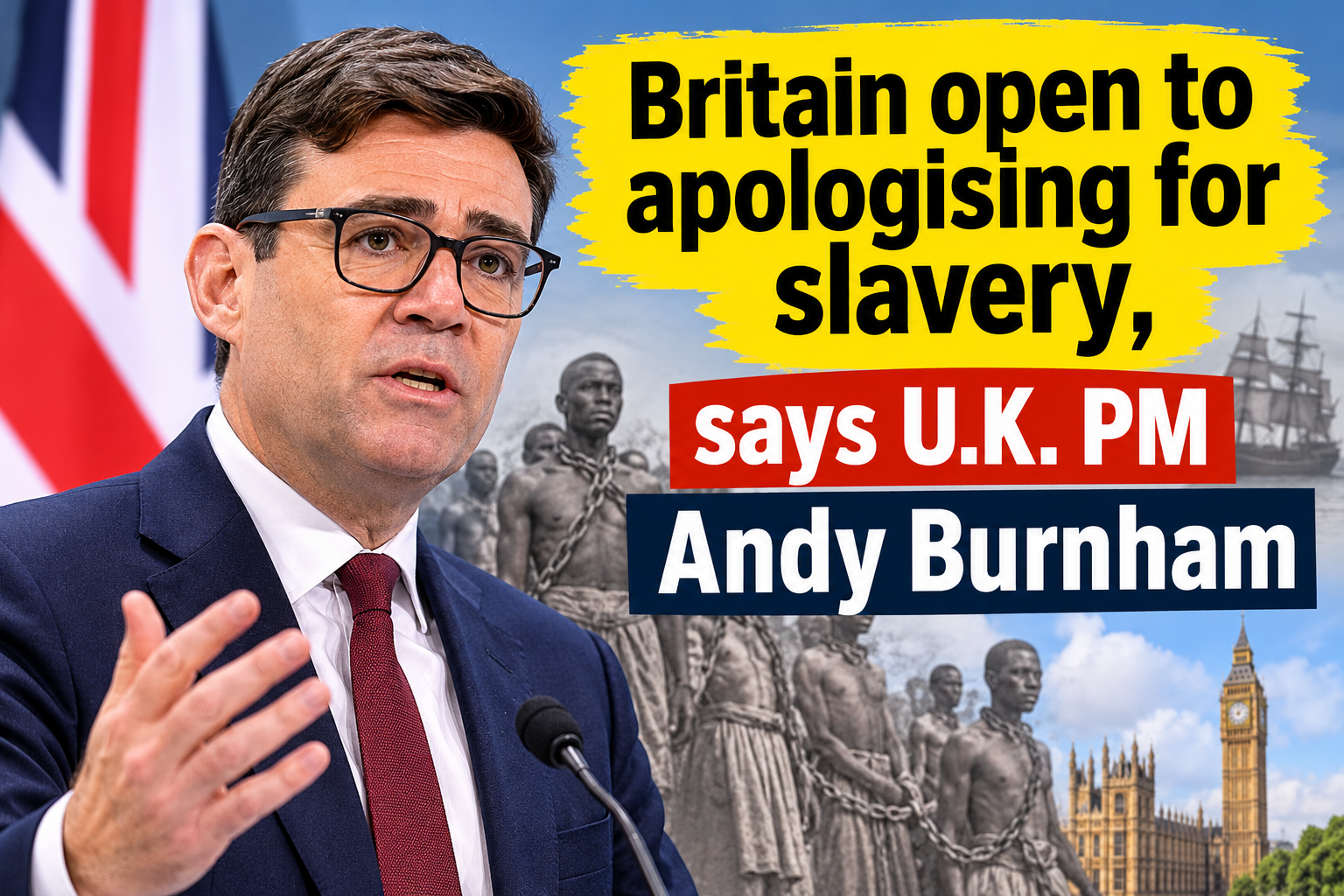
U.K. PM Andy Burnham has signalled that Britain is willing to consider a formal state apology for its role in the transatlantic slave trade. He has also ruled out paying financial reparations. The announcement comes days before a Commonwealth leaders’ summit in Antigua and Barbuda, where the issue is expected to dominate.
What the Prime Minister Said
Burnham set out his position in an opinion piece for The Guardian. He expressed personal sorrow and regret for the suffering of millions of enslaved people and acknowledged that the legacy of slavery still shapes the modern world. He argued that Britain led the way in abolishing slavery and should show leadership again by confronting its past honestly.
In practical terms, the government is offering a structured dialogue with countries and communities affected by the slave trade. In that article, U.K. PM Andy Burnham said that listening to calls for a formal apology on behalf of the British state would be an important part of the process, and that he was open to those calls. Former Prime Minister Gordon Brown will help support the initiative.
Why Reparations Remain Off the Table
Burnham was equally clear about where the government draws the line. He said people in Britain today cannot be held liable for historical wrongs that took place under different laws and in which they played no personal part. That is consistent with the stance of earlier British governments, which have expressed regret but never offered a formal apology or compensation.
Parliament abolished slavery across most of the British Empire in 1833, yet Britain has never formally apologised. Historians estimate that at least 12.5 million Africans were abducted and sold into slavery during the trade.
Caribbean Leaders Respond With Caution
Reaction has been mixed. Antigua and Barbuda’s prime minister, Gaston Browne, welcomed the tone and the offer of practical support. He stressed that the Caribbean’s long-standing demand for reparatory justice has not changed. Barbados’ prime minister, Mia Mottley, also welcomed the opening for talks while restating her government’s position on reparations.
Campaigners were less impressed. Denis O’Brien of The Repair Campaign called the statement disappointing and said it would not end demands for a full and formal apology. For many Caribbean governments and advocacy groups, an apology without reparations is only a first step.
Why It Matters
The announcement matters for several reasons.
- A shift in tone: Recent governments rejected calls for a formal apology outright. Leaving the door open is a notable change.
- A diplomatic test: The Commonwealth summit will show whether dialogue satisfies Caribbean leaders or whether the reparations dispute deepens.
- Royal context: King Charles has been touring the Caribbean, acknowledging the great suffering and injustices of the past, which adds moral weight to the moment.
- Political risk at home: Apologies on historical wrongs divide opinion in Britain, and critics may question the legal and financial implications.
What Happens Next
The immediate test is the Commonwealth summit, where U.K. PM Andy Burnham is expected to face direct questions about timing, format and who would be consulted. No date for an apology has been announced, and his wording suggests the government wants talks first, with any apology to follow as part of that process.
For now, the message from Downing Street is cautious. Britain is prepared to talk, listen and possibly apologise, but it is not prepared to pay. Whether that compromise can satisfy those demanding justice remains uncertain.
As the summit approaches, all eyes will be on how U.K. PM Andy Burnham balances moral acknowledgement with fiscal and political limits. Whatever happens, the debate over how Britain faces its colonial past is now firmly on the diplomatic agenda.