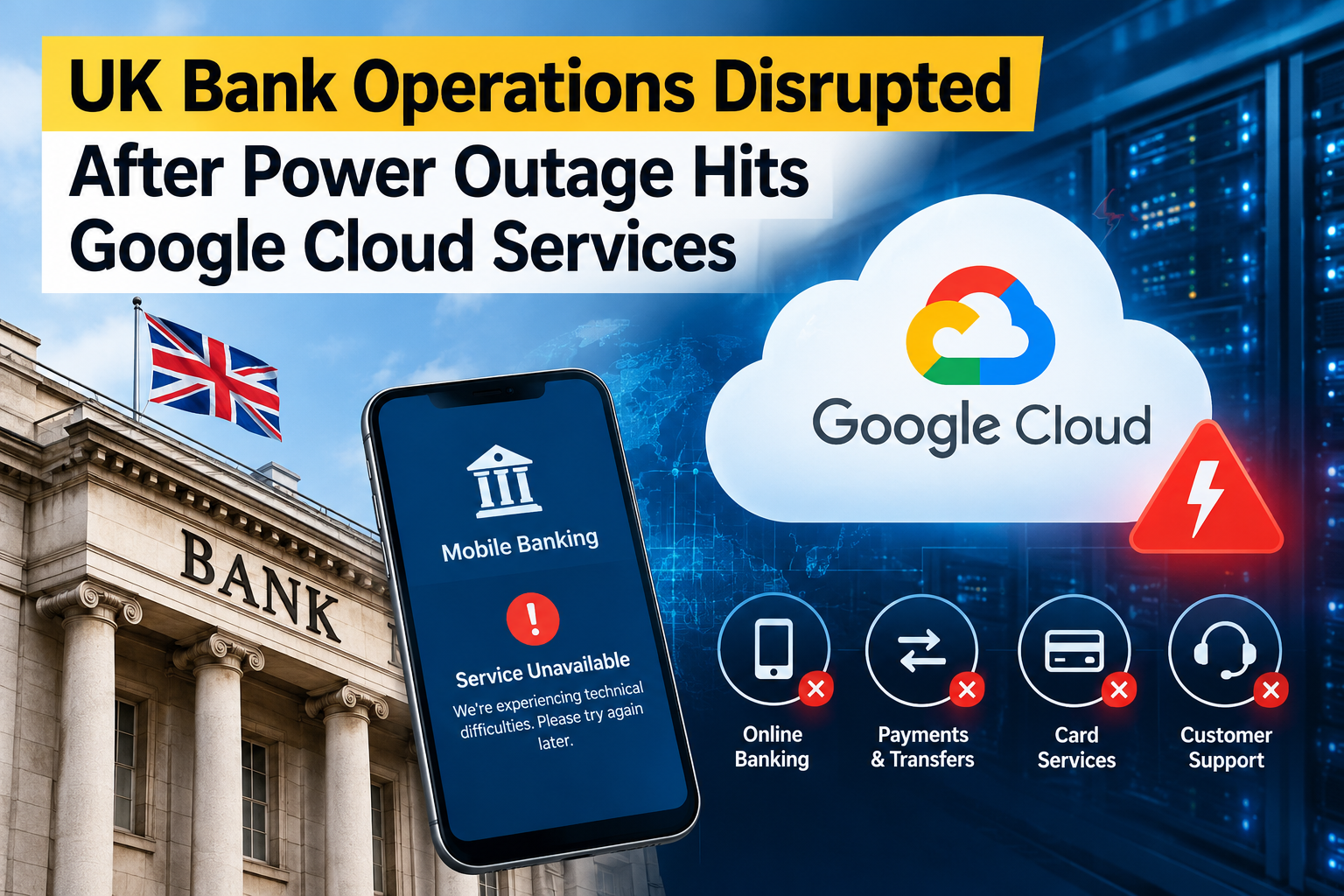
Digital banking has become an essential part of everyday life, allowing customers to transfer money, check balances, pay bills, and manage their finances without visiting a branch. However, when critical technology infrastructure experiences a disruption, the consequences can extend across multiple financial services. Reports of a power outage affecting Google Cloud services have raised concerns about the potential impact on UK Bank operations and the reliability of cloud-dependent banking systems.
For a modern UK Bank, uninterrupted access to technology is crucial. Customers expect mobile banking applications, online transactions, payment processing, and account information to remain available throughout the day. Even a temporary interruption can create inconvenience for customers and operational challenges for financial institutions.
The reported incident also highlights a broader question for the financial sector: how can banks maintain reliable services when important parts of their technology infrastructure depend on external cloud providers?
What Happened to Google Cloud Services?
Google Cloud provides computing, storage, networking, databases, and other technology services used by businesses around the world. Financial institutions may use these capabilities to support digital platforms, analytics, customer applications, and selected operational workloads.
A power-related incident affecting cloud infrastructure can potentially interrupt the availability of dependent applications. The precise consequences depend on the affected facilities, services, geographic regions, and the recovery arrangements maintained by individual customers.
For a UK Bank using affected cloud services, disruption could occur if a critical application or supporting component became unavailable. However, the existence of a cloud outage does not automatically mean that every bank using Google Cloud has experienced an interruption.
The precise incident timeline, affected services, duration, and confirmed banking impact should be established through official Google Cloud incident updates and statements from the financial institutions involved.
How a Google Cloud Outage Could Affect a UK Bank
A UK Bank operates a complex network of systems that must work together to provide secure and reliable financial services. These systems may include customer-facing applications, transaction-processing platforms, fraud detection tools, payment integrations, and internal operational software.
If a critical dependency becomes unavailable, the impact can vary depending on how the bank has designed its infrastructure.
1. Online and Mobile Banking Disruptions
Customers increasingly depend on mobile applications and internet banking to manage their money. If an application relies on an affected cloud service, customers could encounter login problems, delayed account information, or temporary service interruptions.
For a UK Bank, maintaining access to essential banking functions is a major operational priority. A disruption affecting selected services may cause confusion among customers who are unable to determine whether their accounts or transactions are functioning normally.
Banks can reduce these risks by maintaining resilient application architectures, monitoring service dependencies, and testing recovery procedures.
2. Delays in Digital Payments
Digital payments involve several interconnected systems, including banking applications, payment gateways, processing platforms, and external payment networks.
If a component supporting a transaction becomes unavailable, a payment may be delayed, rejected, or left awaiting confirmation. The actual outcome depends on the systems involved and the transaction’s processing stage.
A UK Bank must therefore maintain clear procedures for handling incomplete transactions and communicating their status to customers. Customers should avoid repeatedly submitting the same payment when its status is uncertain and should check their transaction history before trying again.
3. Customer Support Challenges
When digital services become unavailable, customers often turn to telephone support, branches, and other available communication channels.
A UK Bank may experience an increase in support requests during a significant technology disruption. Customers may seek clarification about failed transfers, unavailable balances, delayed payments, or access to their accounts.
Financial institutions can prepare for these situations through incident-response plans, customer communication templates, alternative support channels, and clearly defined escalation procedures.
4. Internal Banking Operations
The impact of a cloud disruption may extend beyond customer-facing applications. Depending on the systems involved, internal reporting, document processing, analytics, and other operational workflows could also be affected.
For a UK Bank, these dependencies make technology mapping especially important. Teams need to understand which applications depend on particular cloud services and which business processes could be interrupted if those services become unavailable.
A well-designed continuity plan helps banks prioritize essential activities while technical teams restore affected systems.
Why Banks Depend on Cloud Computing
Cloud computing allows financial institutions to access computing resources without operating every component of their infrastructure independently. It can support faster application development, flexible capacity, data analytics, and improved deployment processes.
A UK Bank may use cloud infrastructure for selected workloads while maintaining other systems in private data centres or separate environments. The exact arrangement varies by institution, application, security requirements, and regulatory obligations.
Cloud technology can also help banks improve disaster recovery when properly configured. For example, applications may be distributed across separate availability zones or geographic regions, with backup systems designed to take over when a primary component fails.
Nevertheless, cloud adoption does not eliminate operational risk. A UK Bank must evaluate the resilience of the cloud services it uses, understand shared dependencies, and ensure that recovery arrangements work in practice.
The key issue is not simply whether a bank uses cloud computing. It is whether its technology architecture can continue delivering critical services when an individual component fails.
Lessons for UK Banks: Building More Resilient Systems
The reported outage provides an opportunity for financial institutions to examine their operational resilience strategies.
Multi-Region and Multi-Provider Planning
A UK Bank can assess whether critical workloads need redundancy across multiple cloud regions or alternative infrastructure environments. Geographic separation may reduce exposure to certain localized incidents, although it does not automatically protect against every type of failure.
Using multiple cloud providers can offer additional flexibility, but it also introduces complexity, cost, and integration challenges. Banks should choose arrangements according to the criticality of each service rather than assuming that a multi-cloud strategy is always the best solution.
Disaster Recovery Testing
Backup systems are useful only when they can be restored successfully. A UK Bank should regularly test disaster recovery procedures, including application failover, data restoration, communication processes, and transaction reconciliation.
Testing should include realistic failure scenarios and clearly defined recovery objectives. Teams should understand how quickly critical services must be restored and how much data loss, if any, can be tolerated.
Third-Party Risk Management
Banks depend on technology providers, software vendors, telecommunications companies, and payment partners. Problems at one supplier can sometimes affect services delivered by another organization.
Every UK Bank should maintain an up-to-date record of critical technology suppliers and their dependencies. Contracts, incident notifications, recovery commitments, and contingency arrangements should be reviewed regularly.
Transparent Customer Communication
During an outage, accurate communication can help prevent unnecessary concern. Customers need clear information about affected services, alternative ways to access support, and recommended actions.
A UK Bank should avoid making unsupported promises about recovery times. Instead, it should provide verified updates and explain how customers can check the status of pending transactions.
What Customers Should Do During a Banking Disruption
Customers who experience problems with a UK Bank should first check the bank’s official website, mobile application notifications, or verified social media channels for service updates.
If a payment appears to have failed, customers should review their account activity before submitting it again. This can help reduce the risk of duplicate payments when the original transaction is still being processed.
Customers should also avoid sharing passwords, one-time passcodes, or account information with anyone claiming to offer outage-related assistance. Service disruptions can create opportunities for scammers to impersonate banks and request sensitive information.
If urgent banking assistance is required, customers should use the contact details published through the bank’s official channels.
The Future of Cloud Resilience in UK Banking
The financial sector is likely to continue adopting cloud technology as banks modernize their applications and data infrastructure. At the same time, technology outages demonstrate why resilience must remain a core part of digital transformation.
For a UK Bank, operational resilience involves more than choosing a reputable cloud provider. It requires identifying critical services, understanding infrastructure dependencies, preparing for supplier failures, and ensuring that employees know how to respond to incidents.
Financial institutions must also consider how cloud-related risks interact with payment systems, customer communications, data protection, and business continuity requirements.
The most resilient organizations are those that plan for interruptions rather than assuming that technology will always be available. Regular testing, strong supplier oversight, reliable monitoring, and effective recovery procedures can help limit the consequences of future incidents.
Conclusion
The reported power outage affecting Google Cloud services highlights the importance of reliable technology infrastructure in modern banking. Any disruption involving a critical cloud dependency can potentially affect customer access, digital transactions, or internal workflows, although the actual impact depends on each institution’s architecture and the services involved.
For every UK Bank, the priority should be maintaining essential financial services, communicating clearly with customers, and ensuring that recovery procedures are tested and effective.
Cloud computing offers significant opportunities for innovation and operational efficiency, but resilience must remain central to its adoption. As banking becomes increasingly digital, the ability to manage infrastructure failures will remain an important measure of operational preparedness and customer trust.