
Hiring your first employee is the moment a founder’s idea starts to look like a real company. For UK startups, it is also the moment the law starts to pay close attention. Investors scrutinise payroll compliance during due diligence, and a rushed hire can leave a young business with unexpected tax bills, tribunal claims or a messy cap table. This guide explains the legal basics that UK startups need to know before signing that first contract.
Whether you run a fintech in London, a biotech spinout in Cambridge or a SaaS company in Manchester, the rules are broadly the same across England, Scotland and Wales (Northern Ireland has some differences). Below we cover employment status, costs, right to work checks, contracts, payroll, pensions, equity and the reforms arriving under the Employment Rights Act 2025. Throughout, we focus on what matters most to UK startups operating on tight budgets and tighter timelines.
Why the First Hire Matters for UK Startups
The first hire sets the template for every hire that follows. Get it right and you build a repeatable, investor-ready process. Get it wrong and the mistakes multiply. Advisers regularly point to early people problems as a source of friction in UK startups, from unclear roles to disputes over equity. A badly handled hire can quickly become a costly distraction that few UK startups can afford.
Before you advertise, ask whether you need an employee at all. Many UK startups begin with freelancers, contractors or part-time help, which is perfectly sensible. The risk arises when someone you treat as a contractor is, in law, an employee.
Employee, Worker or Contractor?
UK law recognises three main categories, and the label in your contract does not settle the question. Tribunals and HMRC look at the reality of the working relationship.
| Status | Key features | Main rights | Tax treatment |
|---|---|---|---|
| Employee | Contract of service; you control the work; personal service required | Full statutory rights: notice, redundancy pay, unfair dismissal (after qualifying period), family leave | PAYE and employer National Insurance |
| Worker | Personal service, but more flexibility over when work is offered or accepted | National minimum wage, paid holiday, rest breaks, discrimination protection | PAYE |
| Self-employed contractor | Controls how and when work is done; can send a substitute; carries own risk | Few statutory rights; mainly contractual | Invoices you; handles own tax (IR35 may apply) |
Relevant factors include control over how and when work is done, whether the person can send a substitute, and whether you are obliged to offer work. A common trap for UK startups is calling someone a “consultant” while dictating their hours, tools and tasks. HMRC’s free Check Employment Status for Tax tool is a useful starting point, because misclassification can mean back-dated tax, National Insurance and holiday pay. Investors reviewing UK startups will often ask how every team member is engaged.
The True Cost of Your First Hire
Budget discipline is critical for UK startups, where runway is everything. Salary is only part of the bill. The table models an illustrative employee on £35,000 a year, using 2026-27 rules for employer National Insurance (15% above £5,000) and the minimum 3% employer pension contribution on qualifying earnings.
| Cost item | Annual amount |
|---|---|
| Gross salary | £35,000 |
| Employer NICs (15% above £5,000) | £4,500 |
| Employer pension (3% of qualifying earnings) | £863 |
| Recruitment and equipment (estimate) | £1,500 |
| Employers’ liability insurance (estimate) | £200 |
| Payroll software (estimate) | £300 |
| Total | £42,363 |
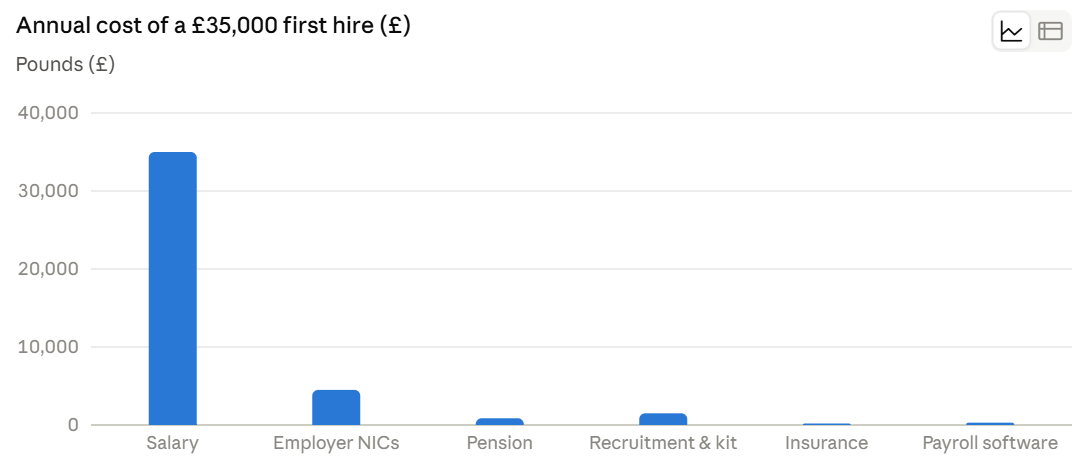
The total comes to roughly £42,400, about 21% above the headline salary. There is some good news: eligible employers can claim the Employment Allowance, worth up to £10,500 off the employer National Insurance bill, which would cover the £4,500 above entirely. Companies where the director is the only employee paid above the secondary threshold are excluded, though a first hire usually changes that. Accurate budgeting is a basic survival skill for UK startups.
Right to Work Checks
Before an employee starts, you must verify that they have the legal right to work in the UK. This applies to every hire, including friends, family and British citizens. Failing to check can lead to a civil penalty of up to £60,000 per illegal worker for a first breach. Right to work compliance is non-negotiable for UK startups of any size.
The process depends on the candidate:
- British and Irish citizens: check an original passport in person, or use a certified digital identity service provider.
- Non-UK nationals with an eVisa: use the Home Office online service with the candidate’s share code and date of birth.
- Record keeping: keep a secure copy of the evidence for the duration of employment plus two years.
If you plan to recruit overseas talent, you may need a sponsor licence, which takes weeks to obtain. Many UK startups in AI, biotech and deep tech rely on international hires, so factor this lead time into your plan.
Employment Contracts and the Written Statement
Every employee must receive a written statement of employment particulars on or before their first day. A full contract is not strictly required on day one, but issuing one is best practice and protects both sides. Strong contracts matter even more for UK startups, because a single ambiguous clause can surface during investor due diligence.
| Clause | Why it matters |
|---|---|
| IP assignment | Confirms the company owns code, designs and research created by the employee |
| Confidentiality | Protects trade secrets, customer lists and product roadmaps |
| Probation period | Typically three to six months; gives time to assess fit |
| Notice period | Provides certainty; the statutory minimum is one week after one month’s service |
| Restrictive covenants | Must be reasonable and proportionate to be enforceable |
Intellectual property is the clause investors check first. For UK startups whose main asset is code, designs or research, work created in the course of employment generally belongs to the employer, but an explicit assignment clause removes any doubt.
Pay, Holiday and Working Time
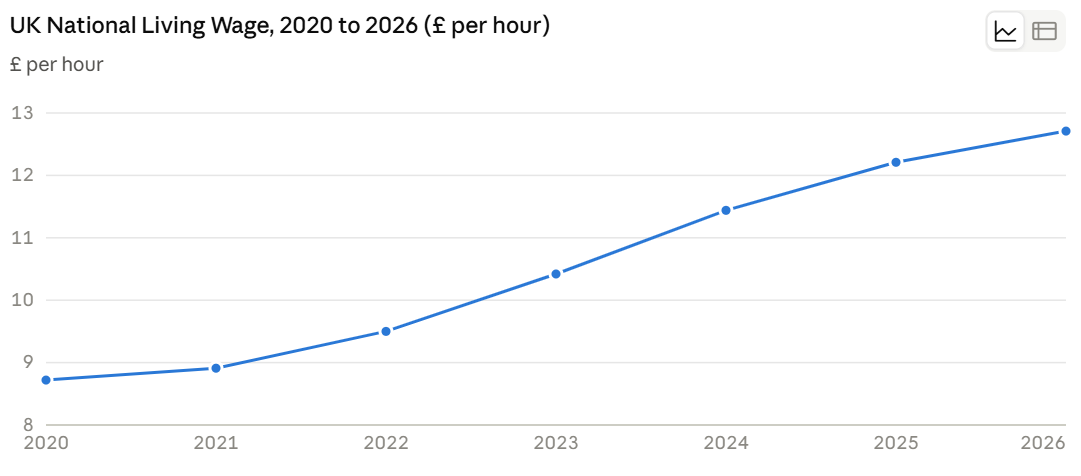
You must pay at least the National Minimum Wage or National Living Wage. From April 2026 the National Living Wage for those aged 21 and over is £12.71 per hour. The chart below shows how quickly it has risen. The rate changes each April, so UK startups should build annual increases into their forecasts.
Other statutory basics include:
- Paid holiday: 5.6 weeks a year (28 days for a full-time employee), which may include bank holidays.
- Working time: an average 48-hour week limit unless the employee opts out in writing, 11 hours of daily rest, and a 20-minute break on shifts over six hours.
- Sick pay: Statutory Sick Pay is payable from the first day of illness from April 2026.
- Family leave: statutory maternity, paternity, adoption and shared parental leave.
Cash-strapped UK startups sometimes treat these as optional extras. They are not, and tribunals can award compensation for breaches.
Payroll, Pensions and Insurance
Register as an employer with HMRC before the first payday and run PAYE through software that submits Real Time Information. Payroll mistakes can be expensive for UK startups, as HMRC penalties accrue for late or incorrect filings.
Pensions: staff aged 22 to state pension age earning over £10,000 must be automatically enrolled in a workplace pension. Minimum total contributions are 8% of qualifying earnings, with at least 3% from you. You must also declare compliance to The Pensions Regulator.
Insurance: employers’ liability insurance is a legal requirement, with minimum cover of £5 million. Fines can reach £2,500 for each day you are uninsured.
Data protection: employee records fall under UK GDPR, so founders at UK startups should also issue a privacy notice explaining how staff data is used.
Offering Equity: EMI Options
Share options are a powerful hiring tool when cash is tight. Equity helps UK startups compete with larger employers for talent. The Enterprise Management Incentive (EMI) scheme lets qualifying companies grant tax-advantaged options worth up to £250,000 per employee, with a £3 million cap across the company.
Employees generally pay no income tax or National Insurance on exercise if options were granted at market value, and gains may qualify for Capital Gains Tax treatment. The company needs gross assets under £30 million, fewer than 250 employees and a qualifying trade. You should agree a valuation with HMRC and notify the grant within 92 days. EMI is one of the most attractive tools available to UK startups, and investors expect to see a tidy option pool.
Employment Rights Act 2025: What Is Changing
The Employment Rights Act 2025 is the biggest overhaul of employment law in a generation, and its measures are being phased in through 2026 and 2027. The measures most relevant to UK startups are summarised below. Always check GOV.UK for the latest dates.
| Reform | Expected timing | What changes |
|---|---|---|
| Fair Work Agency | April 2026 | New body enforcing employment rights |
| Statutory Sick Pay | April 2026 | Paid from day one; lower earnings limit removed |
| Paternity and parental leave | April 2026 | Day-one entitlement |
| Unfair dismissal | 1 January 2027 | Qualifying period cut from two years to six months |
| Zero-hours and fire-and-rehire rules | 2027 | Stronger protections for flexible workers |
The most important change for UK startups is the shorter qualifying period for unfair dismissal. If it takes effect as scheduled, an employee hired this autumn would be protected by spring 2027, so probation reviews will matter far more. Document performance conversations from the start.
Step-by-Step Hiring Checklist
- Confirm the role is genuine employment, not contracting.
- Budget the full cost, not just the salary.
- Register as an employer with HMRC and choose payroll software.
- Arrange employers’ liability insurance.
- Draft a contract and written statement with IP, confidentiality and probation terms.
- Advertise and interview fairly, in line with the Equality Act 2010.
- Complete the right to work check before day one.
- Set up pension auto-enrolment.
- Onboard with policies, a privacy notice and clear objectives.
- Hold a documented review before probation ends.
Treat this list as a minimum standard for UK startups.
Common Mistakes to Avoid
- Misclassifying staff: this is a recurring problem for UK startups.
- Skipping right to work checks because the candidate is a friend.
- Verbal equity promises: these are among the costliest errors made by UK startups, because undocumented promises create disputes.
- Forgetting pension duties once the first salary is paid.
- Ignoring discrimination law in job adverts and interviews.
Conclusion
Hiring your first employee is exciting, but it is also a legal commitment. For UK startups, compliance is not red tape; it is the foundation of a scalable, investable business. Founders of UK startups who get contracts, payroll, pensions and right to work checks right from day one save time, money and stress later, and they signal to investors that the company is run professionally.
Because employment law is changing quickly, review your documents regularly and take advice from a qualified employment solicitor before finalising contracts. Good luck with your first hire, and here’s to the next generation of UK startups.