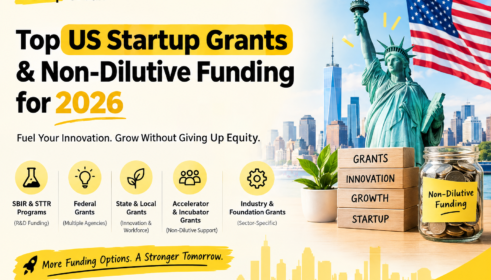
Equity is not the only way to fund a company. For many US startups, the smartest early dollar is one that never costs a slice of ownership. Non-dilutive funding means grants, government contracts, tax credits, prizes, and certain loans. It lets founders prove their technology and traction while keeping control. 2026 was a turbulent year for this space. The federal SBIR and STTR programs, the biggest grant engine for US startups, lapsed on September 30, 2025 and came back in April 2026. This guide covers the best options open to US startups right now, how they compare, and how to build an application that wins.
Why Non-Dilutive Funding Matters
Every percentage point of equity you sell early becomes more expensive later. That is why US startups increasingly layer grants underneath venture rounds instead of replacing them. A grant carries no board seat, no liquidation preference, and no pressure to exit. Investors benefit too. When evaluating US startups for seed or Series A, many treat a competitive federal award as independent technical validation, because reviewers are domain experts with no financial stake in the outcome. A funded feasibility project can also de-risk the science before a priced round, which often improves the valuation you negotiate.
Table 1: Non-dilutive funding at a glance
| Funding type | Typical sources | Best suited for | Equity given up |
|---|---|---|---|
| Federal R&D grants and contracts | SBIR, STTR, NSF, NIH, DOE, DoD | Deep tech, biotech, hardware | None |
| State and local grants | State innovation agencies | Early traction, local hiring | None |
| Corporate and nonprofit grants | Company contests, foundations | Small business, consumer brands | None |
| Tax incentives | Federal R&D tax credit | Any company with engineering spend | None |
| Prizes and competitions | Pitch events, challenge prizes | Demo-ready teams | None |
| Debt and revenue-based financing | SBA loans, RBF lenders | Companies with revenue | None (must repay) |
SBIR and STTR: America’s Seed Fund
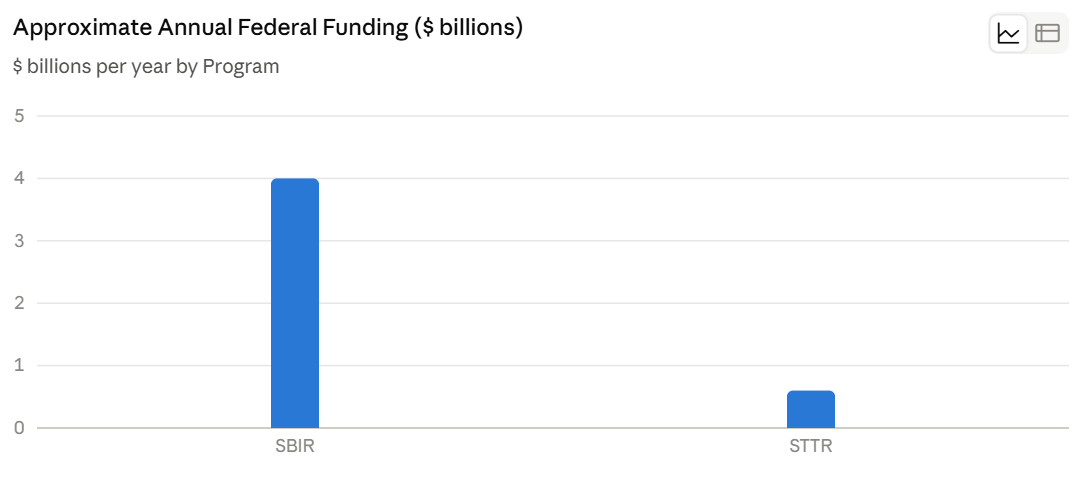
The Small Business Innovation Research (SBIR) and Small Business Technology Transfer (STTR) programs remain the cornerstone for research-driven US startups. Federal agencies with large research budgets must reserve a share of that money for small businesses. The set-asides are 3.2% for SBIR and 0.45% for STTR, and the 2026 law left them unchanged. In recent years, roughly $4 billion has flowed through SBIR and another $600 million through STTR annually.
What Changed in the 2026 Reauthorization
The programs were reauthorized on April 13, 2026, after a six-month lapse, and extended through September 30, 2031. The new law also rewrote several rules founders plan around. mondaq
Table 2: Key 2026 changes and what they mean
| Change | What it means for founders |
|---|---|
| Extension to September 30, 2031 | A longer planning horizon for multi-year strategy |
| Strategic Breakthrough Awards | A new post-Phase II tier for scaling critical technology |
| Expanded national security screening | Foreign ownership and cybersecurity will be examined closely |
| Proposal submission limits | Quality over volume; aimed at “SBIR mills” |
| Rollover of unspent FY2026 funds | A larger pool of money flowing into FY2027 |
| Faster decision targets | Shorter waits between submission and award |
The most talked-about addition is the Strategic Breakthrough category, which can reach up to $30 million. It is limited to agencies with annual SBIR obligations above $100 million. Another practical change: agencies with money left at the end of fiscal 2026 may use it in fiscal 2027. The law also pushes agencies toward making award decisions within 90 days.
The security changes deserve special attention. Founders at US startups with overseas investors, contractors, or research partners should document ownership and data-handling practices before applying. Agencies began reopening solicitations over the summer of 2026, so check each agency’s current calendar rather than relying on older deadlines.
Federal Agencies Beyond the Basics
Each agency has its own personality, and picking the right one is half the battle.
- National Science Foundation (NSF): Often the best entry point for technology-agnostic US startups, because it begins with a short Project Pitch and invites only promising ideas to submit a full proposal.
- National Institutes of Health (NIH): Biomedical, diagnostics, and digital health, with strong support for clinical-stage science.
- Department of Energy and ARPA-E: Clean energy, grid, materials, and hardware with a climate or energy-security angle.
- Department of Defense: Rewards dual-use ideas. Many US startups use defense topics to land a first government customer, and contracts can lead directly into procurement.
- NASA: Space systems, sensing, and advanced materials.
The Small Business Administration does not usually write grant checks to startups. It oversees the SBIR and STTR programs and offers counseling and loan guarantees.
State and Local Programs
Do not overlook your home state. Many states run matching grants for SBIR winners, innovation vouchers, and early-stage funds. Examples include MassVentures START in Massachusetts and Ohio’s Third Frontier initiatives. State money is usually smaller but faster, and local economic development agencies tend to favor US startups that create jobs in the region. Budgets and eligibility change from year to year, so confirm current status directly with your state agency.
Corporate Grants and Competitions
Corporate programs suit consumer, retail, and service-focused US startups that don’t fit research-heavy federal programs. Hello Alice partners with companies on small business grant opportunities, and FedEx has run a well-known small business grant contest. Eligibility and prize pools change by year. Pitch competitions and challenge prizes add visibility and cash. Treat them as marketing as much as capital. A single win can bring press coverage, investor introductions, and customer interest to US startups at very low cost.
R&D Tax Credits: The Quiet Winner
The federal R&D tax credit is among the most overlooked tools for US startups. Qualified small businesses with little or no income-tax liability can apply part of the credit against payroll taxes, up to an annual cap that is currently $500,000. Recent tax law changes also improved how domestic research costs are deducted, but the rules are technical, so work with a qualified tax professional. Because the credit rewards engineering salaries, it can quietly return cash to US startups that spend heavily on development.
Repayable but Non-Dilutive Alternatives
Some options give up no equity but still require repayment. SBA-backed loans offer favorable terms for companies with an operating history. Revenue-based financing trades a share of monthly revenue for upfront capital, which fits SaaS and e-commerce US startups with predictable income. Venture debt usually follows an equity round. Customer prepayments and paid pilots are the original non-dilutive capital, and for many US startups they are also the quickest to close.
Table 3: Indicative comparison of options
| Option | Typical time to funds | Effort | Competition |
|---|---|---|---|
| SBIR/STTR | 6 to 12+ months | High | High |
| State grants | 2 to 6 months | Medium | Moderate |
| Corporate grants and contests | 1 to 3 months | Low to medium | Very high |
| R&D tax credit | At tax filing | Medium | None |
| Revenue-based financing / SBA loans | Weeks to a few months | Medium | Qualification-based |
A Step-by-Step Application Strategy
- Match your stage to the program. Pre-revenue science points to SBIR or STTR. Companies with revenue should look at revenue-based financing, corporate grants, and loans.
- Register early. Federal registrations, including SAM.gov and a unique entity ID, can take weeks, and missing them can sink a deadline.
- Read the solicitation twice. Topics, eligibility, page limits, and scoring criteria are spelled out. Follow them literally.
- Document ownership and ties. Under the new screening rules, clear cap tables and foreign-relationship disclosures matter more than before.
- Write for reviewers. Federal reviewers read many proposals, so clarity wins. US startups that explain the problem, the technical risk, and the commercial path in plain language score better than those that hide behind jargon.
- Build a commercialization story. Name customers, pricing, and a path to revenue beyond the grant.
- Plan for resubmission. Many winners succeed on a second attempt after studying reviewer feedback.
Common Mistakes to Avoid
- Treating grants as free money. Awards come with reporting, budget rules, and intellectual property terms.
- Applying to everything. Under the new submission limits, US startups should pick fewer, stronger targets.
- Ignoring commercialization. Reviewers fund companies, not just experiments.
- Starting too late. Registrations, letters of support, and budgets take longer than expected.
The Outlook for 2026 and Beyond
Expect agencies to move quickly to use rolled-over funds, to screen applicants more strictly, and to keep prioritizing AI, energy, biotech, space, and defense technologies. Investors are paying closer attention as well. Funds that back US startups in deep tech now routinely ask whether a company has pursued SBIR awards before a round.
Non-dilutive funding will not replace venture capital for every company. But for US startups it can extend runway, validate technology, and strengthen negotiating power. The best strategy for US startups in 2026 is a portfolio: one well-chosen federal application, one state program, a tax credit claim, and a few selective competitions.
Frequently Asked Questions
Are grants really free money for US startups?
There is no repayment, but there are conditions. Many US startups discover that reporting, spending rules, and IP provisions require real administrative effort, so budget time for compliance.
Can foreign-founded or foreign-funded companies apply?
SBIR generally requires a US-based business majority-owned by US citizens or permanent residents, with certain exceptions for venture-backed firms at some agencies. Founders of US startups with foreign investors should get legal advice, especially under the new screening rules.
How long until I receive money?
Federal awards often take six months or more from submission. Many US startups apply to state programs and corporate contests while they wait.
Can a solo founder apply?
Yes. Many US startups begin with a single technical founder, though STTR requires a research-institution partner and reviewers like to see a credible team plan.
Which option is best for software-only companies?
Revenue-based financing, state programs, corporate grants, and the R&D tax credit usually fit better than research-heavy federal programs, unless the product involves genuine technical risk.