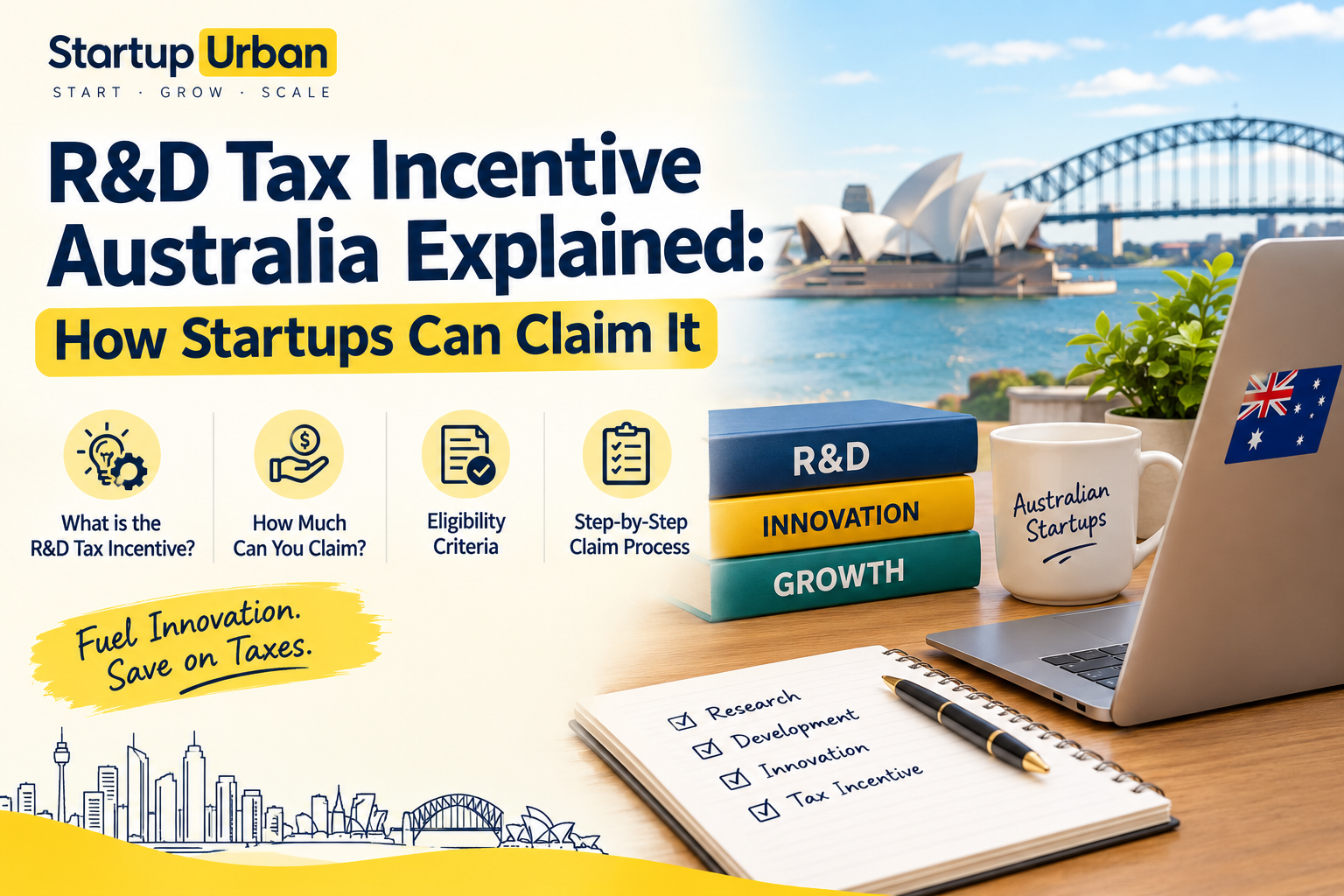
Australia startups sit on top of one of the most generous innovation-funding tools in the developed world, yet a surprising number of founders never claim it. The Research and Development Tax Incentive (RDTI) can return tens of thousands of dollars in cash to a pre-revenue company or shave a significant chunk off a growing company’s tax bill — and for Australia startups racing against a limited runway, that difference can decide whether a product ships on time. This guide breaks down exactly how the scheme works in 2026, who qualifies, how much you can claim, and what’s about to change.
What Is the R&D Tax Incentive?
The RDTI is a joint program run by AusIndustry (part of the Department of Industry, Science and Resources) and the Australian Taxation Office. It exists to encourage Australia startups and larger companies to invest in genuine experimentation — activities where the outcome can’t be known in advance and can only be determined through a systematic process of hypothesis, experiment, and evaluation. If your company is writing new algorithms, engineering novel hardware, or testing an unproven biotech process, there’s a strong chance some of that work qualifies.
Unlike a grant, the RDTI isn’t competitive. There’s no pitch, no panel, and no cap on the number of Australia startups that can be approved in a given year, which is a key reason it’s become a foundational piece of financial planning for Australia startups of every size. If your activities meet the legislative definition and you register on time, you get the offset — full stop. That predictability is exactly what makes it such a valuable planning tool for Australia startups mapping out an 18-to-24-month cash runway.
Who Is Eligible?
To claim, your company must be incorporated under Australian law (a foreign company with only an Australian branch generally cannot claim), and it must have spent at least AUD 20,000 on eligible “notional R&D deductions” in the income year, unless the work was carried out through a registered Research Service Provider, in which case the minimum spend doesn’t apply. Eligible costs typically include salaries for technical staff, contractor fees for R&D work, prototype materials, cloud compute costs tied directly to experimentation, and a portion of overheads that can be reasonably apportioned to R&D activity.
| Eligibility Criterion | Requirement |
|---|---|
| Entity type | Incorporated Australian company (or foreign company with an Australian subsidiary) |
| Minimum R&D spend | AUD 20,000 per year (waived if using a Research Service Provider) |
| Activity type | “Core” experimental activities plus directly related “supporting” activities |
| Registration deadline | Within 10 months of income year end (typically 30 April) |
| Documentation | Contemporaneous records proving the hypothesis, experiment, and evaluation process |
A lot of Australia startups assume the scheme is only for deep-tech or biotech companies. In practice, AusIndustry regularly approves claims from SaaS companies building novel machine-learning pipelines, fintechs solving genuinely unsolved integration problems, and consumer-hardware teams iterating on unproven designs. The test isn’t the industry — it’s whether the technical outcome was genuinely uncertain at the outset.
How the Offset Rates Work in 2026
This is where most Australia startups leave money on the table, because the rate you receive depends entirely on your aggregated turnover and, for larger claimants, how intensively you invest in R&D relative to total spend.
For the 2025–26 and 2026–27 income years, the rules are: companies with an aggregated turnover of less than $20 million per annum receive a refundable tax offset equal to their company tax rate plus an 18.5% premium, provided they are not controlled by income tax-exempt entities. For everyone else, the offset is non-refundable and equals the company tax rate plus a two-tiered premium based on R&D intensity: 8.5% for R&D expenditure up to 2% of total expenditure, and 16.5% for R&D expenditure above that 2% threshold. In practical terms, for most small Australia startups on the 25% company tax rate, that works out to a refundable offset of roughly 43.5% of eligible spend — cash back even in a loss-making year.
| Company Profile | Offset Type | Effective Rate (approx.) |
|---|---|---|
| Turnover under $20M | Refundable (cash refund possible) | ~43.5% |
| Turnover $20M+, R&D intensity ≤ 2% | Non-refundable (tax credit) | ~33.5% |
| Turnover $20M+, R&D intensity > 2% | Non-refundable (tax credit) | ~41.5% |
(Rates are indicative, based on the 25% base company tax rate plus current legislated premiums. Individual outcomes depend on your specific tax rate and expenditure mix.)
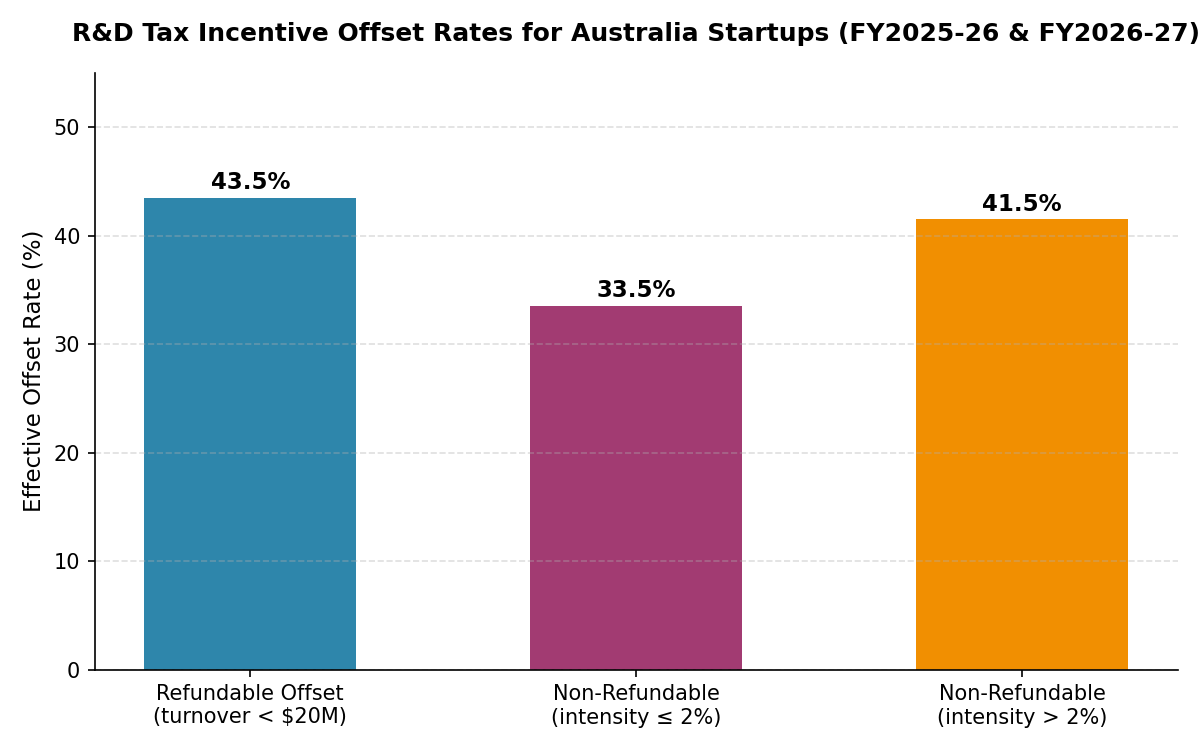
The refundable offset is the headline benefit for Australia startups specifically, because it converts straight into cash even if the company hasn’t turned a profit yet — there’s no need to wait years to use the credit against future tax.
How to Claim: A Step-by-Step Process
- Confirm eligibility before you spend, not after. Map your planned technical work against the “core” and “supporting” activity definitions early in the financial year.
- Keep contemporaneous records. Lab notebooks, Git commit logs, experiment trackers, and dated design documents all help prove the hypothesis-test-evaluate cycle AusIndustry looks for.
- Register your R&D activities with AusIndustry within 10 months of your income year’s end — for most Australia startups on a standard financial year, that’s 30 April.
- Calculate your notional R&D deductions with your accountant or an R&D tax specialist, separating eligible technical costs from ineligible commercial or administrative work.
- Lodge the R&D Tax Incentive Schedule together with your company tax return so the ATO can apply the offset or process the refund.
- Retain evidence for five years, since AusIndustry and the ATO can review claims well after they’re paid out.
A common failure point for Australia startups is treating registration as an afterthought during tax time. Because the AusIndustry registration and the ATO tax return are two separate steps with two separate bodies, missing the 10-month window means you lose the claim for that year entirely — there’s no late-lodgement exception for simply forgetting.
Common Mistakes That Cost Australia Startups Money
- Blending eligible and ineligible activities without a clear apportionment methodology, which invites review and clawback.
- Treating routine software development as R&D when there’s no genuine technical uncertainty — building a known feature with an established framework usually doesn’t qualify.
- Under-claiming legitimate overheads, like a fair share of cloud infrastructure or equipment depreciation directly tied to experiments.
- Missing the registration deadline, particularly for founders juggling fundraising and product launches in the same quarter.
- Weak documentation, which is the single biggest reason claims get challenged on audit.
Which Sectors of Australia Startups Benefit Most?
While any incorporated company can apply, certain sectors among Australia startups tend to see the strongest claim outcomes because their day-to-day work naturally involves technical uncertainty. Software and AI companies building novel model architectures, agritech and cleantech companies running unproven field trials, medtech and biotech Australia startups validating new diagnostic methods, and advanced-manufacturing teams prototyping new materials all regularly clear the bar. Marketplaces and typical CRUD-style SaaS products, by contrast, often struggle to demonstrate the required uncertainty unless a specific technical component — like a custom recommendation engine or a novel data-compression method — genuinely pushes past known solutions.
What’s Changing: The 2026–27 Budget Reforms
On 12 May 2026, as part of the Federal Budget, the Government announced it will reform the R&D Tax Incentive to better target business R&D spending that leads to positive economic spillovers. These changes are not yet law and are scheduled to take effect from 1 July 2028, but every founder planning multi-year R&D spend should understand the direction of travel.
| Feature | Current Rules (FY25-26 & FY26-27) | Proposed from 1 July 2028 |
|---|---|---|
| Refundable offset turnover cap | $20 million | $50 million |
| Refundability age limit | None | Limited to companies under 10 years old |
| Core R&D offset rate | Base rate | +4.5 percentage points |
| Intensity premium threshold | 2% of total expenditure | 1.5% of total expenditure |
| Supporting R&D activities | Eligible | No longer eligible |
| Minimum R&D spend | $20,000 | $50,000 (unless via a Research Service Provider) |
The government plans to increase the offset for core R&D expenditure by roughly 25 to 50 per cent through a 4.5 percentage-point rise in core R&D offset rates, while the aggregated turnover threshold for the refundable offset will rise from $20 million to $50 million, letting more growth-stage Australia startups keep access to cash refunds for longer. The trade-off is that refundability will only be available to businesses operating for less than 10 years, with older businesses eligible for an equivalent non-refundable offset instead. For younger, high-growth Australia startups this is broadly positive; for established R&D-heavy companies past the 10-year mark, it changes the cash-flow calculus significantly.
Why This Matters for Founders and Investors
For founders, the RDTI is effectively non-dilutive funding — it doesn’t touch your cap table the way a priced round or a convertible note does. For investors evaluating Australia startups, a company’s history of successfully claiming (and defending) its R&D offset is also a quiet signal of financial discipline: it means the technical team can articulate what’s genuinely novel about their work, and the finance function keeps clean, auditable records. Due diligence processes increasingly ask for RDTI claim history precisely because it correlates with governance maturity across early-stage Australia startups.
Frequently Asked Questions
Can a pre-revenue startup claim the RDTI? Yes. Because the refundable offset pays out even without taxable profit, it’s one of the few funding mechanisms explicitly built for pre-revenue Australia startups, and it’s often the very first non-dilutive capital many Australia startups ever receive.
Does the RDTI reduce the amount I can raise from investors? No — it’s not counted as revenue or equity, so it doesn’t typically affect valuation conversations for Australia startups, though some investors do ask about it as part of financial due diligence.
Can a company claim both a grant and the RDTI on the same project costs? Generally not on the same dollar of expenditure — you need to apportion costs carefully to avoid double-dipping, which is a frequent audit trigger for Australia startups running multiple funding programs at once.
What happens if AusIndustry rejects part of my claim? You can request a formal review or seek an Advance/Overseas Finding in future years to lock in certainty before you spend, which many repeat-claiming Australia startups now do as standard practice.
Building an RDTI Habit Into Your Startup’s Calendar
The Australia startups that get the most value from the RDTI year after year are rarely the ones scrambling in April. They treat R&D documentation as an ongoing habit: a standing monthly note logging what was attempted, what was uncertain, and what was learned. That habit alone often separates a claim that sails through review from one that draws a lengthy AusIndustry request for further information. If you’re building a startup calendar around fundraising milestones, it’s worth slotting quarterly RDTI check-ins alongside board meetings — a small operational discipline that keeps Australia startups audit-ready year-round.
Final Thoughts
The R&D Tax Incentive remains one of the most reliable, non-dilutive funding sources available to Australia startups today, and the 2026–27 Budget reforms — while not yet law — signal that policymakers want to keep steering support toward younger, high-intensity innovators. Whether you’re pre-seed or scaling past Series A, building a disciplined registration and documentation habit now will pay off well beyond the current financial year. For more guides on funding, tax, and growth strategy tailored to Australia startups, keep exploring StartupUrban — the resource built specifically for Australia startups navigating funding, tax, and growth.