Raising capital is one of the biggest milestones — and biggest headaches — for any founder. If you’re building a company in Britain, understanding UK startup funding rounds is the difference between walking into an investor meeting prepared and walking in blind. This guide breaks down every stage of the journey, from the earliest cheque to a fully-fledged Series A, so both founders and investors researching the UK startup landscape know exactly what to expect at each step.
Whether you’re a first-time founder trying to figure out how much to raise, or an investor trying to benchmark deal terms, this article covers the full picture: typical round sizes, valuations, equity given away, timelines, and the metrics that matter at each stage of the UK startup funding ladder.
Why Understanding UK Startup Funding Stages Matters
The UK startup ecosystem is one of the largest and most active in Europe. Britain’s startups collectively raised somewhere in the region of £17.5 billion across more than 2,000 deals in 2025, with artificial intelligence companies capturing a disproportionate share of that capital — over £6 billion by some estimates. Global startup funding hit a record high in early 2026, and the UK alone pulled in several billion dollars of that total in a single quarter.
For a UK startup founder, this activity is both an opportunity and a trap. There’s real money moving through the system, but investors have become far more disciplined since the highs of 2021. Knowing which round you’re actually raising — and what evidence investors expect at that stage — saves months of wasted conversations. A UK startup that pitches seed-stage metrics to a Series A investor, or vice versa, will struggle regardless of how good the underlying business is.
Pre-Seed Funding for UK Startups
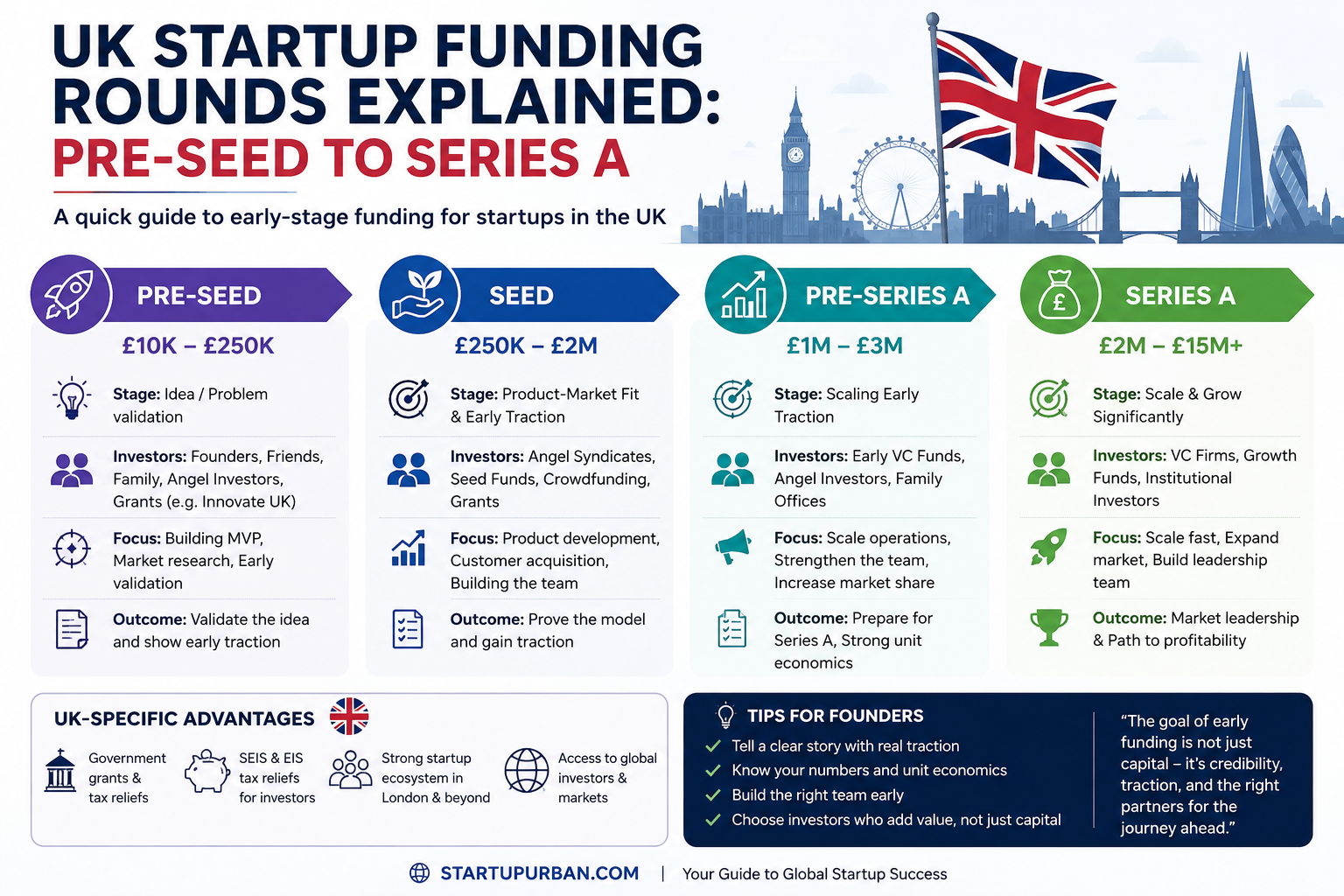
Pre-seed is the earliest formal funding stage for a UK startup. At this point, most companies have little more than an idea, a founding team, and perhaps an early prototype. Investors aren’t looking for proof yet — they’re betting on potential.
Typical characteristics of UK startup pre-seed rounds:
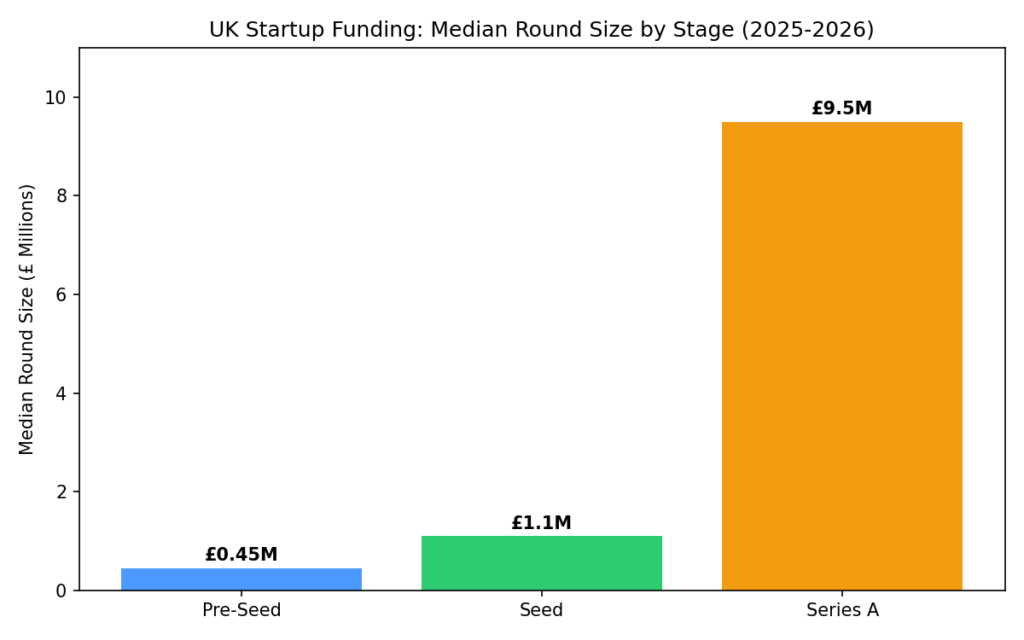
- Round size: Most pre-seed rounds for a UK startup fall between £100,000 and £500,000, with the market median sitting at roughly £450,000 as of late 2025.
- Time to close: Around 14 weeks on average.
- Investors involved: Angel investors, friends and family, accelerators, and dedicated pre-seed funds such as those focused on SEIS-eligible deals.
- Equity given away: Typically 10–20%.
- What’s expected: A credible team, a clear problem statement, and a tight use-of-funds plan — not necessarily revenue.
Activity at this stage has been strong. In the first half of 2025 alone, well over a billion pounds flowed into pre-seed deals across the UK startup market, with total annual deal volume expected to land near 1,450 rounds. A large share of this capital is structured to preserve SEIS (Seed Enterprise Investment Scheme) eligibility, which offers UK investors generous tax relief and makes early-stage UK startup investing structurally cheaper than in many other markets.
One important nuance: a market median of £450,000 doesn’t mean every UK startup should target that figure. The right raise size maps to the actual work required to reach your next milestone — not to what looks impressive on a pitch deck.
Seed Funding for UK Startups
Seed is where a UK startup needs to start showing evidence, not just potential. By this stage, investors expect signs of traction: early users, initial revenue, partnerships, or strong engagement metrics that suggest the problem-solution fit is real.
Typical characteristics of UK startup seed rounds:
- Round size: Average seed rounds for a UK startup have ranged between roughly £1.5 million and £3 million in 2025, though the median deal is smaller, around £1.1 million, down from a £1.4 million peak in prior years.
- Pre-money valuation: Commonly £4–6 million for pre-revenue companies, rising to £6–9 million with early monthly recurring revenue (MRR) around £20,000, and £10–14 million once MRR reaches roughly £60,000.
- Investors involved: Seed-focused VCs, super angels, and syndicates. Total UK seed investment reached around £1.8 billion in 2025 across more than 1,600 first-time seed rounds.
- Equity given away: Typically 15–25%.
- What’s expected: Retention data, gross margin visibility, customer acquisition cost (CAC) payback, and a credible 18-month runway plan.
The single biggest shift in the UK startup seed market over the past two years is that investors now price-test runway discipline rather than ambition. Founders who structure their raise around 18 months of efficient runway close faster than those who raise purely to fund headcount growth.
Series A Funding for UK Startups
Series A is the first major growth round for a UK startup, and the bar is considerably higher than at seed. By now, a company needs to demonstrate genuine product-market fit and a repeatable go-to-market motion — not just early signs of interest.
Typical characteristics of UK startup Series A rounds:
- Round size: Series A rounds for a growth-stage UK startup commonly range from £8 million to £16 million, broadly comparable to the global median of around $12 million.
- Pre-money valuation: Generally falls between £20 million and £40 million, with strong companies commanding more.
- Investors involved: Institutional venture capital firms, often including US or European funds co-investing alongside UK-based lead investors.
- Equity given away: Typically 15–20%.
- What’s expected: £1 million–£3 million in annual recurring revenue (ARR), 15–20% month-on-month growth, and a sales or growth motion that can be repeated and scaled.
Series A is also the stage with the sharpest drop-off. Fewer than 40% of seed-funded companies successfully raise a Series A, and the average time between seed and Series A has stretched to well over 18 months. For a UK startup, this means the seed round needs to be sized generously enough to reach genuine Series A metrics — running out of runway one milestone short of qualifying is one of the most common and preventable founder mistakes.
UK Startup Funding Rounds at a Glance
| Stage | Typical Round Size | Pre-Money Valuation | Equity Given Away | Time to Close | Key Investors |
|---|---|---|---|---|---|
| Pre-Seed | £100K – £500K | £1M – £4M | 10–20% | ~14 weeks | Angels, accelerators, SEIS funds |
| Seed | £750K – £3M | £4M – £14M | 15–25% | 3–5 months | Seed VCs, super angels, syndicates |
| Series A | £8M – £16M | £20M – £40M+ | 15–20% | 4–7 months | Institutional VCs, growth funds |
UK Startup Funding: Median Round Size by Stage
The chart below illustrates how sharply capital requirements scale as a UK startup matures from pre-seed to Series A. The jump from seed to Series A is particularly steep, reflecting the much higher bar for proven traction at that stage.
From One Round to the Next: UK Startup Conversion Rates
Not every UK startup that raises a pre-seed round goes on to raise further capital. Conversion rates between stages have tightened considerably since the 2021 peak, and understanding them helps set realistic expectations for both founders and investors.
| Transition | Approximate Conversion Rate | Typical Timeframe |
|---|---|---|
| Pre-Seed → Seed | ~45% | Within 24 months |
| Seed → Series A | ~38% | 18–24+ months |
| Series A → Series B | ~55% | 18–24 months |
These figures underline why a UK startup shouldn’t treat fundraising as a single event. Each round needs to be sized and timed to give the company genuine room to hit the milestones the next stage requires.
How Investors Evaluate a UK Startup at Each Stage
Investors don’t apply the same lens across every round. Early on, a UK startup is judged almost entirely on team quality and market opportunity. By seed, the focus shifts to traction and unit economics. By Series A, investors want proof that growth is repeatable and that the business model actually scales.
A few consistent factors matter across every stage of the UK startup funding journey:
- Team credibility — domain expertise, prior execution, and coachability.
- Market size — is the addressable market big enough to justify venture-scale returns?
- Capital efficiency — how much progress has the company made per pound raised?
- Tax-advantaged structuring — SEIS and EIS eligibility remain a major draw for UK-based investors, and recent policy changes have made these schemes even more attractive, including an increase in the EIS annual company cap and an extension of relief eligibility out to 2035.
Tips for UK Startup Founders Raising Capital
- Raise for milestones, not for a round size. A UK startup should size its raise around the evidence needed to unlock the next stage, not around what sounds impressive.
- Protect your SEIS/EIS eligibility. These schemes make your UK startup structurally more attractive to angel and early-stage investors, so structure your cap table carefully.
- Build monthly investor updates into your routine. Consistent visibility into retention, margin, and runway builds trust well before your next UK startup fundraise begins.
- Don’t confuse interest with commitment. Term sheets, not warm meetings, are what move a UK startup round forward.
- Diversify your investor base geographically. London still dominates deal volume, but strong UK startup funds increasingly operate outside the capital, in cities like Manchester, Edinburgh, and Cambridge.
Final Thoughts
Every UK startup follows a different path, but the underlying mechanics of pre-seed, seed, and Series A funding are remarkably consistent. Knowing the typical round sizes, the evidence investors expect, and the realistic conversion rates between stages puts founders in a far stronger negotiating position — and gives investors a clearer framework for evaluating opportunities in one of Europe’s most active startup markets.
If you’re building or backing a UK startup, treat each funding round as a distinct milestone with its own goals, rather than a single continuous fundraising effort. That mindset shift alone separates the founders who raise efficiently from those who spend a year chasing capital they didn’t need to.
Looking ahead, the broader UK startup market shows no signs of slowing down. Policy support through extended SEIS and EIS relief, a growing number of regional funds outside London, and record levels of AI-related investment all point to a deepening ecosystem. For founders weighing their first raise, and for investors scanning the market for the next promising deal, the fundamentals covered in this guide — round sizes, valuations, equity dilution, and realistic conversion rates — remain the clearest lens for evaluating opportunity in British venture capital today.