
Raising money without giving away equity is one of the smartest moves a UK founder can make in the early days of building a company. While venture capital and angel investment dominate the funding headlines, a quieter and often more accessible route exists through government-backed grants, loans, and tax incentives. In 2026, the UK continues to run one of the most developed public funding ecosystems in Europe, with billions of pounds channelled through national agencies, regional Growth Hubs, and sector-specific innovation programmes.
The challenge for most founders isn’t a lack of options — it’s knowing which of the dozens of available schemes actually fits their stage, sector, and funding requirement. This guide breaks down the ten strongest UK government grants and funding schemes currently open to startups in 2026, along with practical advice on eligibility, funding size, and how to apply.
Why Government Funding Still Matters in 2026
Government grants and loans are described as “non-dilutive” because founders don’t have to hand over any equity or take on the reporting obligations that come with venture capital. That makes them particularly valuable for early-stage founders who want to preserve ownership while proving out their product, hitting technical milestones, or funding R&D that private investors consider too risky.
Public funding also carries a signalling effect. Winning a competitive Innovate UK grant or a sector-specific award is a credibility marker that founders can use later when approaching private investors — it demonstrates that an independent panel of experts has already validated the underlying technology or business model. Used strategically, government funding becomes a stepping stone rather than a substitute for a larger raise.
With that context in mind, here are the ten schemes worth prioritising this year.
1. Start Up Loans (British Business Bank)
The Start Up Loans programme, delivered through the British Business Bank, remains the most accessible entry point for early-stage founders. It provides personal loans of between £500 and £25,000 per founder, with a typical award sitting around the £6,000 mark. The scheme carries a fixed interest rate and repayment terms of up to five years, and successful applicants also receive access to free mentoring for up to 12 months.
Because it’s structured as a personal loan rather than a business grant, eligibility is comparatively relaxed — founders don’t need trading history, and pre-revenue businesses are welcome to apply. For many first-time entrepreneurs, this is the natural first stop before exploring larger, more competitive schemes.
Best for: Pre-revenue and very early-stage founders needing working capital or initial setup costs.
2. Innovate UK Smart Grants
Innovate UK, the UK’s national innovation agency and part of UK Research and Innovation (UKRI), runs one of the country’s most well-known competitive grant programmes. Smart Grants fund game-changing, disruptive innovations that can significantly impact the UK economy, with awards typically ranging from £25,000 for small projects up to £2 million for large collaborative ones.
Competition is fierce, with success rates often sitting in the 10–15% range, and applications require a detailed technical and commercial case. However, for startups building genuinely novel technology, this remains one of the largest sources of non-dilutive funding available anywhere in the country.
Best for: Technology-driven startups with a clear, innovative product roadmap and a strong written application.
3. Innovate UK Innovation Loans
For startups with later-stage R&D projects that are closer to commercialisation, Innovation Loans offer between £100,000 and £5 million on favourable terms compared to commercial lending. Unlike grants, these are loans that must eventually be repaid, but the rates and repayment flexibility are designed specifically to support high-growth, R&D-intensive businesses.
Rounds open on a rolling basis throughout the year, so founders should check Innovate UK’s competition calendar regularly rather than assuming a single annual deadline. A clear commercialisation pathway is essential to a successful application.
Best for: Startups with a working prototype or near-market technology that need capital to bridge the gap to revenue.
4. Biomedical Catalyst (BMC)
Life sciences and healthtech founders have a dedicated route through the Biomedical Catalyst, Innovate UK’s flagship grant scheme for small and medium enterprises working across health and healthcare innovation. The BMC supports projects spanning early feasibility studies through to late-stage clinical development, with funding amounts scaling according to project maturity and risk.
This scheme is jointly backed by UKRI and the Medical Research Council, giving it particular credibility within the life sciences investment community.
Best for: Early and growth-stage biomedical, medtech, and digital health startups.
5. Invention for Innovation (i4i) Programme
Funded by the Department of Health and Social Care through the National Institute for Health and Care Research (NIHR), the i4i programme is one of the UK’s largest funders of academic and private-sector medical research. It’s structured across three separate awards: the i4i Product Development Award, which has no upper funding limit and can cover up to 100% of eligible project costs; the i4i Connect scheme, offering £50,000 to £150,000 to help SMEs reach their next development milestone; and a smaller-scale award aimed at innovators who need modest funding to close specific evidence gaps.
Best for: Startups developing medical devices, diagnostics, or digital health technologies for clinical or social care settings.
6. Women in Innovation Awards
Run by Innovate UK, the Women in Innovation Awards specifically target female founders leading innovative, high-growth businesses. Winners receive a grant of up to £75,000, alongside 12 months of tailored business support, mentoring, and networking opportunities designed to help scale the business beyond the funding itself.
The assessment process typically takes 8–12 weeks from the closing date, with the full journey from application to funds landing usually spanning several months, so early preparation is essential.
Best for: Female-led startups at a growth stage looking for both capital and structured business support.
7. Seed Enterprise Investment Scheme (SEIS)
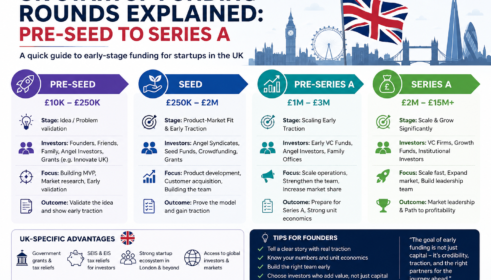
SEIS isn’t a direct grant, but it functions as one of the most powerful funding levers available to very early-stage UK startups. The scheme incentivises private individuals to invest in qualifying early-stage companies by offering them up to 50% income tax relief on investments of up to £200,000 per tax year. In turn, eligible startups can raise up to £250,000 in SEIS-qualifying investment.
Because SEIS dramatically reduces the risk for investors, it often makes the difference between a stalled seed round and a completed one. Founders should apply for advance assurance from HMRC before approaching investors, as this reassures backers that their investment will genuinely qualify for relief.
Best for: Pre-seed and seed-stage startups raising their first round of outside investment.
8. Enterprise Investment Scheme (EIS)
EIS is the sister scheme to SEIS, designed for slightly more established companies that have outgrown SEIS eligibility limits. It offers investors 30% income tax relief on investments of up to £1 million per year (or £2 million for knowledge-intensive companies), and allows qualifying companies to raise significantly larger sums than under SEIS.
Like SEIS, EIS works by making a startup more attractive to private investors rather than paying money directly to the company, but its effect on fundraising ability is substantial.
Best for: Startups moving beyond their first funding round who need to raise larger amounts from private investors.
9. Local Growth Hub Grants
Beyond national schemes, every region of England has a Growth Hub — a locally delivered service offering free business advice alongside small grants, typically ranging from £500 to £10,000. These are considerably less competitive than national programmes and are specifically designed to support businesses trading for under three years.
Many founders combine a Growth Hub grant with a Start Up Loan to access a combined package of £5,000 to £30,000, plus ongoing local advisory support. Scotland, Wales, and Northern Ireland run equivalent regional bodies, so founders outside England shouldn’t overlook this route.
Best for: Early-stage local businesses wanting quick, low-competition access to smaller amounts of funding and hands-on advice.
10. University Startup and Incubator Funding
Many UK universities run their own startup funding programmes, offering small grants of roughly £1,000 to £10,000 alongside subsidised office space, mentoring, and access to research facilities. These programmes are usually open to recent graduates, current students, or startups with some connection to the institution, such as a licensing agreement or research collaboration.
For founders building on top of academic research or emerging technology, this route combines funding with credibility and a built-in network of technical expertise.
Best for: Founders with an academic or research-based startup idea, particularly recent graduates.
How to Choose the Right Scheme for Your Startup
With so many options available, the key is to map each scheme against three factors: your business stage, your sector, and how much capital you genuinely need right now. A pre-revenue founder with a general business idea is better served by a Start Up Loan or Growth Hub grant than by attempting a highly technical Innovate UK Smart Grant application. Conversely, a startup with a defensible, innovative technology and a clear R&D roadmap should prioritise Innovate UK or sector-specific schemes like the Biomedical Catalyst, where the funding ceiling is far higher.
It’s also worth treating public funding as a deliberate part of your broader fundraising strategy rather than a one-off application. Founders who sequence grants, tax-relief schemes like SEIS or EIS, and eventual private investment tend to end up in the strongest negotiating position when they do raise equity, because each grant becomes proof that an independent body has already validated part of their business.
Final Thoughts
The UK government’s funding ecosystem in 2026 remains one of the most generous and diverse in the world, spanning everything from £500 microloans to multi-million-pound innovation grants. The common thread across all ten schemes above is that success depends on matching the right programme to the right stage of your business, preparing a detailed and evidence-backed application, and being realistic about timelines — most schemes take several months from application to funds landing.
Start by identifying which one or two schemes align most closely with your current stage and sector, then build your application around clear milestones and measurable outcomes. Done well, government funding can meaningfully extend your runway while strengthening your position for the next stage of growth.