
Raising money from American investors is a different game than raising money almost anywhere else. The pace is faster, the competition is fiercer, and the expectations around a US startup pitch deck template are more standardized than founders often assume. If you’re building a company outside the US and eyeing Silicon Valley, New York, or Austin capital, or if you’re already based in the US and simply want a deck that converts meetings into term sheets, this guide walks through exactly how to structure one.
By the end, you’ll understand the slide-by-slide anatomy investors expect, the design conventions that signal credibility, and the mistakes that quietly kill a US startup’s chances before a single question is asked.
Why a US-Ready Pitch Deck Is Different
Every US startup fundraising conversation is compressed. Seed-stage investors in the US often decide whether to take a second meeting within the first three to five minutes of a pitch. That means your deck isn’t just a supporting document — it’s doing the persuading before you even open your mouth.
A generic slide deck built for a local bank loan or a regional accelerator won’t translate. US venture investors read hundreds of decks a month, and they’ve internalized a specific rhythm: problem, solution, market, traction, business model, team, ask. Deviate too far from that rhythm and you force the investor to work harder to understand your US startup, which almost always costs you the meeting.
What US Investors Expect From a Pitch Deck
Before touching a slide template, it helps to understand the psychology behind a US startup pitch deck template. Investors are pattern-matching machines. They’ve seen thousands of decks, and they subconsciously compare yours against the last unicorn deck that crossed their desk.
| What US Investors Expect | Why It Matters for a US Startup |
|---|---|
| Clear, single-sentence problem statement | Signals founder clarity of thought |
| Market sized in dollars, not adjectives | US investors distrust vague TAM claims |
| Traction shown as a trend line, not a snapshot | Growth rate matters more than absolute numbers |
| A named, credible ask | Vague asks read as unpreparedness |
| Ten to fifteen slides, not thirty | Attention spans are short; brevity signals discipline |
| Data-backed unit economics | US startup investors underwrite on CAC/LTV, not vision alone |
If your deck violates more than two or three of these norms, you’re already fighting an uphill battle — regardless of how strong the underlying business is.
The Standard US Startup Pitch Deck Structure
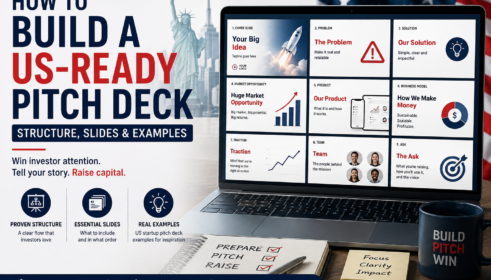
Below is the slide order most seed-to-Series-A investors in the US expect to see, roughly in this sequence. This is the backbone of nearly every effective US startup pitch deck template in circulation today.
| Slide | Slide Name | Core Purpose |
|---|---|---|
| 1 | Cover / Company Name | First impression, tagline, contact info |
| 2 | Problem | Establish pain point and urgency |
| 3 | Solution | Show your product as the fix |
| 4 | Market Size (TAM/SAM/SOM) | Prove the opportunity is venture-scale |
| 5 | Product | Demonstrate how it works, ideally with visuals |
| 6 | Business Model | Explain how the company makes money |
| 7 | Traction | Show growth, revenue, or usage momentum |
| 8 | Go-to-Market Strategy | Explain how you’ll acquire customers at scale |
| 9 | Competition | Position against alternatives, not just competitors |
| 10 | Team | Establish founder-market fit |
| 11 | Financials & Projections | Show a credible 3-year forecast |
| 12 | The Ask | State the raise amount and use of funds |
Some founders add an appendix with additional data for follow-up questions, but the core narrative should never exceed fifteen slides for an early-stage US startup raise.
Slide-by-Slide Breakdown
1. Cover Slide Keep it minimal: company name, a one-line description, and your contact details. This isn’t the place for cleverness — it’s the place for clarity about what your US startup does in under ten words.
2. Problem Frame the problem in terms an investor can feel, ideally backed by a statistic. Avoid describing the problem from your own frustration alone; tie it to a broader market pain that a US startup is uniquely positioned to solve.
3. Solution Show, don’t just tell. A screenshot, short demo GIF, or simple diagram beats three bullet points every time. This slide should make an investor think “obviously, why doesn’t this already exist.”
4. Market Size This is often where non-US founders lose credibility fastest. Avoid top-down market sizing (“the global market is $500B, if we capture just 1%…”). Build your TAM/SAM/SOM from the bottom up using real pricing and real customer counts — American investors have seen the top-down trick too many times.
5. Product Walk through the core product experience visually. If you have a live product, a short embedded video or annotated screenshots work better than dense text. This is your chance to prove the US startup isn’t just a slide deck — it’s real.
6. Business Model State plainly how money moves: subscription, transaction fee, marketplace take rate, or licensing. US investors want a one-line answer here, not a paragraph.
7. Traction This is frequently the single most important slide in a US startup pitch deck template. Show a growth curve — users, revenue, or engagement — trending up and to the right. Even modest but consistent growth outperforms flat, larger numbers.
8. Go-to-Market Strategy Explain exactly how you’ll acquire your next 1,000 customers, not just your first ten. Naming specific channels (paid, SEO, partnerships, outbound) with rough CAC estimates builds far more confidence than generic statements like “word of mouth and virality.”
9. Competition Never claim you have no competitors — it signals naivety. Use a simple 2×2 positioning matrix instead, showing where your US startup sits relative to incumbents and adjacent players.
10. Team US investors invest heavily in founder-market fit. Highlight relevant domain expertise, prior exits, or technical credentials. If you’re a non-US founding team raising from American investors, briefly address your US market access and any local advisors or co-founders.
11. Financials & Projections Keep this to a single clean chart with three years of projected revenue, expenses, and headcount. Investors know projections are guesses — what they’re really evaluating is whether your logic is sound.
12. The Ask State the exact amount you’re raising, the round type (pre-seed, seed, Series A), and a simple breakdown of how funds will be used. Vague asks are one of the fastest ways to lose investor confidence in a US startup pitch.
Fundraising Benchmarks: What “Normal” Looks Like
Founders often ask how their numbers compare to the average US startup at their stage. Below is a rough benchmark drawn from commonly cited seed and Series A data across the US startup ecosystem.
| Stage | Typical Raise | Typical Deck Length | Average Investor Meetings Before Term Sheet |
|---|---|---|---|
| Pre-Seed | $250K – $1M | 10–12 slides | 15–25 |
| Seed | $1M – $4M | 12–15 slides | 20–35 |
| Series A | $5M – $15M | 15–18 slides | 25–40 |
Deck-to-Meeting Conversion (Illustrative)
Cold Outreach Decks Sent     ████████████████████ 100
Decks Opened & Read Fully    ██████████ 50
First Meetings Booked        ████ 20
Second Meetings              ██ 8
Term Sheets Issued           █ 2
The pattern holds across almost every US startup fundraising cycle: the deck’s job is simply to survive each stage of this funnel, not to close the deal by itself.
Design Best Practices for a US Startup Deck
- One idea per slide. If a slide needs a scroll to digest, split it.
- Consistent typography and color palette. Investors associate visual discipline with operational discipline.
- Real screenshots over stock icons. Authenticity beats polish for an early-stage US startup.
- Numbers should be the largest text on the page when the slide’s job is to prove scale or traction.
- Avoid dense paragraphs. Investors skim; bullet fragments outperform full sentences.
Common Mistakes That Sink a US Startup Pitch
- Overloading the market size slide with global statistics that have no bearing on your actual go-to-market plan.
- Burying the ask on a crowded final slide instead of giving it dedicated space.
- Ignoring US-specific context, such as regulatory nuance, payment infrastructure, or state-level considerations relevant to your industry.
- Using currency or metrics unfamiliar to US investors without converting them clearly.
- Skipping the competitive slide entirely, which reads as a lack of market research.
Localizing Your Deck for US Investors
If you’re building outside the United States, a few adjustments make your deck read as genuinely US-ready rather than adapted at the last minute:
- Convert all financials to USD and clarify any assumptions about exchange rates.
- Reference US-based comparable companies where relevant, since investors benchmark against what they know.
- Clarify your legal structure — many US investors expect a Delaware C-Corp before writing a check into a foreign-founded US startup.
- Show evidence of US market traction specifically, not just global numbers, since a strong home-market performance doesn’t always de-risk US expansion in an investor’s eyes.
Examples Worth Studying
Several publicly shared decks are widely referenced as strong examples of the US startup pitch deck format: Airbnb’s original seed deck for its clean problem-solution framing, Buffer’s transparent traction-and-metrics-driven deck, and DoorDash’s early go-to-market-focused deck. Studying the sequencing in these examples — rather than copying their exact slides — is the fastest way to internalize what a compelling US startup narrative looks like on paper.
Frequently Asked Questions
How many slides should a US startup pitch deck have? Most successful early-stage decks run 10–15 slides. Investors reviewing a US startup opportunity for the first time rarely need more than that to decide whether a follow-up conversation is worth their time.
Do I need a US-based lawyer to build a compliant deck? Not for the deck itself, but if you’re incorporating as a US startup or planning to raise from US venture funds, most investors will expect a Delaware C-Corp structure to be in place, or at least in progress, before closing the round.
Should the deck differ between seed and Series A? Yes. A seed-stage US startup deck leans heavily on market opportunity and founder credibility, since there’s limited data to show. A Series A deck shifts the weight toward proven traction, unit economics, and a repeatable go-to-market motion.
Final Thoughts
A strong US startup pitch deck template isn’t about design flair or clever copywriting. It’s about respecting the investor’s time by presenting a clear, evidence-backed narrative in the exact order they’ve been trained to expect. Nail the structure, back every claim with a number, and make the ask impossible to misread — and your deck will do exactly what it’s supposed to do: earn you a second meeting.