
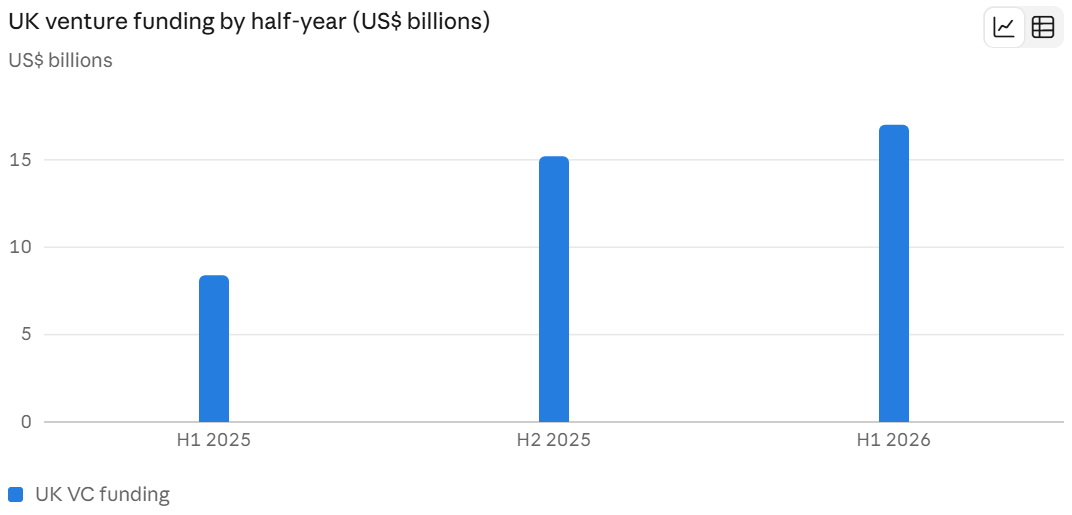
If you have been searching for uk startup success stories 2026, you are probably a founder hunting for a playbook or an investor hunting for the next category winner. Both groups have plenty to study. British startups raised $23.6 billion in 2025. They then raised another $17 billion in the first half of 2026 alone, the strongest opening half since 2022, according to HSBC Innovation Banking UK and Dealroom.
This guide examines the most instructive uk startup success stories of the past two years. It covers the funding data, five company case studies, three tables, two charts and a set of lessons you can apply whether you are preparing a pre-seed pitch or underwriting a growth round. Everything is written in original language from published research and reporting, with sources listed at the end.
Why UK Startup Success Stories Matter More in 2026
The strongest uk startup success stories of this cycle share a backdrop worth understanding first. 2025 was the first year of growth in UK venture investment in four years, up 35% on 2024, and it produced 16 new unicorns. Momentum then accelerated. In the first half of 2026, UK startups raised roughly double what they raised a year earlier, and AI companies took about three-quarters of the money.
Maturity matters just as much. Late-stage rounds made up 68% of H1 2026 funding, against 42% a year earlier. Investors are no longer only backing promising ideas. They are funding companies that have already shown they can scale. For founders, that raises the bar for growth capital. For investors, it means a deeper pool of proven winners.
Table 1: UK venture snapshot
| Metric | Figure | Source |
|---|---|---|
| UK VC funding, full-year 2025 | $23.6B (+35% year on year) | HSBC Innovation Banking / Dealroom |
| UK VC funding, H1 2026 | $17B (+102% vs H1 2025) | HSBC Innovation Banking / Dealroom |
| AI funding, H1 2026 | $12.6B (about 74% of UK VC) | Dealroom |
| Late-stage share of funding | 42% (H1 2025) → 68% (H1 2026) | Dealroom |
| UK share of European VC, H1 2026 | 39% | Dealroom |
| Total UK unicorns | 217 | Dealroom |
Chart 1: UK venture funding by half-year (US$ billions)
Five UK Startup Success Stories Worth Studying
1. Isomorphic Labs: science-led AI at scale
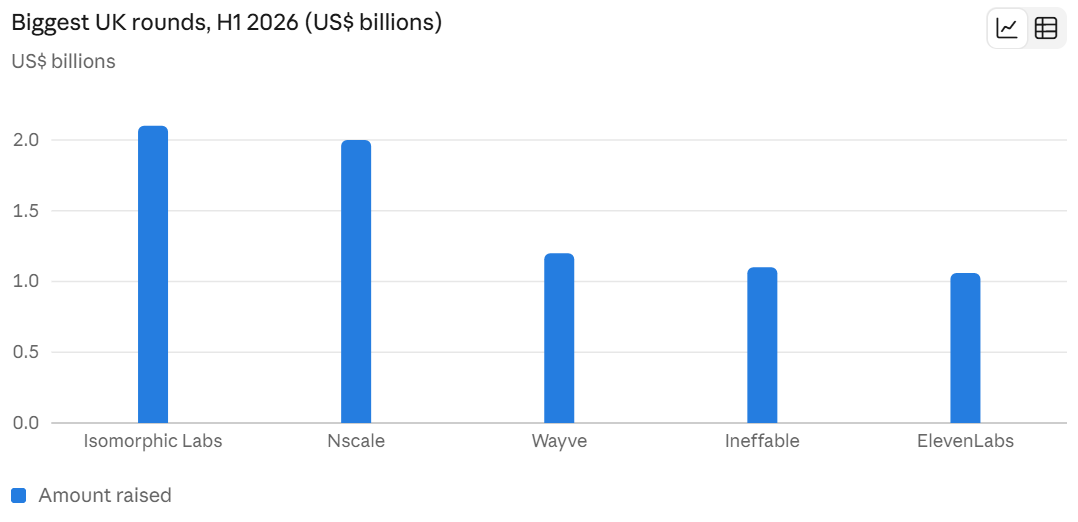
Isomorphic Labs, a spin-out from Google DeepMind, raised a $2.1 billion Series B in H1 2026 to advance its AI-driven drug discovery platform. It was the largest UK round of the period. The lesson is that deep technical credibility, tied to a market as large as pharmaceuticals, can command capital that ordinary software metrics cannot explain. This is one of the uk startup success stories that proves research-heavy businesses can win mainstream funding.
2. Nscale: infrastructure as the product
Nscale, a British AI infrastructure company backed by Nvidia, closed a $2 billion Series C in March 2026 at a reported $14.6 billion valuation. That was described as the largest Series C in European history. Tech.eu counts roughly €3.6 billion raised across three announcements in the half as it expanded data centre and compute capacity. The lesson is that when a technology wave creates a bottleneck, selling the picks and shovels can be as lucrative as building the app on top. Among uk startup success stories from this period, Nscale is the clearest example of riding demand for compute.
3. Wayve: patient capital for hard problems
Wayve, which builds embodied AI for autonomous driving, raised about $1.2 billion in a Series D. Its backers include the British Business Bank, Ontario Teachers’ Pension Plan, Baillie Gifford and Schroders Capital. Self-driving technology takes years to mature, so the company needed investors willing to wait. Few uk startup success stories illustrate the value of patient, institutional money as well as Wayve does.
4. Ineffable Intelligence: a seed round without precedent
Ineffable Intelligence raised roughly $1.1 billion at seed stage, with support from the UK’s Sovereign AI Fund, the British Business Bank, Sequoia and Lightspeed. A seed round of that size would have seemed absurd a few years ago. The lesson is that an exceptional team in frontier AI can raise on research direction and reputation, but this is a rare path, not a template. Treat it as an outlier when you read uk startup success stories about early funding.
5. ElevenLabs: product-led global growth
ElevenLabs, the AI voice company, raised about $1.06 billion across three rounds in H1 2026, according to Tech.eu, including a $500 million round reported in the first quarter. Its product spread through developers and creators who adopted it voluntarily, and that usage gave investors hard evidence of demand. Product-led growth runs through many uk startup success stories beyond AI.
Not all uk startup success stories of 2025-26 are about AI. Allica Bank joined the unicorn list at a $1.2 billion valuation, and 9fin also crossed the threshold. Earlier UK unicorn waves were dominated by consumer fintech. This one is broader, spanning AI, infrastructure, banking and deep tech.
Table 2: Largest UK funding rounds, H1 2026
| Company | Sector | Round | Amount |
|---|---|---|---|
| Isomorphic Labs | AI drug discovery | Series B | $2.1B |
| Nscale | AI infrastructure | Series C | $2.0B |
| Wayve | Autonomous driving | Series D | $1.2B |
| Ineffable Intelligence | Frontier AI | Seed | $1.1B |
| ElevenLabs | AI voice | Three rounds (total) | about $1.06B |
Chart 2: Biggest UK rounds of H1 2026 (US$ billions)
What These UK Startup Success Stories Have in Common
1. They start with a big, specific problem. The best uk startup success stories begin with a clear pain point: drug discovery takes too long, compute is scarce, driving is hard to automate. Vague ambition does not raise a billion dollars.
2. They build a moat that is hard to copy. In every one of the uk startup success stories above, the advantage is hard to replicate. It might be proprietary research, scarce infrastructure, a large training dataset or a product that users genuinely love.
3. They match investors to their timeline. Capital-intensive companies like Wayve and Nscale chose backers with long horizons and deep pockets. Matching your funding source to your development cycle is one of the cheapest ways to avoid a painful down round.
4. They use public capital as a catalyst. Several uk startup success stories here involved the British Business Bank or the Sovereign AI Fund alongside private investors. Public money can signal confidence and de-risk early commitments.
5. They think globally from day one. The NatWest “Future of UK Innovation” report found that international investors supplied around 80% of UK startup capital in 2025. The most celebrated uk startup success stories sell to global customers and raise from global investors.
6. They scale talent and infrastructure together. Large rounds pay for compute, labs and senior hires at the same time. Companies that expand one without the other tend to stall.
Founder and Investor Takeaways from UK Startup Success Stories
The table below turns these uk startup success stories into practical action for each audience.
Table 3: Practical takeaways
| Theme | For founders | For investors |
|---|---|---|
| Funding stage | Prove traction before chasing growth capital; late-stage dominates | Expect larger, later rounds and higher entry prices |
| Sector focus | Anchor AI features to a real customer problem | Look beyond AI at deep tech, health and defence |
| Investor fit | Choose backers who can follow on | Reserve capital for follow-on rounds |
| Public support | Explore British Business Bank and sovereign programmes | Co-invest where public money reduces risk |
| Exit planning | Build for scale, not just a quick sale | Plan for long holding periods |
The Caveats Behind the Headlines
Readers of uk startup success stories should remember survivorship bias. Tracxn found that the UK’s five best-funded AI companies took $8.1 billion, 84% of the $9.6 billion raised by UK AI companies in H1 2026, and that London captured nearly all of it. Isomorphic Labs, Nscale and Wayve alone accounted for $5.3 billion. Trackers also disagree on totals: Dealroom puts H1 AI funding at $12.6 billion, while Tracxn counts $9.6 billion, because each defines “AI company” differently.
Liquidity is also tight. NatWest’s report noted only three IPO exits in 2025, so many of the valuations above remain on paper. Treat uk startup success stories as case studies, not guarantees. They show what is possible, not what is typical.
How to Use UK Startup Success Stories in Your Own Plan
You can turn research into strategy in four steps.
- Build a comparison set. Collect five uk startup success stories in your own sector and note each company’s stage, funding, investors and growth drivers.
- Benchmark honestly. Compare each of the uk startup success stories against your current traction, not your aspirations.
- Map your investors. List who backed the winners, then identify which of those funds invest at your stage.
- Stress-test your story. Ask whether your pitch would still hold if funding conditions tightened. The strongest companies would survive a colder market.
FAQ
What are the best uk startup success stories of 2026?
The most cited uk startup success stories of 2026 include Isomorphic Labs, Nscale, Wayve, Ineffable Intelligence and ElevenLabs, all of which raised $1 billion or more in H1 2026.
Which sector dominates uk startup success stories?
AI dominates uk startup success stories because it attracted roughly three-quarters of UK venture funding in H1 2026, including all four rounds above $1 billion.
How many unicorns has the UK produced?
Dealroom counts 217 UK unicorns. Trackers report between 13 and 18 new ones in 2026, depending on methodology and cut-off date.
Conclusion
The uk startup success stories of 2025-26 show an ecosystem moving from promise to scale. Capital is abundant at the top, public and private investors are collaborating, and founders in AI, deep tech and fintech are building globally relevant companies. The lessons are consistent: solve a large problem, build a defensible moat, match your funding to your timeline and think globally from the start.
Whether you are a founder planning your next raise or an investor mapping the market, keep following uk startup success stories 2026 as the year closes. The next breakout company may already be in an early round.