
Knowing how to pitch Australian investors can decide whether your startup closes a seed round or spends a year chasing polite emails. Australia’s venture market is smaller than Silicon Valley’s, but it is close-knit, disciplined and increasingly sophisticated. Sydney and Melbourne VCs see hundreds of decks every year, and they reward founders who respect their time, understand local conditions and show real evidence of progress.
This guide explains what Australian investors actually want to hear, how the Sydney and Melbourne scenes differ, and how to build a pitch that earns a second meeting. Whether you are a local founder or an overseas team eyeing the region, these principles will help you speak the language of Australian investors.
Why Understanding Australian Investors Comes First
Australian investors tend to be pragmatic. Capital is more limited than in the United States, so funds back fewer companies and ask harder questions about unit economics early in the process. Many partners are former founders or operators, which means they can spot vague claims within minutes.
Another defining feature is global thinking. Most Australian investors see the domestic market of roughly 27 million people as a launchpad rather than a ceiling. If your plan only works inside Australia, expect pushback on the size of the opportunity.
Founders who research Australian investors before a meeting stand out immediately. Read the fund’s investment thesis, scan its portfolio, and note which partner leads which sector. A pitch that references a relevant portfolio company, and explains why you are complementary rather than competitive, shows real preparation.
Sydney vs Melbourne: How the Two Ecosystems Differ
Both cities are major hubs, but their cultures shape every pitch. Sydney leans towards fintech, marketplaces and enterprise software, helped by proximity to banks, large corporates and a deep angel network. Melbourne is known for healthtech, edtech, consumer brands and university-linked deep tech. Neither is better. The smart move is to tailor your story to the room.
| Factor | Sydney | Melbourne |
|---|---|---|
| Common sector strengths | Fintech, SaaS, marketplaces | Healthtech, edtech, deep tech, consumer |
| Investor style | Fast-moving, metrics-led, globally focused | Thoughtful, relationship-led, research-driven |
| Meeting tone | Direct and brisk | Conversational and collaborative |
| What lands well | A clear growth engine and a path to the US | Strong science, customer impact and sound unit economics |
| Tip | Lead with traction numbers | Lead with problem depth and customer stories |
Treat these as tendencies, not rules. Many Australian investors work across both cities and share deal flow, so a warm introduction in one city often opens doors in the other.
What Australian Investors Want to Hear in Your Pitch
Across both cities, the same themes come up again and again. These are the seven messages Australian investors listen for.
- A real, painful problem. Australian investors are wary of hypothetical problems. Describe a specific customer, what the problem costs them today, and how you know it matters.
- Evidence of traction. Revenue, paid pilots, signed letters of intent and retention data carry far more weight than forecasts. Australian investors discount hockey-stick projections heavily.
- Capital efficiency. Rounds are smaller than in the US, so Australian investors value founders who can show how far each dollar goes and what milestones the raise will unlock.
- Global scalability. Show a credible path to the US, UK or Southeast Asia. Australian investors want to know why your product travels and who your first overseas customers will be.
- A credible team. Explain why your team is the one to win. Australian investors back people first, and a complementary founding group with relevant experience is a major signal.
- A realistic valuation. Inflated asks backfire. Australian investors generally prefer fair terms that leave room for the next round.
- Clean structure and compliance. Have a tidy cap table, signed IP assignments and a clear ESOP. Australian investors will check. If you qualify, mention the Early Stage Innovation Company tax offset or the R&D Tax Incentive, as these can make your round more attractive to angels. Confirm eligibility with an accountant.
The Ideal Pitch Deck Structure
Aim for 10 slides that can be presented in about 20 minutes, leaving time for questions. The table below shows each slide and what Australian investors look for.
| Slide | Purpose | What investors look for |
|---|---|---|
| 1. Problem | Make the pain tangible | A specific customer and a quantified cost |
| 2. Solution | Show your product | Clear differentiation and a simple demo |
| 3. Traction | Prove momentum | Revenue, growth rate and retention |
| 4. Market | Size the opportunity | Bottom-up numbers, not a vague TAM |
| 5. Business model | Explain how you earn | Margins, pricing logic, CAC and LTV |
| 6. Go-to-market | Show how you win customers | Repeatable, measurable channels |
| 7. Competition | Position honestly | Real alternatives and a defensible edge |
| 8. Team | Build trust | Relevant experience and complementary skills |
| 9. Financials | Show your runway | Sensible assumptions and burn rate |
| 10. The ask | Be specific | Amount, use of funds and milestones |
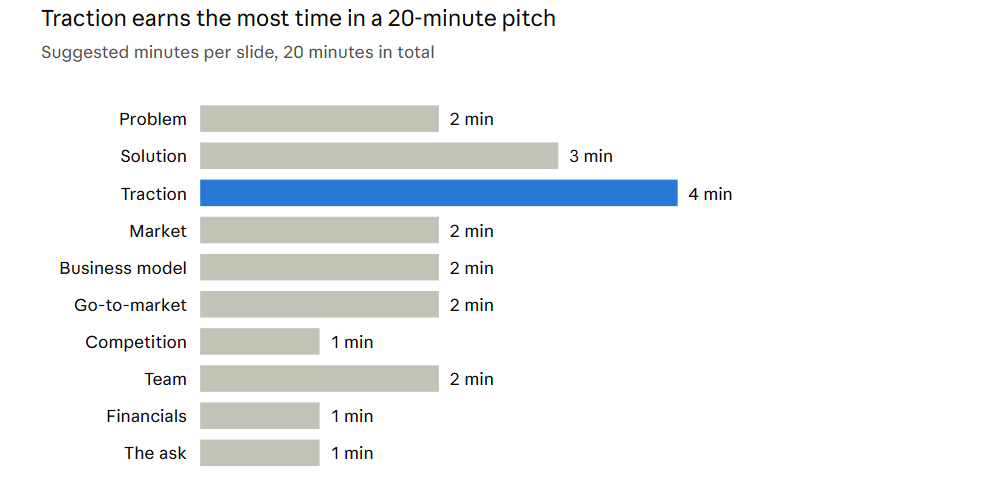
Use these minutes as a starting point and adjust them to your stage and sector.
How to Run the Pitch Conversation
Open with a one-sentence summary of what you do and for whom. Directness is valued in Australia, and a culture that is wary of boasting means exaggerated claims land badly. Let the numbers do the talking. Australian investors respond to quiet confidence backed by evidence rather than hype.
Keep the session conversational. Expect interruptions and treat them as buying signals rather than attacks. Australian investors often prefer a genuine discussion over a polished monologue, and the way you handle tough questions tells them how you will handle board meetings.
Prepare crisp answers to the questions that come up in almost every meeting: Why now? Why you? What happens if a large competitor copies you? What will you do with the money over the next 18 months? What does success look like at the next round?
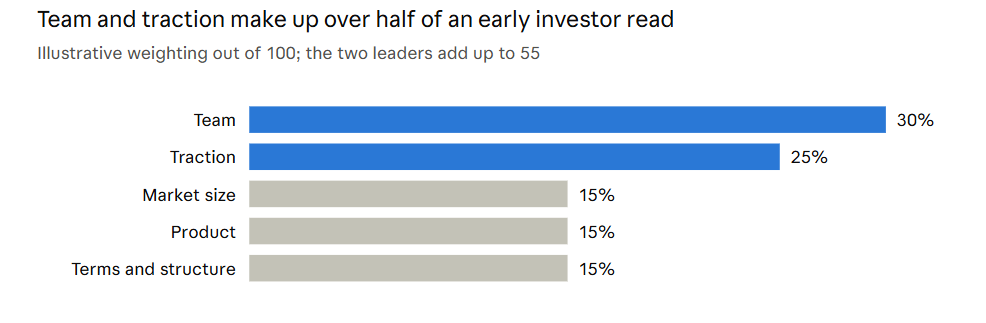
Weightings vary by fund and stage, so use this as a rough guide to where preparation pays off most.
Common Mistakes When Pitching Australian Investors
| Mistake | Why it hurts | Better approach |
|---|---|---|
| Inflated market size (“a $50 billion TAM”) | Destroys credibility instantly | Build a bottom-up estimate |
| Ignoring local context | Suggests you have not done your homework | Reference local customers, regulation and funds |
| No traction metrics | Leaves the biggest risk unaddressed | Share even early pilots and waitlist conversion |
| Cold, attachment-heavy outreach | Often goes unread | Seek a warm introduction and send a short teaser |
| A 30-slide deck | Hides the story | Keep to 10 slides and use an appendix for detail |
| Dodging risk questions | Signals weak judgement | Name the top risks and your mitigation plan |
Avoiding these errors puts you ahead of most founders approaching Australian investors.
Warm Introductions and Relationship Building
The Australian startup community is small and reputations travel fast. Introductions from founders, lawyers, accelerator alumni or angels consistently outperform cold emails. Funds such as Blackbird, Square Peg, AirTree and Folklore, and programs like Startmate, are well known to founders, so study their public content and portfolios, and check each fund’s current focus and cheque size before you reach out.
After a first meeting, follow up within 24 hours with a short thank-you and any requested materials. Many Australian investors also appreciate a concise monthly update, even before they invest, because it shows consistency and progress. Ideally, begin building relationships with Australian investors six to twelve months before you plan to raise, so the pitch feels like the next step in a conversation rather than a cold request.
Preparing Your Data Room
Have these ready before Australian investors ask:
- Pitch deck and a one-page summary
- Financial model with clear assumptions
- Cap table and any SAFEs, convertible notes or prior agreements
- Company registration, IP assignments and key contracts
- Customer references and a metrics dashboard
- ESOP details and founder vesting terms
Frequently Asked Questions
How long does it take to raise from Australian investors? Plan for roughly three to six months from first conversations to cash, and longer in a quiet market. Start earlier than you think you need to.
Do I need an Australian company? Many Australian investors prefer an Australian-incorporated entity or a clear plan to restructure, particularly because of local tax incentives. Get legal advice before you decide.
Should I pitch Sydney or Melbourne first? Choose based on sector fit and warm introductions, not geography alone.
Conclusion
Learning how to pitch Australian investors comes down to preparation, honesty and evidence. Know the fund, tell a focused story, show traction, and prove you can build a global company from an Australian base. Do that consistently and Australian investors will treat you as a serious partner rather than another name in the inbox.