

Saudi Arabia has become one of the most open large economies in the Gulf for overseas entrepreneurs. If you want to register a company in Saudi Arabia foreigner ownership rules are far friendlier than they were a decade ago: most sectors now allow full ownership without a local sponsor, and much of the process runs online. This guide walks through the full route, from choosing a legal structure to opening a bank account, so every Saudi Arabia foreigner founder or investor can plan with realistic numbers and timelines.
Regulations and fees change often, so treat the figures below as planning estimates and confirm them with the Ministry of Investment (MISA) or a licensed adviser before committing funds. This article is general information, not legal advice.
Why Foreign Founders Are Looking at Saudi Arabia
Vision 2030 is steering the Kingdom away from oil dependence and opening room for fintech, logistics, healthcare, tourism, renewable energy, and software. For a Saudi Arabia foreigner investor, the headline attraction is 100% ownership in most sectors with no obligation to take a Saudi partner. Giga-projects such as NEOM and Red Sea Global, a young and digitally active population, and growing venture funding add real demand. Every Saudi Arabia foreigner entrepreneur still has to weigh costs and localization rules, but the direction of policy is clearly pro-investment.
Who Can Register and What You Need First
Both individuals and companies can invest. In practice, overseas applicants usually fall into three groups: an existing foreign company opening a subsidiary or branch, an individual founder launching a startup, or a multinational placing a regional headquarters in the Kingdom. A Saudi Arabia foreigner applicant should prepare these basics before opening any application:
- Passport copies and identification for the proposed manager
- Parent company commercial registration, if applying as a company
- Recent audited financial statements of the parent company
- A short business plan describing your planned activities
- Notarized, legalized, and Arabic-translated copies of foreign documents
Incorrect translations and missing attestations are among the most frequent reasons applications get sent back, so allow time for this stage.
Choosing the Right Legal Structure
Your structure decides liability, governance, tax treatment, and how easily you can raise money. The table compares the main options.
| Structure | Best for | Key feature |
|---|---|---|
| Limited Liability Company (LLC) | SMEs, trading, services, startups | Limited liability; the most popular choice |
| Simplified Joint Stock Company (SJSC) | Venture-backed startups | Flexible share classes, easier fundraising |
| Branch of a foreign company | Established firms extending operations | Not a separate legal entity; parent stays liable |
| Joint Stock Company | Large or listing-bound businesses | Stricter governance and disclosure |
| Regional Headquarters (RHQ) | Multinationals serving the region | Relevant to government contracting eligibility |
| Entrepreneur license | Early-stage founders | Startup-focused MISA route |
For a typical Saudi Arabia foreigner starting small, an LLC is the usual first step. A Saudi Arabia foreigner planning to raise venture capital should look closely at the SJSC, because its share structure is built with investors in mind.
The 8 Steps to Register a Company in Saudi Arabia Foreigner Founders Follow
Step 1: Confirm Your Activity and Structure
Check that your business activity is open to foreign investment. A short negative list restricts a few sectors, and some activities need extra approval from sector regulators. Every Saudi Arabia foreigner applicant should review this list first, since it can save weeks of wasted effort.
Step 2: Obtain Your MISA License or Registration
The Ministry of Investment is the gatekeeper. Applications go through the Invest Saudi portal, where you upload corporate documents, audited financials, a business plan, and your proposed structure. With complete files, advisers commonly report issuance within roughly 3 to 10 business days. Several advisory firms also report that MISA issuance and renewal fees are suspended in 2026, whereas older guides quote SAR 12,000 for the first year, so verify the current position before budgeting. No Saudi Arabia foreigner company can move forward without this approval.
Step 3: Reserve a Trade Name
Reserve your name through the Ministry of Commerce. Branches normally use the parent company’s name, while subsidiaries have more freedom but must follow naming rules and avoid names that are misleading or already taken. These rules apply equally to every Saudi Arabia foreigner applicant.
Step 4: Draft the Articles of Association
The articles set out shareholders, capital, management powers, and profit distribution. Documentation is handled through the Ministry of Commerce’s digital channels. A Saudi Arabia foreigner shareholder who is abroad can usually sign through a properly attested power of attorney.
Step 5: Obtain the Commercial Registration
The commercial registration (CR) is your company’s legal identity. Once it is issued, your Saudi Arabia foreigner owned business legally exists and can begin the registrations that follow.
Step 6: Register With Tax, Labor, and Social Insurance Authorities
Enroll with ZATCA for tax and VAT, GOSI for social insurance, and Qiwa for labor services, and join the Chamber of Commerce. Premises-based businesses also need a municipal license. Many a Saudi Arabia foreigner founder underestimates how many small registrations sit after the CR.
Step 7: Open a Corporate Bank Account
Banks typically ask for the CR, articles, MISA license, and signatory passports, and some require an in-person visit or notarized authority. Capital rules depend on the Companies Law, your structure, and the sector, so confirm any capital expectation with MISA and your bank rather than assuming a fixed minimum. A Saudi Arabia foreigner opening an account remotely should expect extra verification.
Step 8: Arrange Visas, Iqama, and Hiring
Use Qiwa and Muqeem to issue work visas and residence permits. Remember the Nitaqat system, which sets Saudization targets based on your size and sector. Hiring Saudi nationals early also eases other approvals, and planning headcount in advance helps a Saudi Arabia foreigner avoid visa delays.
What It Costs: A Planning Table
Costs vary by structure, sector, and advisory support. Use these as indicative categories, not quotes.
| Cost item | Indicative figure | Comment |
|---|---|---|
| MISA license | SAR 0 (reported suspended in 2026); previously about SAR 12,000 in year one | Confirm current status |
| Commercial registration and Chamber membership | Low thousands of SAR | Varies by capital and activity |
| Notarization, translation, attestation | Hundreds to low thousands of SAR | Depends on document volume |
| Professional advisory package | Roughly SAR 55,000–75,000 for full setup, as quoted by some providers | Optional but common |
| Office or flexible workspace | Varies widely by city | Riyadh usually costs more than Jeddah or Dammam |
| Visas and iqama per employee | Government fees plus levies | Depends on role and sector |
A buffer of 15 to 20 percent for unexpected charges is sensible. A Saudi Arabia foreigner who works with a reputable adviser can usually avoid expensive rework.
Taxes and Compliance
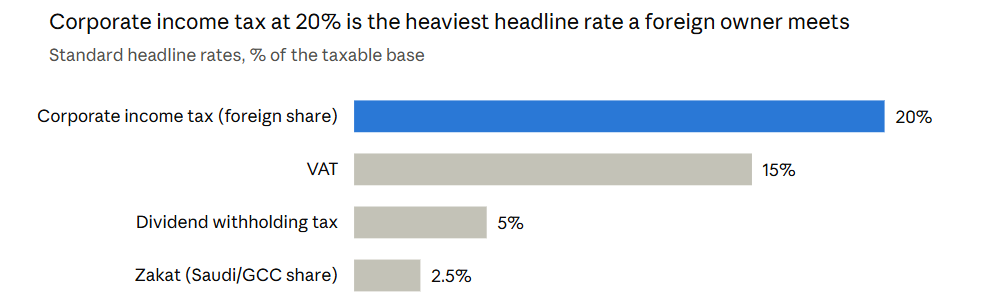
Profit is taxed according to who owns the company. The foreign-owned share pays corporate income tax, while the Saudi or GCC-owned share pays zakat. Rates below are standard headline figures; sector rules and treaties can change the outcome. The chart after the table compares the headline rates a Saudi Arabia foreigner will meet most often.
| Tax | Rate | Applies to |
|---|---|---|
| Corporate income tax | 20% | Foreign-owned share of profits |
| Zakat | 2.5% | Saudi and GCC-owned share |
| VAT | 15% | Taxable supplies |
| Withholding tax on dividends | 5% | Payments to non-residents |
Other withholding rates run from 5% to 20% depending on the payment type. E-invoicing is mandatory for VAT-registered businesses, so choose compatible accounting software early. A Saudi Arabia foreigner should keep clean books from day one, because tax authorities expect timely filings and complete records.
How Long Does It Take?
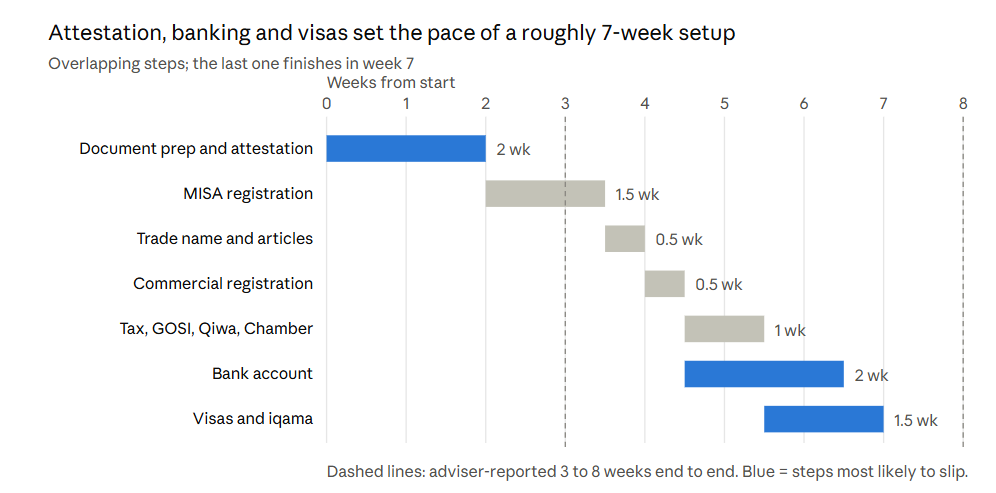
Most advisers estimate roughly 3 to 8 weeks from complete documents to an operating company. Delays usually come from document attestation, bank onboarding, and visa processing rather than the MISA step itself. The chart below shows an indicative timeline for a Saudi Arabia foreigner setting up an LLC. A well-organized Saudi Arabia foreigner team that prepares paperwork in parallel will finish faster than one that handles each step in sequence.
Common Mistakes to Avoid
- Skipping the negative list check before paying for anything
- Submitting documents that are not attested or properly translated
- Ignoring Saudization targets until the first hiring round
- Choosing a branch when a subsidiary would limit parent-company risk
- Underestimating how long bank onboarding takes
Every Saudi Arabia foreigner who avoids these five mistakes saves both money and momentum.
Tips for Founders and Investors
Investors comparing markets should look beyond the licensing process and study demand, talent, and competition in their chosen sector. Riyadh leads for corporate and government-linked work, Jeddah for trade and consumer businesses, and the Eastern Province for industry and energy. A Saudi Arabia foreigner investor should also consider a local adviser, a bilingual accountant, and a clear plan for Saudi hiring. For a Saudi Arabia foreigner founder with limited time on the ground, a trusted local representative can handle bank visits and government appointments.
Frequently Asked Questions
Can a Saudi Arabia foreigner own 100% of a company?
In most sectors, yes. A limited negative list still restricts or conditions certain activities, so confirm yours first.
Do I need to live in the Kingdom to start?
No. A Saudi Arabia foreigner can begin the process from abroad, though a manager will eventually need residency to operate day to day.
Is there a minimum capital requirement?
It depends on structure, activity, and sector regulator. Ask MISA and your bank before assuming any figure.
Is it worth the effort?
For many founders, yes. A Saudi Arabia foreigner gains access to the region’s largest economy, heavy government spending, and a fast-growing startup scene.
Does a company give residency to the owner?
Once the company is operating, it can sponsor visas and iqamas for eligible owners and staff, subject to Nitaqat and other rules.
Conclusion
The route to register a company in Saudi Arabia foreigner investors now follow is shorter, more digital, and more transparent than before. Pick the right structure, secure your MISA approval, complete the Ministry of Commerce steps, and finish with tax, labor, and banking registrations. Every Saudi Arabia foreigner who prepares documents carefully and budgets realistically stands a strong chance of launching smoothly. Confirm current fees and rules with official sources before you file, and treat this guide as your starting map rather than the final word for any Saudi Arabia foreigner venture.