

Foreign founders are watching the Gulf more closely than at any point in the last decade. Venture funding is growing, government agencies are backing new companies, and the Kingdom is openly courting people who will build businesses rather than simply fill jobs. If you have been researching Saudi Arabia entrepreneur visa requirements, this guide lays out the full picture: how the program works, who qualifies, what it costs, and what changed in 2026.
One clarification first. There is no product literally called a “startup visa.” Founders who want to settle in Saudi Arabia go through the Premium Residency program, which includes an Entrepreneur category split into two tiers. Everything below is built around that route.
How Premium Residency Works in Saudi Arabia
Premium Residency launched in 2019 as a paid, long-term residency product, often nicknamed the “Saudi Green Card.” In 2024, Saudi Arabia widened the program with five new categories: Special Talent, Gifted, Investor, Entrepreneur and Real Estate Owner. These sit beside the two original products, Limited Duration (SAR 100,000 per year, for up to five years) and Unlimited Duration (a one-off SAR 800,000).
Holders generally enjoy residency without a local sponsor, the freedom to move between employers or establishments, the ability to bring family members, and an exemption from the expatriate fees that normally apply to foreign residents and their dependents. For founders, independence is the real prize. Your right to live in the Kingdom is not tied to one employer, which matters when you are building a company in Saudi Arabia.
Table 1: Premium Residency products available in Saudi Arabia
| Product | Who it targets | Government cost |
|---|---|---|
| Special Talent | Specialist professionals | SAR 4,000 |
| Gifted | Talent in culture, sport and creative fields | SAR 4,000 |
| Investor | Business investors | SAR 4,000 |
| Entrepreneur | Startup founders | SAR 4,000 |
| Real Estate Owner | Property owners | SAR 4,000 |
| Limited Duration | Anyone preferring annual payments | SAR 100,000 per year, up to 5 years |
| Unlimited Duration | Long-term residents paying once | SAR 800,000 one-off |
The Two Entrepreneur Tiers Explained
The Entrepreneur residency is divided into two tiers, and Saudi Arabia sets very different bars for each.
Tier 1 suits early-stage founders launching a startup in Saudi Arabia. You need an entrepreneur license from the Ministry of Investment (MISA), at least SAR 400,000 in investment secured from an accredited entity, and a stake of no less than 20% in the startup. Residency is granted for five years and can be renewed once, provided you keep meeting the eligibility standards and spend at least 30 months in the Kingdom during the five-year term.
Tier 2 is built for scaled operators. You commit SAR 15 million and create at least 10 jobs in the first year and 10 or more in the second. In return, you receive permanent residency directly, without first passing through a fixed term.
Table 2: Entrepreneur Tier 1 vs Tier 2 in Saudi Arabia
| Feature | Tier 1 | Tier 2 |
|---|---|---|
| Target founder | Early-stage startup | Established or scaling business |
| Minimum investment | SAR 400,000 (accredited entity) | SAR 15 million |
| Founder stake | At least 20% | Confirm current rules |
| Job creation | Not specified | 10+ jobs in year one, 10+ in year two |
| Residency type | 5 years, renewable once | Permanent |
| Presence rule | 30 months in the Kingdom within 5 years | Confirm current rules |
| Government fee | SAR 4,000 | SAR 4,000 |
General Eligibility Rules for All Applicants
Beyond the category tests, applicants are generally expected to:
- Be at least 21 years old
- Hold a clean criminal record
- Show proof of financial solvency, such as bank statements or asset ownership
- Provide a valid passport and supporting company documents
Each Saudi Arabia entrepreneur residency application is reviewed against these basics, and the exact checklist can change. Confirm it on the official portal before you pay anything.
Saudi Arabia Entrepreneur Visa Requirements: Step-by-Step Application
- Pick your tier. Tier 1 fits most early-stage founders. Tier 2 only makes sense if you can fund SAR 15 million and commit to a hiring plan.
- Obtain the entrepreneur license. MISA issues it. Without this license, your residency file cannot move forward in Saudi Arabia.
- Secure accredited investment. For Tier 1, line up at least SAR 400,000 from an entity that meets the program’s accreditation standards.
- Confirm your ownership. Your personal share in the startup must be at least 20%. Check your cap table before you raise further rounds.
- Gather documents. Typically this means your passport, a criminal record certificate, proof of solvency, the license, funding evidence and ownership papers.
- Apply online. Create an account on the Premium Residency Center portal, complete the form, upload your documents and pay the SAR 4,000 fee.
- Track the decision. Processing time varies by nationality, category and document quality, so keep relocation plans flexible until approval arrives.
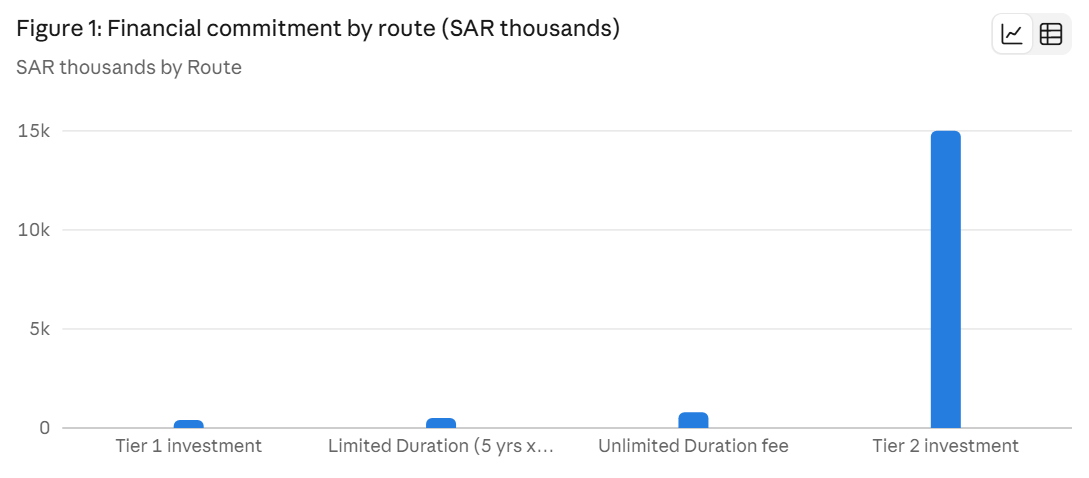
The chart below compares the financial commitment of each route. Note that the entrepreneur figures are capital you invest in your own company, while the Limited and Unlimited Duration figures are fees paid to the government. Founders comparing routes in Saudi Arabia should weigh them on that basis.
What Premium Residency Really Costs
Table 3: Estimated costs for a Tier 1 founder in Saudi Arabia
| Item | Amount | Notes |
|---|---|---|
| Premium Residency fee | SAR 4,000 (about USD 1,065) | One-time, entrepreneur category |
| Work permit via Qiwa | SAR 100 | Required when taking up employment (see below) |
| Startup funding requirement | SAR 400,000 minimum | Invested in your company, not a government fee |
| Legal, translation, attestation | Varies | Depends on your home country and adviser |
The biggest line item is rarely the government fee. It is the capital you must raise. For investors reading this, the structure is attractive because residency is tied to real money deployed and real jobs created inside Saudi Arabia.
2026 Update: New Work Permit Rule for Premium Residency Holders
In June 2026, Qiwa, the labor platform run by the Ministry of Human Resources and Social Development, confirmed that Premium Residency holders must obtain a dedicated work permit before starting employment, at a fee of SAR 100. Previously, holders could work without a separate permit. Saudi Arabia has effectively moved this group under the same work-authorization framework that applies to other foreign workers.
Advisory firms noted that guidance for existing holders, including any transition period, was still unclear when the change was reported. If you plan to take a paid role, including one in your own company, ask a licensed adviser whether a permit applies to your structure and check the current position on Qiwa. Changes like this show why anyone planning a move to Saudi Arabia should verify the rules close to the application date.
Why Founders and Investors Pay Attention
Between January 2024 and July 2025, more than 40,000 people applied for Premium Residency, and over 8,000 permits were issued in 2024 alone, according to one industry analysis. Most of those went to the exceptional-competence and talent categories, so entrepreneur numbers are smaller, but the demand shows how seriously the program is being used.
The scheme also supports the Kingdom’s Vision 2030 push to diversify beyond oil, which is why accelerators, funds and startup support programs keep expanding across Saudi Arabia. Investors benefit as well. A founder who has qualified through the entrepreneur track has already cleared licensing and funding checks, which is a helpful signal when you evaluate startups in Saudi Arabia.
Common Mistakes to Avoid
- Letting your stake drop below 20%. Plan fundraising so Tier 1 ownership stays intact.
- Using non-accredited funding. Money from sources outside the program’s standards may not count toward the SAR 400,000 threshold.
- Ignoring the presence rule. Spending too little time in the Kingdom can jeopardize renewal.
- Assuming the rules in Saudi Arabia never change. The June 2026 work permit update is proof they do.
- Trusting guaranteed-approval promises. Decisions in Saudi Arabia rest with the authorities, not with agents.
Frequently Asked Questions
Is there a separate startup visa in Saudi Arabia?
No. The entrepreneur route sits inside the Premium Residency program.
How much does the Saudi Arabia entrepreneur residency cost?
The government fee is a one-time SAR 4,000 (about USD 1,065). You must also meet the investment threshold for your tier.
Can I bring my family?
Premium Residency offers family sponsorship options depending on the category. Check the current documentation requirements for yours.
Can I get permanent residency in Saudi Arabia?
Yes, directly through Tier 2 if you meet the SAR 15 million and job-creation conditions.
Do Premium Residency holders in Saudi Arabia need a work permit?
Since June 2026, yes. A dedicated permit is required through Qiwa at SAR 100 before you start employment.