
Getting your name into the right headlines can change a young company’s trajectory. One well-placed feature can bring investor emails, strong candidates and first customers within days. But Australia is a small market with a handful of outlets that really matter, so a scattershot approach wastes everyone’s time. This guide is an Australian Startup media list built for founders who want to know who covers what, how editors prefer to be approached, and where a pitch is most likely to land.
Whether you are raising a seed round in Melbourne or launching a SaaS product from Perth, understanding the Australian Startup media landscape helps you choose a few well-matched targets instead of blasting fifty inboxes. Below you will find outlet profiles, comparison tables, two charts and a repeatable pitching process.
Why Australian Startup media Deserves a Strategy
Australia’s tech and venture scene is concentrated in Sydney and Melbourne, with growing hubs in Brisbane, Adelaide and Perth. Journalists covering it tend to know each other, follow the same investors and read the same newsletters. That concentration cuts both ways. A strong story spreads quickly between reporters, but a sloppy pitch is remembered just as long.
Three reasons make a deliberate approach worthwhile:
- Investor visibility: Venture partners and angel groups read Australian Startup media daily, and funding announcements often turn into deal-flow leads.
- Talent attraction: Candidates research employers through press coverage before they apply.
- Credibility: Third-party coverage carries more weight than anything published on your own site.
Global tech publications rarely cover Australian seed rounds unless the numbers are unusual, so homegrown outlets are your realistic first step. Treat Australian Startup media relationships like investor relationships: built over time, not in a single email.
The Australian Startup media List at a Glance
The table below summarises the outlets covered in this guide. Scores are our own editorial assessment of how receptive each outlet typically is to early-stage founder pitches (10 is most accessible). They are not published audience figures.
| Outlet | Primary focus | Best for | Pitch-fit score |
|---|---|---|---|
| Startup Daily | Startups, venture, tech | Funding news, launches | 9 |
| SmartCompany | SME and growth business | Case studies, lessons | 8 |
| Business Insider Australia | Business and tech news | Data-led, trending stories | 7 |
| Anthill | Innovation, entrepreneurship | Founder profiles | 7 |
| Mumbrella | Marketing, media, adtech | Martech and adtech | 6 |
| Inside Retail | Retail and ecommerce | Retail tech, consumer brands | 6 |
| Which-50 / iTnews / CRN | Enterprise technology | B2B SaaS, cybersecurity | 6 |
| Stockhead | ASX small caps | Listed or pre-IPO companies | 5 |
| Australian Financial Review | Deals, finance, markets | Large raises, exclusives | 4 |
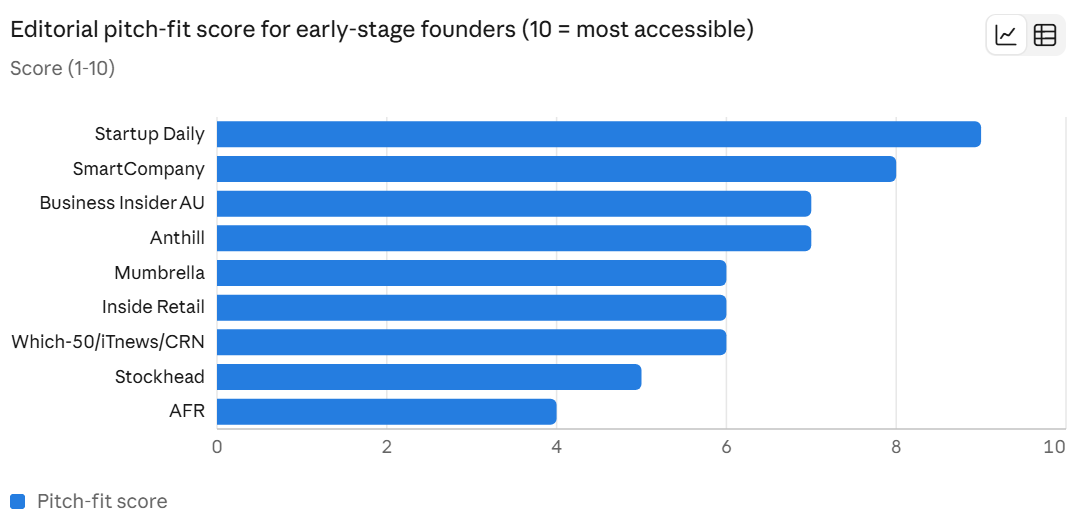
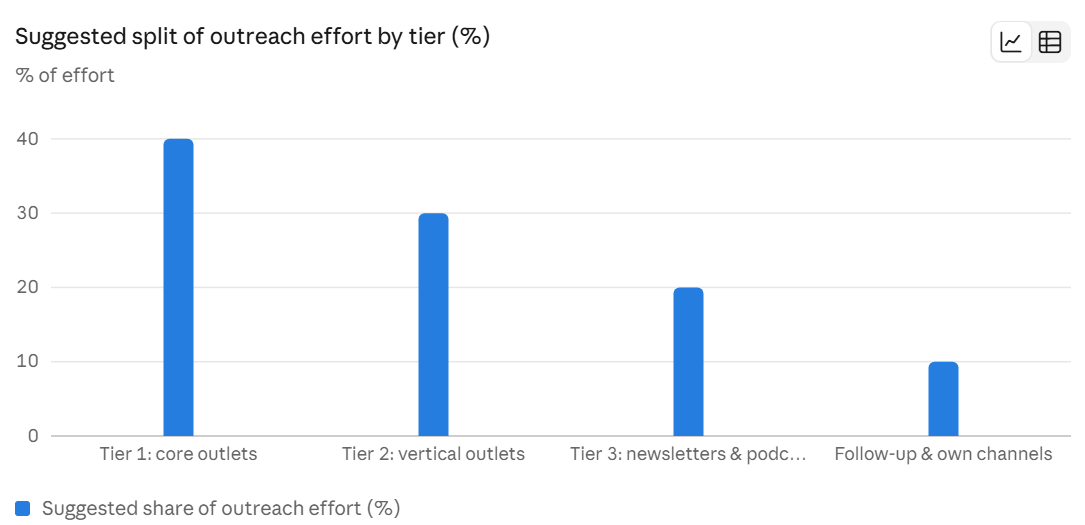
The first chart above shows how accessible each outlet tends to be, and the second chart, which I’ll come back to in the effort section, suggests how to split your time.
Tier 1: Core Startup and Business Outlets
Every Australian Startup media plan should begin with these four.
Startup Daily. Within the Australian Startup media world, this is the most obvious first stop. It reports on funding rounds, product launches, accelerator cohorts and ecosystem moves. Editors handle heavy volume, so lead with the news in one sentence, add the round size or growth number, and link a clean media folder.
SmartCompany. Aimed at small and growing businesses, it favours practical lessons: how a founder solved a hiring problem, scaled a channel or survived a downturn. Opinion pieces and case studies often work better here than pure funding news.
Australian Financial Review. The AFR sits near the top of the Australian Startup media pyramid for deal-driven stories. It prefers larger raises, valuation angles and market-moving news, and exclusives are prized. Treat it as a goal for Series A and beyond rather than a first pitch.
Business Insider Australia. Strong on trending, shareable business and tech stories. Data-backed angles, such as a survey of local founders or a market snapshot, travel well here.
Tier 2: Specialist and Vertical Publications
Vertical outlets reward founders who know their niche. The best Australian Startup media targets in this tier depend on your sector.
- Anthill: Long-form profiles on innovation and entrepreneurship, ideal for founder stories with a clear arc.
- Mumbrella: Marketing, media and adtech, suited to martech and creator-economy startups.
- Inside Retail: Retail and ecommerce technology, logistics and consumer brands.
- Stockhead: ASX small-cap coverage, relevant if you are listed or planning to be.
- Which-50, iTnews and CRN: Enterprise and B2B technology, suited to SaaS, cybersecurity and infrastructure companies selling to businesses.
Tier 3: Newsletters, Podcasts and Community Channels
Newsletters and podcasts are a growing part of the Australian Startup media mix. Venture firm newsletters, accelerator bulletins, founder podcasts and ecosystem bodies such as StartupAus and state innovation hubs often welcome community news. They reach a smaller audience, but the readers are highly relevant, and a mention here can lead to a conversation with a bigger outlet later.
Matching Australian Startup media to Your Funding Stage
Different stages call for different stories. The table below shows where to aim first.
| Stage | Best targets | Story angle |
|---|---|---|
| Pre-seed / seed | Startup Daily, SmartCompany, newsletters | Founder story, early traction, launch |
| Series A | Startup Daily, Business Insider Australia, vertical outlets | Growth metrics, hiring, market gap |
| Series B and beyond | AFR, vertical trade press | Valuation, expansion, sector impact |
| IPO preparation | AFR, Stockhead | Financial performance, governance, market thesis |
Matching the stage to the outlet keeps your Australian Startup media outreach credible and saves editors from stories that do not fit their beat.
How to Divide Your Outreach Effort
The second chart above shows a sensible split of effort across Australian Startup media tiers. Spend the largest share on Tier 1 and Tier 2, where one placement can move the needle, and keep a smaller share for newsletters, podcasts and follow-ups. Adjust it to your sector. A retail brand might shift more time to Tier 2, while a deep-tech company might lean on enterprise titles.
How to Pitch Australian Startup media Journalists
- Build a short target list. Choose ten reporters whose recent stories match your sector, not a hundred names from a database.
- Read before you write. Reference a recent article they wrote and explain why your news fits their beat.
- Lead with the news. Put what happened, the key number and why it matters in the first two sentences.
- Offer an exclusive. Giving one outlet from your Australian Startup media list a first look usually earns more attention than a simultaneous blast.
- Make it easy. Include a founder headshot, logo, one-page fact sheet and a ready-to-use quote.
- Follow up once. A single polite reminder after three to four working days is enough.
| Pitch element | What to include | Ideal length |
|---|---|---|
| Subject line | News plus one specific detail | Under 10 words |
| Opening | The announcement and key number | 2 sentences |
| Context | Why it matters to Australian readers | 2-3 sentences |
| Proof | Traction, customers, investors | 1-2 sentences |
| Assets | Link to media folder | 1 line |
| Close | Availability for interview | 1 sentence |
Timing and Follow-Up
Most Australian Startup media editors plan their day in the morning, so mid-week mornings in Sydney or Melbourne time tend to work well. Avoid Friday afternoons and major public holidays. For embargoed funding news, agree the release time in writing and confirm it the day before.
Common Mistakes When Approaching Australian Startup media
- Sending a generic press release to every address at once.
- Pitching without a clear, verifiable number or milestone.
- Forgetting the local angle that Australian Startup media audiences care about.
- Following up daily, which quickly turns editors against you.
- Exaggerating claims, which damages trust far longer than a missed placement.
Measuring Results
Track every placement from your Australian Startup media campaign so you can see what actually works.
| Metric | Why it matters | How to track |
|---|---|---|
| Referral traffic | Shows reader interest | Analytics with UTM-tagged links |
| Investor and partner enquiries | Shows commercial impact | Note the source in your CRM |
| Backlinks | Adds SEO value | Backlink checker tools |
| Branded search | Shows growing awareness | Search Console |
Building a Long-Term Relationship with the Australian Startup media
The founders who appear repeatedly in the Australian Startup media are rarely those with the biggest budgets. They respond quickly, share honest numbers and help reporters with background even when there is nothing to promote. Offer commentary on industry news, share anonymised data and introduce reporters to customers who can speak on the record.
Over time this makes you a trusted source, which is the strongest position in the Australian Startup media ecosystem. Reporters begin to come to you. Keep a simple log of every conversation so your approach to Australian Startup media contacts stays personal and consistent.
Frequently Asked Questions
How many outlets should I pitch at once? Start with three to five well-matched targets from the Australian Startup media list rather than everyone.
Do I need a PR agency? Not at the beginning. Many founders land early coverage themselves. An agency helps when you need ongoing Australian Startup media relationships across several sectors.
How long does coverage take? Funding news can run within days, while features can take weeks. Plan for the real Australian Startup media cycle, not the one you hope for.
Conclusion
A focused Australian Startup media list beats a long one. Start with Startup Daily and SmartCompany, add a vertical outlet that matches your sector, and aim for the AFR once your numbers justify it. Keep every pitch short, local and backed by evidence.
Use the tables above as a working template: copy the outlet list into a spreadsheet, add journalist names and track each pitch. Done consistently, your Australian Startup media outreach will compound into investor trust, customer awareness and hiring strength.
Ready to begin? Pick your three best targets today, draft one exclusive pitch and send it. The Australian Startup media ecosystem is small, welcoming to good stories and always looking for the next founder worth writing about. Strong preparation turns a cold email into the start of a long Australian Startup media relationship.