The startup ecosystem down under has moved well past its “emerging market” phase. With Canva now valued near US$32 billion, Atlassian trading as a public company worth more than US$43 billion, and fintech unicorn Airwallex sitting around US$5.6 billion, the country has proven it can build category-defining technology companies from Sydney, Melbourne and beyond. For anyone researching the Australia startup accelerators list for 2026, or trying to work out which fund actually writes checks at their stage, this guide breaks down the landscape end to end: accelerators, incubators, venture capital firms, funding benchmarks, and how to choose the right partner for your stage.
Whether you are a first-time founder building a pitch deck or an investor scanning the market for deal flow, the startup scene here now spans capital cities and regional hubs alike, backed by a growing pool of local and international capital. Compared to a decade ago, when most early-stage capital and mentorship sat almost entirely in Sydney, today’s landscape is more evenly distributed, more specialised by sector, and considerably better funded.
Why the Australia Startup Ecosystem Is Growing in 2026
Australia startup funding reached new highs heading into 2026. Local startups attracted roughly A$5.4 billion in capital during 2025, and the broader venture capital and private equity industry in the country now manages more than A$65 billion in assets under management, deploying around A$5 billion annually across pre-seed through growth-stage deals. Sydney remains the largest hub for capital and talent, with Melbourne and Brisbane growing quickly as secondary centres.
Government-backed programs, university accelerators, corporate innovation labs and independent VC funds have all expanded their presence, which means an Australia startup founder today has more entry points into funding than at almost any point in the country’s history. According to ecosystem tracking data, Australia is now home to roughly 249 active accelerators and incubators, spanning fintech, deep tech, health tech, climate tech and AI-first startups.
Two structural shifts explain much of this growth. First, corporate Australia has become a genuine source of venture capital rather than just a customer base — banks, telcos and insurers now run internal venture-building units, sourcing deal flow the way a traditional fund would. Second, the success of a handful of global companies with Australian roots, particularly Canva and Atlassian, has convinced a new generation of engineers and product leaders to leave big tech roles and start companies of their own, feeding a steady pipeline of applicants into every accelerator and incubator on this list.
Top Australia Startup Accelerators List for 2026
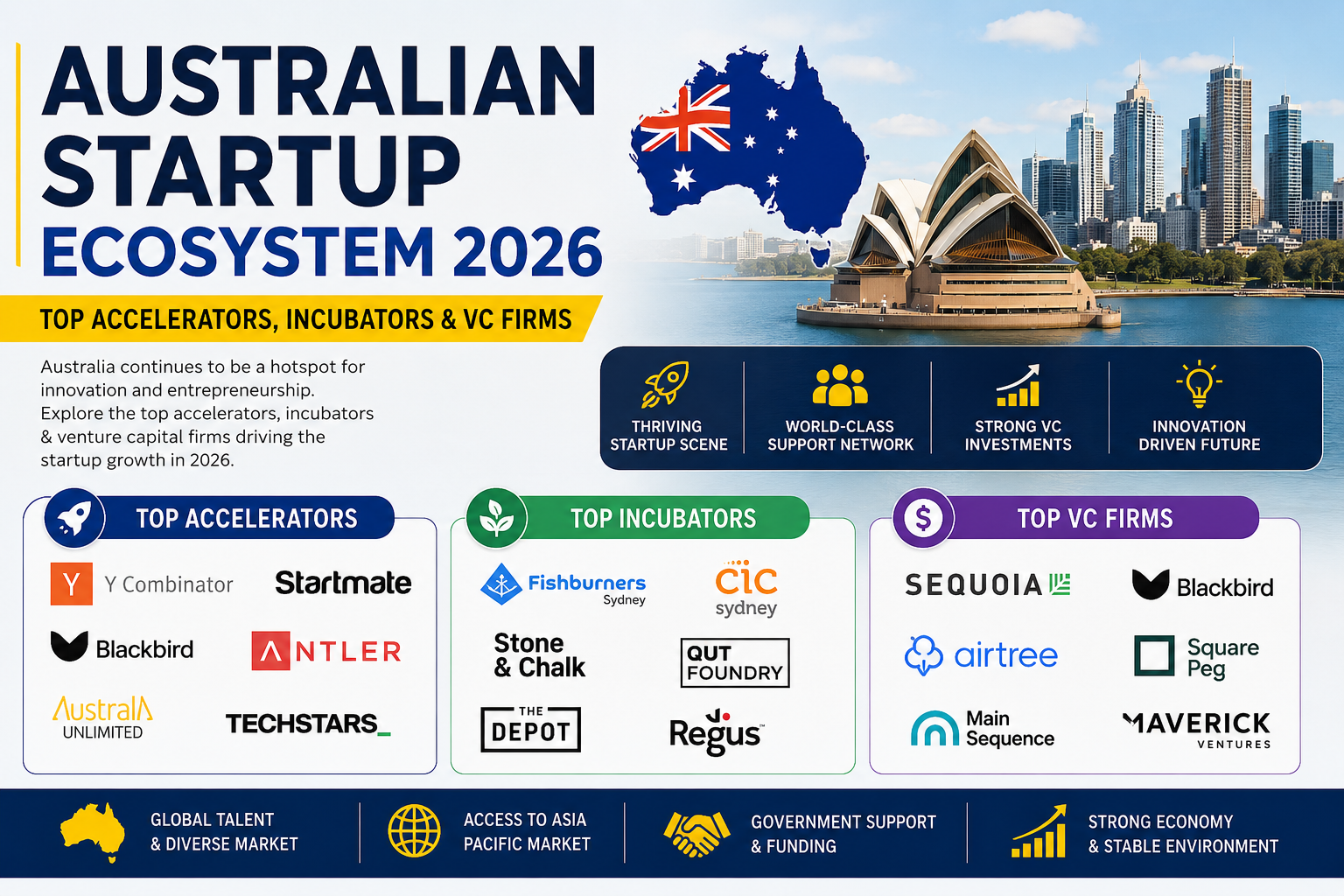
Choosing the right accelerator is often the first major decision an Australia startup founder makes, since it can shape valuation, equity structure and access to follow-on investors. Below is our full accelerators list for 2026, covering equity and non-equity programs across the country, from national generalist cohorts to city-specific and sector-specific tracks.
| Accelerator | Location | Focus | Typical Terms |
|---|---|---|---|
| Startmate | Sydney / Melbourne (national) | Generalist, SaaS, deep tech | ~A$120,000 at A$1.5M post-money for ~8% equity, 12-week program |
| Google for Startups Accelerator: AI First | Sydney & Melbourne | AI & machine learning, Seed–Series A | Equity-free, up to A$350,000 in Google Cloud credits, 10-week cohort, 10–15 startups |
| Melbourne Accelerator Program (MAP) | Melbourne | Generalist, university-linked | Non-equity, up to A$20,000 in support |
| Techstars Tech Central Sydney | Sydney (NSW Government-backed) | Generalist, enterprise tech | Seed-stage investment plus mentorship network |
| Startupbootcamp Australia | Multiple cities | Fintech, industry-specific tracks | Part of a global accelerator network, equity-based |
| BlueChilli | Sydney (with Singapore office) | Technical/advisory partner for non-technical founders | Program and terms vary by cohort and partner |
| Founder Institute (Australia chapters) | Multiple cities | Pre-seed, generalist | Structured part-time curriculum, modest equity stake |
Every entry on this Australia startup accelerators list was chosen based on active 2026 cohorts, funding track record, and the strength of their mentor and alumni networks. Leading programs are competitive: some report acceptance rates below 5%, and standard 2026 equity terms typically land between A$75,000 and A$120,000 for the stake taken.
What a Good Accelerator Actually Gives You
- Capital: Either a direct cheque (equity or non-equity) or non-dilutive credits, like Google Cloud’s grant to AI-first cohorts.
- Structured mentorship: Access to operators and investors who have built and exited companies in the same sector.
- Investor introductions: Demo days and warm introductions to the VC firms covered later in this guide.
- Peer network: A cohort of founders solving similar problems at the same stage, which often outlasts the program itself.
Leading Incubators in the Australia Startup Landscape
Incubators differ from accelerators in that they tend to run longer, take less (or no) equity, and focus more on validation than rapid scaling. University-affiliated incubators also play a major role in the Australia startup landscape, giving researchers and student founders a path from lab or classroom to commercial product.
| Incubator | Affiliation | What It Offers |
|---|---|---|
| UNSW 10x | University of New South Wales | Cohort-based program for student and alumni founders, structured mentoring |
| Stone & Chalk | Independent, fintech-focused | Co-working, corporate partnerships, sector-specific programming |
| LaunchVic-affiliated programs | Victorian State Government | Grants and co-funded incubation programs across Melbourne and regional Victoria |
| x15ventures | Corporate venture builder (bank-backed) | Builds and incubates startups internally, then spins them out with funding |
These programs matter because not every young company is ready for a 10- or 12-week sprint. Deep tech, biotech and hardware companies in particular often need the longer runway an incubator provides before they are ready for accelerator-style intensity or VC due diligence. Skipping this step and jumping straight into a fast-paced accelerator can leave founders under-prepared for the fundraising conversations that follow.
Top VC Firms Backing the Australia Startup Market
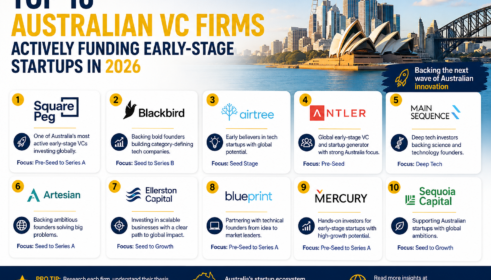
Once a company has traction, the next step is usually institutional capital. These funds represent the backbone of Australia startup investing, and most operate across several stages rather than sticking to one. Unlike some overseas markets where seed and growth investing are handled by entirely separate firms, several of the funds below — Blackbird and AirTree in particular — will follow a company all the way from a pre-seed cheque to a pre-IPO round, which gives founders continuity of relationship as the business scales.
| VC Firm | Stage Focus | Sector Strength | Notable Portfolio |
|---|---|---|---|
| Blackbird Ventures | Pre-seed to IPO | Generalist, software, deep tech | Canva, SafetyCulture, Zoox |
| AirTree Ventures | Seed to growth | SaaS, fintech, marketplaces | Canva, Linktree, Employment Hero |
| Square Peg Capital | Seed to Series A+ | Fintech, consumer, marketplaces | Canva, Fiverr, Airwallex |
| Main Sequence Ventures | Pre-seed to Series A | Deep tech, robotics, AI (CSIRO-backed) | Various CSIRO spin-outs |
| OneVentures | Seed to growth/IPO readiness | Health tech, life sciences, enterprise tech | Multiple ASX-listed graduates |
| Artesian | Pre-seed to Series A, plus a growth breakout fund | Climate, agrifood, AI, impact | 625+ portfolio companies |
| Tank Stream Ventures | Seed | Generalist tech | Early-stage Sydney-heavy portfolio |
The investor community backing Australia startup founders has matured significantly over the past few funding cycles. Where early-stage capital was once scarce outside Sydney, funds like Main Sequence Ventures and Artesian now actively source deep tech and climate deals nationally, while corporate-backed vehicles such as x15ventures and SEEK Investments add strategic, sector-specific capital to the mix. Family offices and international funds have also become more willing to co-invest alongside local leads once a company clears Series A.
How Much Capital Does an Australia Startup Typically Raise?
Funding bands vary by sector and traction, but the average Australia startup raises within fairly predictable bands depending on stage:
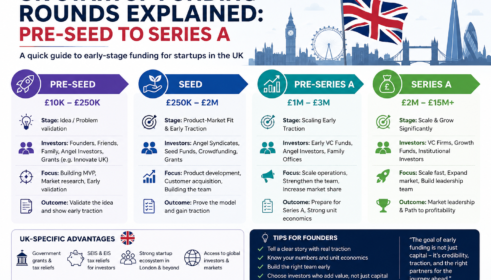
- Pre-seed: A$50,000 – A$500,000, usually from accelerators, angel networks, or programs like Antler and Startmate.
- Seed: A$500,000 – A$3 million, often from funds such as Tank Stream Ventures, Tidal Ventures or Folklore.
- Series A: A$5 million – A$15 million, typically led by Blackbird, AirTree or Square Peg Capital.
- Growth stage: Rounds scale well beyond this depending on revenue traction, with late-stage rounds increasingly involving international funds alongside local lead investors.
This is one reason the “Australia startup accelerators list” is such a common search: the accelerator stage is where most founders make their first real capital-raising decision, and getting the terms and program fit right early tends to compound through every later round.
How to Choose the Right Program for Your Australia Startup
With dozens of accelerators, incubators and VC firms competing for attention, picking the right one comes down to a few practical filters rather than brand recognition alone.
- Match your stage. Pre-revenue, idea-stage founders fit incubators or equity-free accelerators like Google for Startups AI First; founders with early traction are better suited to Startmate, Techstars or a direct seed round.
- Check sector fit. A deep tech or biotech founder should prioritise CSIRO-backed Main Sequence Ventures or a university incubator over a generalist fintech-focused program.
- Understand the real cost. Look past headline capital figures and model out the equity dilution, program fees, and relocation costs some cohorts require.
- Talk to alumni. Founders who have already gone through a program will tell you more about mentor quality and investor introductions than any marketing page will.
- Network warmly within the Australia startup community before applying. Warm introductions to accelerator partners or VC associates consistently outperform cold applications.
Here’s how a first-time founder should approach outreach in practice: build a short list of five to eight target programs, tailor your pitch to each one’s stated focus, and apply to accelerators and VC firms in parallel rather than sequentially, since accelerator selection often accelerates VC interest and vice versa. Keep a simple tracker of application deadlines, since most Australia startup programs run only one or two intakes per year and missing a window can cost you six months of momentum.
Final Thoughts
The Australia startup ecosystem in 2026 offers more pathways than ever: equity-free AI-focused cohorts, university incubators, sector-specific accelerators, and a deep bench of VC firms writing checks from pre-seed through to pre-IPO. Whether you’re bootstrapping or actively fundraising, this market rewards founders who research their options carefully, match their stage to the right program, and build genuine relationships across the ecosystem rather than treating applications as a numbers game. The founders who move fastest tend to be the ones who treat accelerator, incubator and VC research as an ongoing habit rather than a one-off task before a single application deadline — the landscape shifts often enough that a list compiled a year ago is already missing new entrants, closed programs, and updated terms.