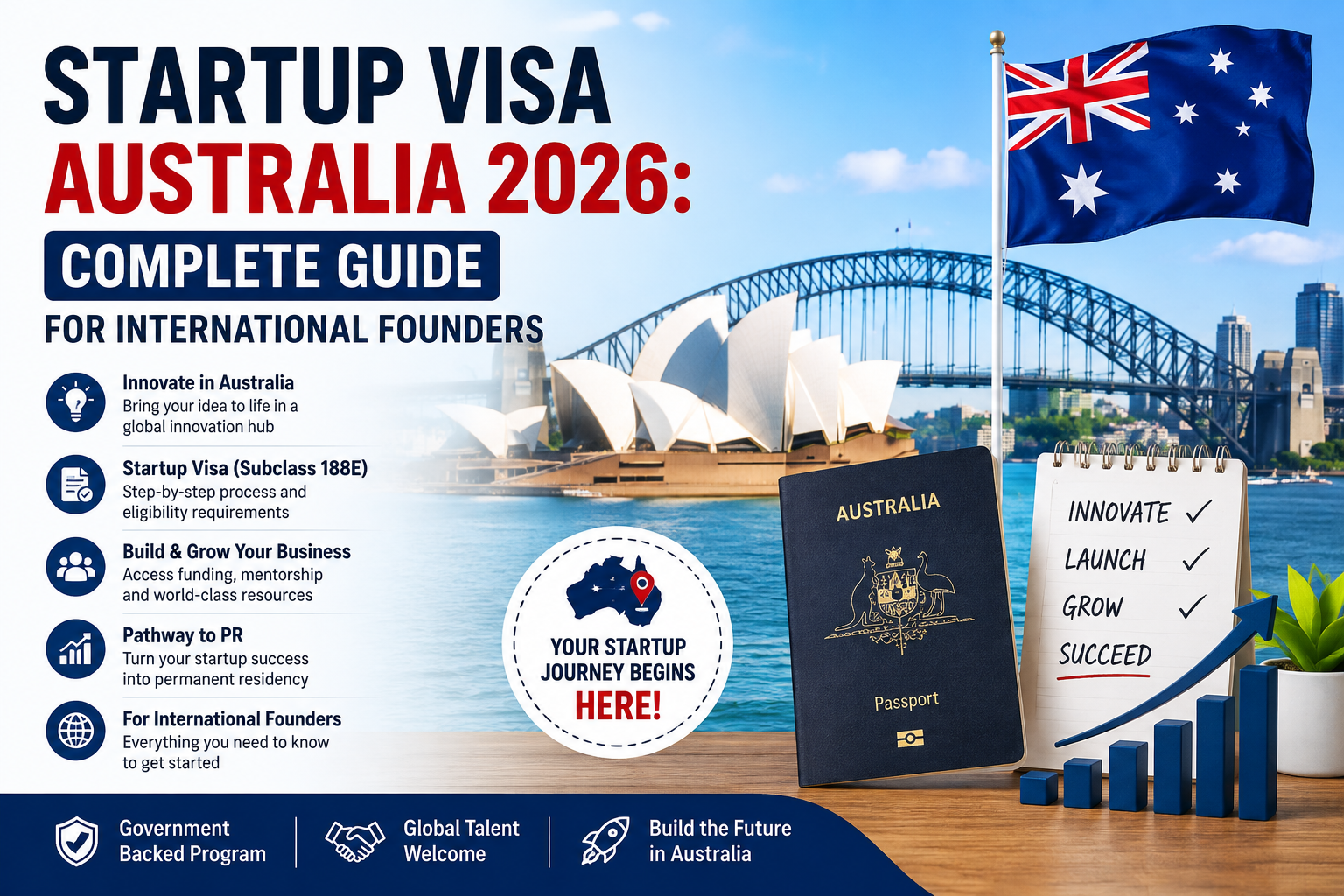
If you’re a founder or investor typing “Australia startup visa requirements” into Google, there’s something you need to know first: the visa most people mean when they say “Australia startup visa” doesn’t exist in its old form anymore. The Business Innovation and Investment visa (subclass 188), which many founders relied on for years, has been phased out and folded into a single, more selective pathway — the National Innovation Visa (NIV), subclass 858.
This guide breaks down exactly how the new system works, who qualifies, what the process looks like in 2026, and how founders and investors can position themselves for an invitation. Whether you’re bootstrapping a SaaS product, running a funded startup, or backing early-stage companies as an investor, this is the roadmap you need before you spend a dollar on an application.
Why the “Startup Visa” Changed
For years, Australia ran a handful of programs aimed at entrepreneurs: the Business Innovation and Investment visa, the Business Talent visa, and the Global Talent Independent program. Each had its own rules, its own investment thresholds, and its own paperwork.
In December 2024, the government scrapped that patchwork and replaced it with one unified, invitation-only visa: the National Innovation Visa. The goal was simple — stop rewarding people who could simply write a big enough cheque, and start rewarding people who could actually build things Australia needs: technology, research breakthroughs, high-growth companies, and capital that flows into innovative ventures rather than passive assets like real estate.
That shift matters enormously for founders. It means:
- There’s no fixed minimum investment amount you need to “buy” your way in.
- A polished pitch deck and a real track record now matter more than your bank balance.
- Competition is tighter, because the visa is capped and demand is high.
What the National Innovation Visa Actually Is
The NIV (subclass 858) is a permanent residency visa — not a temporary one. If you’re invited and approved, you and your family receive PR from day one, with immediate access to Medicare, the right to work and study freely, and a path to citizenship down the line.
It’s built around four broad talent categories:
- Entrepreneurs and business innovators — founders of scalable, high-growth businesses; people who’ve commercialised new technology; leaders with measurable global market traction.
- Innovative investors — individuals with a demonstrated history of backing successful innovative ventures, not just parking money in low-risk assets.
- Researchers and academics — those with a strong publication record, grant funding, or leadership of significant research projects.
- Exceptional talent in the arts and sport — internationally recognised achievers outside the tech and research world.
For most people researching startup visas, categories one and two are the relevant lanes.
Unlike a traditional skilled visa, there’s no points test here. You don’t accumulate points for age, language proficiency, or years of experience. Instead, the Department of Home Affairs is looking for evidence that you’re already operating at an exceptional level in your field — and that bringing you to Australia will generate real economic or innovation benefit.
Australia Startup Visa Requirements: What You Actually Need
Here’s where most guides get vague. Let’s get specific. To be considered for a National Innovation Visa as a founder or investor, you generally need to demonstrate:
1. A genuine record of achievement. This isn’t about intentions — it’s about outcomes. Have you founded or co-founded a company that grew meaningfully? Raised capital from credible investors? Built a product with real users or revenue? Commercialised a patent or piece of technology? The bar is “exceptional and outstanding,” not simply “successful.”
2. Independent evidence, not self-description. Saying you’re a great founder isn’t enough. The Department wants third-party proof: media coverage, investor references, revenue figures, award nominations, patents, or customer contracts. Anything you can point to that didn’t come from your own mouth carries more weight.
3. A credible nominator. Before you can lodge a full application (though not always before submitting an initial Expression of Interest), you typically need to be nominated by someone with a genuine reputation in your field — an Australian citizen, permanent resident, eligible organisation, or in some cases a state or territory government agency. This nomination is submitted via a specific form and needs to explain, in concrete terms, why you’re exceptional.
4. A plan that benefits Australia, not just yourself. Home Affairs isn’t handing out residency as a lifestyle upgrade. Your Expression of Interest should articulate how your business or investment activity will create jobs, transfer knowledge, attract further capital, or strengthen a sector Australia has flagged as a priority.
5. Standard health and character checks. Like any Australian visa, you’ll need to pass medical examinations and provide police clearance certificates from countries you’ve lived in.
6. Functional English or a financial contribution. Applicants generally need to demonstrate functional English ability, or pay an additional visa charge in place of that requirement.
There’s no fixed age cutoff, but applicants under 18 or over 55 typically need to show a compelling case for why their contribution outweighs the usual age-related considerations.
Priority Sectors: Where Your Odds Improve
Not every founder is treated equally in the queue. The Department has organised invitations into a tiered priority system, and understanding it can meaningfully change your strategy.
- Highest priority goes to globally recognised experts — think recipients of major international awards or founders with standout global track records.
- Next priority goes to candidates nominated directly by a state, territory, or Commonwealth government agency.
- Then come applicants working in Tier One priority sectors, which currently include critical and emerging technologies (AI, robotics, quantum computing, cybersecurity), health industries, and renewable or low-emissions technology.
- Everyone else — including strong founders outside these sectors — sits in a lower, slower-moving queue.
If your startup touches AI, health tech, biotech, clean energy, or advanced manufacturing, lean into that positioning heavily in your Expression of Interest. If it doesn’t, you’re not disqualified — but you should expect a longer wait and need an even stronger evidence file to stand out.
The Application Process, Step by Step
Step 1: Self-assess honestly. Before investing time and legal fees, be brutally honest about whether your achievements meet an “exceptional and outstanding” bar, not just a “solid founder” bar.
Step 2: Secure a nominator. Identify someone with genuine standing in your industry — this could be an investor, an academic, an executive, or a government body — who is willing to formally back your application.
Step 3: Build your evidence file. Pull together everything that supports your case: incorporation documents, funding rounds, revenue and growth metrics, press coverage, patents, awards, customer or partnership agreements, and letters of support.
Step 4: Submit an Expression of Interest (EOI). This is done through the Department of Home Affairs’ online system. You’ll outline your achievements, your sector, and your case for why Australia benefits from your presence.
Step 5: Wait for an invitation. This is the step that trips people up. An EOI does not guarantee anything. Recent invitation rounds have seen only a small percentage of submitted EOIs result in an invitation — often in the single-digit percentages per quarter — which tells you how selective this pathway has become.
Step 6: Lodge your full application. If invited, you’ll need to move quickly, submit full documentation, complete health and character checks, and pay the relevant visa application charges.
Step 7: Receive your outcome. Successful applicants are granted permanent residency, along with their spouse and dependent children if included in the application.
Costs to Expect
Visa application charges for this pathway sit at the premium end compared to standard skilled visas, and they change periodically, so always confirm the current figure directly on the Department of Home Affairs website before budgeting. Beyond the government charge, most applicants also factor in costs for migration agent or immigration lawyer fees, document translation and certification, medical exams, and police clearance certificates from every country they’ve lived in for an extended period.
How Founders Can Strengthen Their Case
A few practical moves consistently separate strong applications from weak ones:
- Quantify everything. “Grew user base” means nothing. “Grew monthly active users from 4,000 to 85,000 in 18 months” tells a story.
- Get outside validation early. Press mentions, investor quotes, and industry award nominations all carry more weight than anything you write yourself.
- Target a Tier One sector narrative where genuinely true. Don’t force a fit that isn’t there, but if your technology has real applications in AI, health, or clean energy, make that connection explicit.
- Choose your nominator carefully. A nomination from someone with a thin professional profile can weaken an otherwise strong case. Seniority and relevance matter.
- Don’t rush the EOI. Given how selective invitations have become, a generic or rushed submission is a wasted shot. Treat it like a fundraising pitch, not a form to fill in.
Is This the Right Path for You?
The National Innovation Visa isn’t designed for every small business owner hoping to relocate to Australia. If you’re running a local café or a modest services business with no real innovation or scale component, this pathway likely isn’t a fit — and other skilled or business visa categories may serve you better. It’s built specifically for founders building scalable, exportable, technology-driven, or investment-attracting ventures, and for investors with a genuine track record of backing that kind of growth.
If that describes you, the opportunity is real: immediate permanent residency, no employer sponsorship, no fixed investment threshold, and a direct route into one of the world’s most stable innovation economies.
Final Thoughts
Australia’s approach to startup migration has matured. It’s no longer a checkbook exercise — it’s a merit-based system that rewards founders and investors who can prove real impact. That makes it harder to qualify for, but it also means the founders who do get through are joining a genuinely high-calibre cohort, with real access to Australia’s research institutions, investor networks, and government-backed innovation programs.
Before you begin, treat the Expression of Interest stage as seriously as you would a Series A pitch. Build your evidence file first, choose your nominator carefully, and align your story with the sectors Australia is actively prioritising. And because visa rules and fees are updated regularly, always cross-check the latest requirements on the official Department of Home Affairs website or with a registered migration agent before you apply.