
India’s startup engine has become one of the most closely watched in the world, and a growing number of its founders are no longer content with domestic growth alone. The United Kingdom — with its English-speaking business culture, deep capital markets, and status as a gateway to Europe and the Commonwealth — has become one of the most natural destinations for Indian founders who want to go global. If you are searching for a practical way to expand your startup to the UK from India, this guide walks through everything from market validation to visas, funding, and compliance.
Why the UK Is a Smart Second Market for Indian Startups
Before diving into logistics, it helps to understand why so many Indian companies choose the UK over other Western markets.
1. Language and cultural familiarity. English is the working language of both countries, and decades of trade, education, and diaspora ties mean Indian founders rarely face the steep cultural learning curve they might in, say, Germany or Japan.
2. A large Indian diaspora and business network. The UK is home to one of the largest Indian communities outside India, spanning finance, technology, healthcare, and retail. This network often becomes an early customer base, hiring pool, and source of introductions to investors.
3. Access to a sophisticated capital market. London remains one of the top three global financial centres, with a dense concentration of venture capital funds, angel networks, and family offices actively looking for scalable, tech-enabled businesses.
4. A gateway to Europe and the Commonwealth. A UK entity gives Indian companies credibility and legal footing that can make it easier to court customers and partners across the EU, the Gulf, and other Commonwealth markets.
5. Founder-friendly government support. Successive UK governments have built specific visa routes, tax reliefs, and grant programmes aimed squarely at attracting overseas entrepreneurs — something few other major economies do as deliberately.
Step 1: Validate Product-Market Fit Before You Move
The single biggest mistake Indian founders make when expanding abroad is assuming that what works in Bengaluru or Mumbai will automatically resonate in London or Manchester. Before committing capital, spend time understanding:
- Regulatory differences in your sector (fintech, healthtech, and edtech are especially tightly regulated in the UK).
- Pricing expectations — UK B2B buyers often expect GBP pricing with clear VAT treatment, and B2C customers are highly price-sensitive around delivery timelines and returns.
- Competitive landscape — many categories that feel underserved in India are already crowded in the UK.
- Local pain points — run structured customer discovery calls with UK-based prospects before building region-specific features.
A short reconnaissance trip, a few weeks of remote customer interviews, or a pilot partnership with a UK distributor can save months of costly missteps later.
Step 2: Choose the Right Legal Structure
Indian founders generally have three structural options when entering the UK:
Private Limited Company (Ltd). This is by far the most common route. Registering a UK Ltd company through Companies House is inexpensive and can be completed online within a day, provided you have a UK-registered office address (a virtual office service works for this) and at least one director. A UK Ltd gives you a distinct legal entity, limited liability, and the credibility that many UK customers, banks, and investors expect.
Branch or place of business. If your Indian company wants to operate in the UK without creating a separate legal entity, you can register an overseas company branch. This route is less common for early-stage startups because it ties UK liabilities back to the Indian parent company.
Group structure (Indian parent + UK subsidiary). Fast-growing startups often set up the UK entity as a wholly owned subsidiary of the Indian company. This structure is popular with investors because it keeps IP and cap table matters clean in one jurisdiction while allowing local UK operations, hiring, and revenue recognition in another. It is also the structure most relevant to the Global Business Mobility visa route described below.
Whichever structure you choose, get advice from an accountant familiar with cross-border India–UK company structures, since transfer pricing and intercompany agreements need to be handled correctly from day one to avoid tax complications later.
Step 3: Open a UK Business Bank Account
A UK bank account is essential for collecting revenue, paying local staff, and building financial credibility. Traditional banks such as Barclays, HSBC, and NatWest offer business accounts but often require in-person verification and can take weeks for non-resident founders. Digital-first providers like Wise Business, Revolut Business, and Airwallex have become popular alternatives for early-stage founders because they allow account opening remotely, support multi-currency transactions (useful for GBP–INR flows), and integrate well with accounting software such as Xero or QuickBooks.
Step 4: Understand Your Visa Options
This is where many Indian founders get stuck, so it deserves a detailed look. The route you need depends on whether you are moving to the UK personally to run the business, or simply expanding operations while staying based in India.
Innovator Founder Visa
This is the UK’s flagship route for entrepreneurs who want to relocate and personally run an innovative, scalable business. It replaced the older Innovator and Start-up visa categories in 2023, and a few details are worth knowing if you’re applying:
- There is no fixed minimum investment requirement — the old £50,000 threshold no longer applies for new applicants. What matters is that an approved endorsing body assesses your idea as new, innovative, viable, and scalable.
- The application happens in two stages: first you secure endorsement from a Home Office-approved endorsing body, then you submit the immigration application itself.
- You’ll need an English proficiency score at CEFR level B2 across all four skills, and proof of at least £1,270 in personal savings held for 28 consecutive days.
- The route leads to Indefinite Leave to Remain (permanent settlement) after just three years — notably faster than most other UK work visas.
- Endorsing bodies check in with you at the 12-month and 24-month marks to confirm your business is progressing against its milestones.
Global Business Mobility – Expansion Worker Route
If you already run a registered company in India and want to send yourself or a senior employee to establish a UK branch or subsidiary, this route is often a better fit than the Innovator Founder visa. It’s designed specifically for overseas businesses setting up a UK presence and doesn’t require the same endorsement process, though it does require the UK entity to have genuine trading activity within a set timeframe.
Global Talent Visa
For founders or technical leaders with a strong track record — recognised achievements in digital technology, academia, or the arts — this route offers a faster, more flexible path that doesn’t require a specific business plan or endorsement body, provided you can secure endorsement from a relevant UK body such as Tech Nation’s successor programmes.
Because immigration rules change frequently, always verify current fees, English-language requirements, and endorsing-body lists directly on GOV.UK or with a UK immigration solicitor before applying.
Step 5: Explore UK Funding and Tax-Advantaged Investment Schemes
One underrated advantage of the UK market is how deliberately it incentivises early-stage investment. Two schemes matter most for founders raising capital locally:
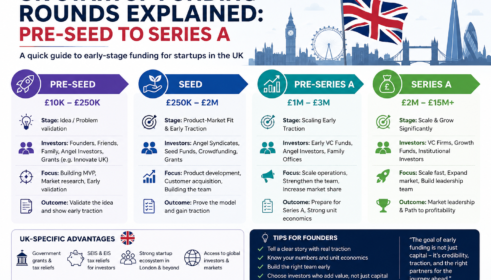
Seed Enterprise Investment Scheme (SEIS). Aimed at very early-stage companies, SEIS lets qualifying startups raise up to £250,000, while individual UK investors can invest up to £200,000 per year and claim substantial income tax relief. Because of this, many UK angel investors specifically look for SEIS-eligible companies, so structuring your funding round to qualify can make fundraising considerably easier.
Enterprise Investment Scheme (EIS). For slightly later-stage companies, EIS allows higher annual and lifetime fundraising limits, with generous income tax and capital gains reliefs for investors. Recent legislative changes have expanded the annual and lifetime limits companies can raise under EIS, particularly for “knowledge-intensive” businesses such as deep tech, biotech, and AI companies — a category many Indian tech startups are well positioned to qualify for.
Beyond these schemes, founders can also explore support from the British Business Bank, sector-specific accelerators (such as those focused on fintech, climate tech, or healthtech), and university-linked incubators in London, Manchester, Cambridge, and Edinburgh.
Step 6: Get Tax and Compliance Fundamentals Right
Once your UK entity is trading, a few compliance basics are non-negotiable:
- Corporation Tax must be filed annually with HMRC on UK-sourced profits.
- VAT registration becomes mandatory once your UK taxable turnover crosses the current threshold, though many startups register voluntarily earlier to reclaim VAT on expenses.
- UK GDPR compliance is essential if you handle any UK customer or employee data — this includes clear privacy policies, data processing agreements, and, in many cases, a registered Data Protection Officer.
- PAYE and National Insurance obligations apply the moment you hire your first UK-based employee.
Engaging a UK-qualified accountant early avoids the common trap of discovering compliance gaps only after your first funding round or acquisition due diligence.
Step 7: Build Local Trust Before You Scale Marketing Spend
UK customers and partners tend to be cautious about newly arrived overseas brands. A few tactics consistently help Indian founders build credibility faster:
- Secure a handful of recognisable UK customer logos or case studies before scaling paid marketing.
- Localise your website and support content — UK spelling conventions, GBP pricing, and UK-specific contact details all signal legitimacy.
- Attend UK-focused industry events and founder communities rather than relying solely on remote outreach.
- Consider a UK-based advisor or non-executive director with local market credibility; many early-stage UK investors specifically value this.
Common Mistakes to Avoid
- Treating the UK as a smaller, easier version of the US market — the regulatory and cultural context is genuinely different.
- Delaying incorporation until after a customer is ready to sign, which often stalls deals since UK buyers frequently want a UK-registered counterparty.
- Underestimating how long visa and endorsement processes take — plan at least four to six months of runway before you need to physically relocate.
- Ignoring transfer pricing rules between the Indian parent and UK subsidiary, which can trigger tax complications in both countries if not documented properly from the start.
Final Thoughts
Expanding a startup from India to the UK is no longer a niche move reserved for late-stage companies — it’s an increasingly common and well-supported path, thanks to founder-friendly visa routes, generous investment incentives, and a market that shares much of India’s business language and rhythm. The founders who succeed are the ones who treat the UK as its own market with its own rules, rather than an extension of their home operations. With the right legal structure, visa strategy, and funding approach, the UK can become not just a second market, but a genuine springboard into Europe and beyond.