Starting a business is exciting, but the paperwork stage can feel like a maze. If you are a founder trying to register limited company UK authorities will recognise, or an overseas entrepreneur wondering how a UK company actually gets built from scratch, this guide walks through the entire process in plain English — no jargon, no guesswork.
By the end of this article you will understand exactly what a UK company is, which structure suits your situation, how much it costs, how long it takes, and what you must do once your UK company is live on the Companies House register.
Why Investors and Founders Both Care About a UK Company
The United Kingdom remains one of the fastest and cheapest places on earth to set up a company. Companies House, the government’s registrar, can approve a new UK company within 24 hours if the application is filed correctly online. That speed, combined with a stable legal system and a large pool of institutional investors, is exactly why so many founders — local and international — choose to register limited company UK structures rather than incorporate elsewhere.
Investors like a UK company for similarly practical reasons:
- Transparency – every UK company must file accounts and confirm its ownership, so due diligence is straightforward.
- Limited liability – shareholders in a UK company are only liable up to the value of their shares, protecting personal assets.
- Familiar legal framework – UK company law (mainly the Companies Act 2006) is well understood by lawyers and VCs worldwide.
- Tax treaties – a UK company can access an extensive network of double-taxation agreements, useful for cross-border founders.
| Reason to Choose a UK Company | Why It Matters to Founders | Why It Matters to Investors |
|---|---|---|
| Fast registration | Live within 24 hours online | Faster deal closing |
| Limited liability | Personal assets protected | Predictable risk exposure |
| Public register | Easy to verify legitimacy | Simple due diligence |
| Low setup cost | From £12 to register | Lower overhead per portfolio company |
| Global tax treaties | Easier international trading | Cleaner cross-border structuring |
Types of UK Company You Can Register
Not every UK company looks the same. Before you file anything with Companies House, decide which legal form actually fits your plans.
| Company Type | Best For | Liability | Shareholders | Typical Use Case |
|---|---|---|---|---|
| Private Company Limited by Shares (Ltd) | Most startups and SMEs | Limited to share value | 1+ | Standard trading UK company |
| Private Company Limited by Guarantee | Non-profits, clubs | Limited to guarantee amount | No shares issued | Charities, community projects |
| Public Limited Company (PLC) | Large businesses raising public capital | Limited to share value | 2+, min £50,000 capital | Stock exchange listings |
| Limited Liability Partnership (LLP) | Professional services | Limited per partner | 2+ partners | Law firms, consultancies |
For nearly every founder reading this, the private company limited by shares is the default choice, and it is what the rest of this guide focuses on when we talk about setting up a UK company.
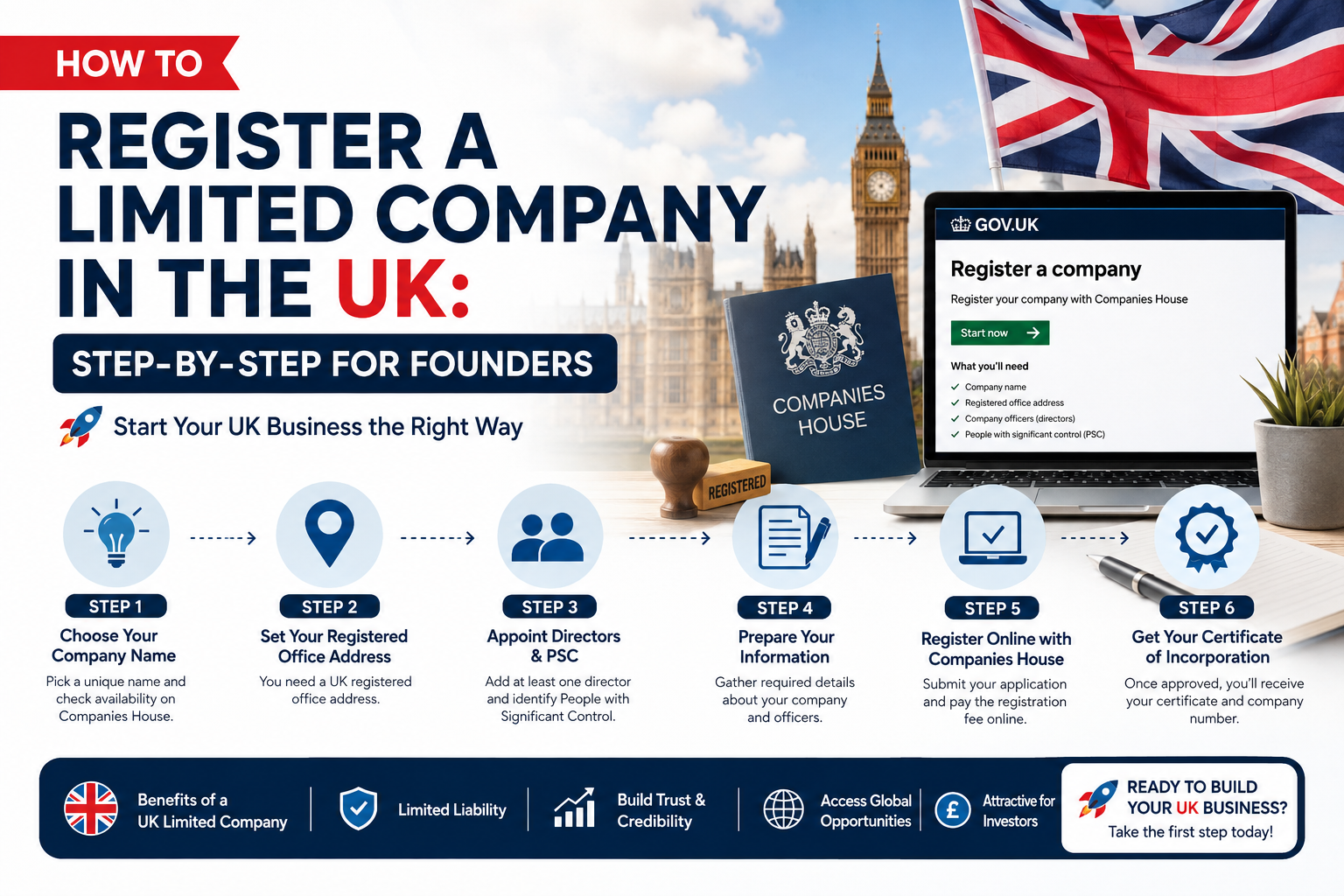
Step-by-Step: How to Register a Limited Company in the UK
Step 1 — Choose and Check Your Company Name
Your UK company name must be unique on the Companies House register and cannot be too similar to an existing trademark or protected term. Use the free Companies House name-checker before you fall in love with a name. Avoid “sensitive words” (like “Royal” or “Bank”) unless you have separate permission, since Companies House will reject a UK company application that uses them without approval.
Step 2 — Choose a Registered Office Address
Every UK company must have a registered office address inside the UK (England, Wales, Scotland, or Northern Ireland, matching where the company is registered). This address appears publicly, so many founders use a formation agent’s address instead of a home address to protect their privacy.
Step 3 — Appoint Directors and a Company Secretary
A private UK company needs at least one director who is a real person aged 16 or over. A company secretary is optional for a private UK company but common for larger structures. Directors do not need to live in the UK, which is why the UK company structure is so popular with founders based abroad.
Step 4 — Identify People with Significant Control (PSC)
Anyone owning more than 25% of shares or voting rights, or who otherwise exercises significant influence, must be listed as a Person with Significant Control. This transparency requirement is one reason investors trust a UK company more than opaque offshore alternatives.
Step 5 — Prepare Your Memorandum and Articles of Association
The memorandum is a short, standard statement that the founding shareholders agree to form the company. The articles of association are the internal rulebook of your UK company — covering voting rights, share transfers, and director powers. Most founders use the default “model articles” provided by Companies House, then customise later with a lawyer once investors are involved.
Step 6 — Decide on Share Structure
Decide how many shares your UK company will issue and at what nominal value (commonly £1 per share). Keep it simple at incorporation — a single class of ordinary shares — and build in an option pool or different share classes later once you understand your funding roadmap.
Step 7 — Register Online with Companies House
You can register a limited company in the UK directly through the Companies House website, through the Gov.uk “start a business” portal, or through a third-party company formation agent. Filing directly costs £12 and is usually approved within 24 hours; postal applications cost £40 and take 8–10 days.
Step 8 — Register for Corporation Tax with HMRC
Within three months of starting to trade, every UK company must register for Corporation Tax with HMRC. Companies House often forwards your details automatically, but it is worth confirming directly to avoid penalties.
Step 9 — Open a UK Business Bank Account
Most banks require proof of incorporation, your registered office details, and identification for all directors and PSCs before opening an account for your UK company. Fintech providers such as digital-first business banks can sometimes onboard a new UK company faster than traditional high-street banks.
Step 10 — Set Up Statutory Registers and Ongoing Compliance
Even a brand-new UK company must maintain statutory registers (of members, directors, and PSCs), file a confirmation statement annually, and submit annual accounts.
Cost Breakdown for Registering a UK Company
| Item | Typical Cost | Frequency |
|---|---|---|
| Online registration (Companies House) | £12 | One-time |
| Postal registration | £40 | One-time |
| Same-day registration | £78 | One-time (optional) |
| Formation agent package | £20–£150 | One-time (optional) |
| Registered office address service | £30–£120 | Annual |
| Confirmation statement filing | £34 (online) | Annual |
| Accountancy support | £600–£2,000+ | Annual |
| Corporation Tax (on profits) | 19–25% | Annual |
How Long Does It Take? A Simple Visual Timeline
The chart below shows the typical time investment at each stage of forming a UK company, from planning to your first bank transaction.
Name Check & Address Setup   ██░░░░░░░░  0.5 day
Director/PSC Details Ready   ██░░░░░░░░  0.5 day
Online Filing at Companies House ████░░░░░░  1 day (approval)
HMRC Corporation Tax Registration ██████░░░░  up to 14 days (processing)
Business Bank Account Opening     ████████░░  3–10 days
Most founders can have a fully incorporated UK company within 24 hours, but the surrounding admin — tax registration and banking — typically stretches the full setup to one to three weeks.
Post-Registration: Staying Compliant
Registering is only the beginning. To keep a UK company in good standing, founders must:
- File a confirmation statement at least once every 12 months confirming company details are accurate.
- Submit annual accounts to Companies House (small companies can file abbreviated accounts).
- File a Company Tax Return with HMRC within 12 months of the end of the accounting period.
- Pay Corporation Tax within 9 months and 1 day of the accounting period ending.
- Update Companies House within 14 days of any change to directors, PSCs, or the registered office.
Failing to file on time can lead to penalties, and persistent non-compliance can result in a UK company being struck off the register — which also removes limited liability protection retroactively for some purposes, so it is not something to ignore.
Common Mistakes Founders Make When Registering a UK Company
- Choosing a name too close to a competitor, forcing a costly rebrand later.
- Using a home address as the registered office, exposing personal details publicly.
- Ignoring the PSC register, which delays investor due diligence.
- Over-complicating share structure before there is even a co-founder or investor to justify it.
- Forgetting the Corporation Tax deadline, which triggers automatic HMRC penalties even for a dormant UK company.
UK Company Formation for Non-UK Residents
Non-residents can absolutely register a limited company in the UK. Directors, shareholders, and PSCs do not need to live in or hold citizenship in the UK. What is required is a UK registered office address, which is why most non-resident founders use a formation agent to provide one along with mail-forwarding services. This flexibility is a major reason the UK company remains one of the world’s most popular vehicles for international founders raising capital from UK or EU investors.
Frequently Asked Questions
Do I need a solicitor to register a limited company in the UK? No. Most founders complete registration themselves through Companies House or a formation agent; a solicitor becomes useful once you draft custom articles or a shareholders’ agreement.
Can one person own and run a UK company? Yes. A single individual can be the sole director and sole shareholder of a private UK company.
Is £12 really the full government cost? Yes, for standard online filing. Any additional cost comes from optional services like formation agents, registered office providers, or accountants.
How soon can I start trading? As soon as Companies House confirms incorporation and issues your certificate, your UK company legally exists and can start trading immediately.
Final Thoughts
Forming a UK company is one of the most founder-friendly processes in the world: fast, cheap, and transparent enough that serious investors trust it without hesitation. Whether you are a first-time founder filing your first UK company or a repeat entrepreneur adding another entity to a group structure, the steps above cover everything you need — from choosing a name to staying compliant long after incorporation. Get the basics right at registration, and your UK company will be built on a foundation that scales cleanly as you raise capital and grow.