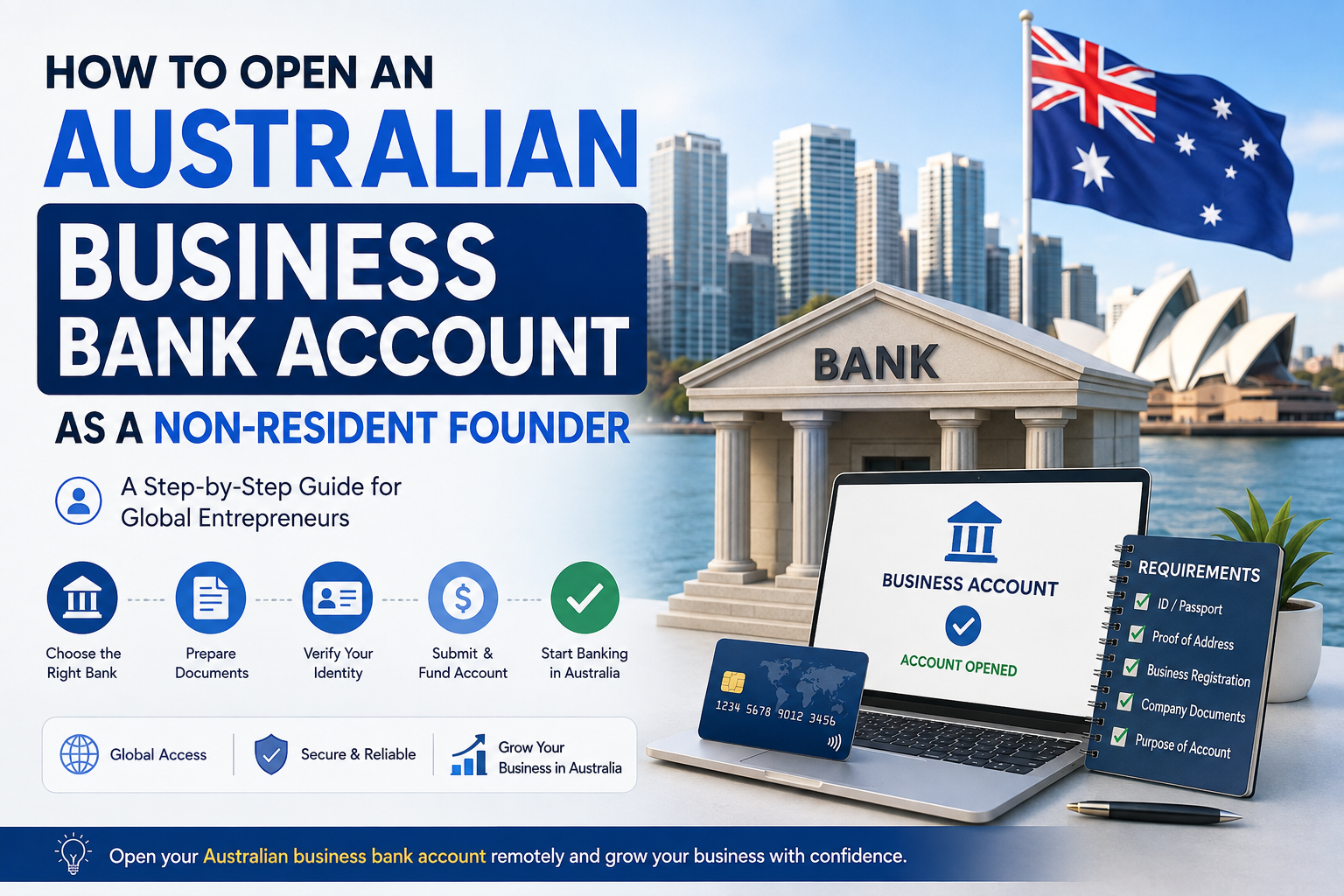
Setting up an Australia business bank account as a non-resident founder is one of the most common — and most misunderstood — steps in launching a company Down Under. Investors want to see a functioning local entity before they wire funds, customers want to pay in AUD, and the Australian Taxation Office simply won’t let you operate a registered company without one. Yet most guides gloss over the real friction: identity verification rules, in-person signatory requirements, and the gap between what a bank’s website promises and what actually happens when a foreign-owned company applies.
This guide walks through exactly what an overseas founder needs to open an Australia business bank account: the legal groundwork, the paperwork, a bank-by-bank comparison, realistic timelines, and the fintech alternatives that are quietly becoming the default choice for early-stage teams.
Why You Need an Australia Business Account Before You Need Investors
An Australia business entity — whether a Pty Ltd company or a registered foreign branch — is legally required to keep business funds separate from personal ones once it starts trading as a partnership, company, or trust. This isn’t a suggestion; the Australian Taxation Office relies on that separation for accurate reporting, and most investors, from local angels to venture funds, will not release capital into a personal account or an account outside Australia. A local Australia business bank account also unlocks day-to-day essentials: paying local contractors and staff, collecting AUD from Australian customers without punishing FX conversion fees, and building the transaction history that Australian lenders eventually look for.
For founders and investors researching how startups actually get set up in Australia, opening an Australia business account is usually the first operational milestone after incorporation — which is exactly why it’s worth doing properly the first time. Skipping straight to fundraising conversations before the Australia business banking foundation is in place is one of the most common (and most avoidable) missteps overseas founders make.
Step 1: Get Your Legal Structure Right First
No Australian bank will open an account for a company that doesn’t formally exist in Australia. Before you approach any bank, you need:
- Company registration with the Australian Securities and Investments Commission (ASIC) — either a new Pty Ltd company or a registered foreign company (ARBN) if you’re extending an existing overseas entity.
- An Australian Business Number (ABN) and, for companies, an Australian Company Number (ACN) issued through the Australian Business Register.
- A registered office and principal place of business address in Australia (a virtual office or registered agent address is generally accepted).
- Tax registrations such as GST, if your projected turnover exceeds the threshold, handled through the Australian Taxation Office.
Only once these are in place will a bank even begin processing an Australia business account application — this sequencing trips up more first-time founders than any other step.
Step 2: Understand the Non-Resident Identity Rules
Australian banks verify identity using AUSTRAC’s 100-point identification system under Anti-Money Laundering and Counter-Terrorism Financing rules. For an Australia business account tied to non-resident directors, this typically means:
- Certified copies of passports and, where required, national ID or driver’s licence for every director and beneficial owner.
- Proof of residential address (utility bill, bank statement) for each signatory.
- A clear description of business activities, expected turnover, and transaction volumes — banks are assessing risk, not just checking boxes.
- In many cases, at least one signatory verifying identity in person — either at an Australian branch, an overseas branch of the same bank, or through a certified identification process such as a notary or Australian consulate.
Appointing an Australian-resident director or authorised signatory is the single most effective way to speed up an Australia business banking application, since it removes the in-person bottleneck for the rest of the team.
Documents Checklist for an Australia Business Bank Account
| Document | Sole Trader | Pty Ltd Company | Foreign Branch (ARBN) |
|---|---|---|---|
| ABN | Required | Required | Required |
| ACN / ARBN | Not applicable | Required (ACN) | Required (ARBN) |
| Certificate of Incorporation | Not applicable | Required | Required (home + AU) |
| Certified passport/ID (all directors) | Required | Required | Required |
| Proof of Australian business address | Required | Required | Required |
| Proof of overseas business address | Optional | Optional | Required |
| Beneficial ownership declaration | Not applicable | Required | Required |
| Business activity description & forecast turnover | Recommended | Required | Required |
| Certified/apostilled foreign documents | Rarely needed | Sometimes | Usually required |
Step 3: Choose Where to Apply — Big Bank or Fintech
This is where most of the real decision-making happens. An Australia business bank account can come from a traditional bank or a licensed fintech, and the right choice depends on how fast you need to move and how complex your ownership structure is.
Big Four and Traditional Banks
| Bank | Non-Resident Friendliness | Remote Opening | Typical Approval Time |
|---|---|---|---|
| Commonwealth Bank (CBA) | Moderate | Available for some structures; one signatory may need in-person or video verification | 2–4 weeks (simple), longer for complex structures |
| Westpac | Moderate–High for simple structures | Online for sole traders and single-director companies | 1–3 weeks (simple), relationship-manager path for complex ones |
| NAB | Case-by-case | Limited; often requires branch or agent involvement | 2–5 weeks |
| ANZ | Moderate | Case-by-case, similar to NAB | 2–5 weeks |
Fintech and Neobank Alternatives
| Provider | Best For | AUD Local Account | Notable Trade-off |
|---|---|---|---|
| Wise Business | Low-cost international transfers, transparent FX | Yes | Fewer advanced banking/lending features |
| Airwallex | Multi-currency collection across 20+ currencies | Yes | Pricing can vary by volume/use case |
| Revolut Business | Startup teams wanting cards + multi-currency in one app | Yes (AUD, EUR) | Weekend FX surcharge on some plans |
| OFX | Larger cross-border trade payments, FX hedging | Yes | Less suited to everyday day-to-day banking |
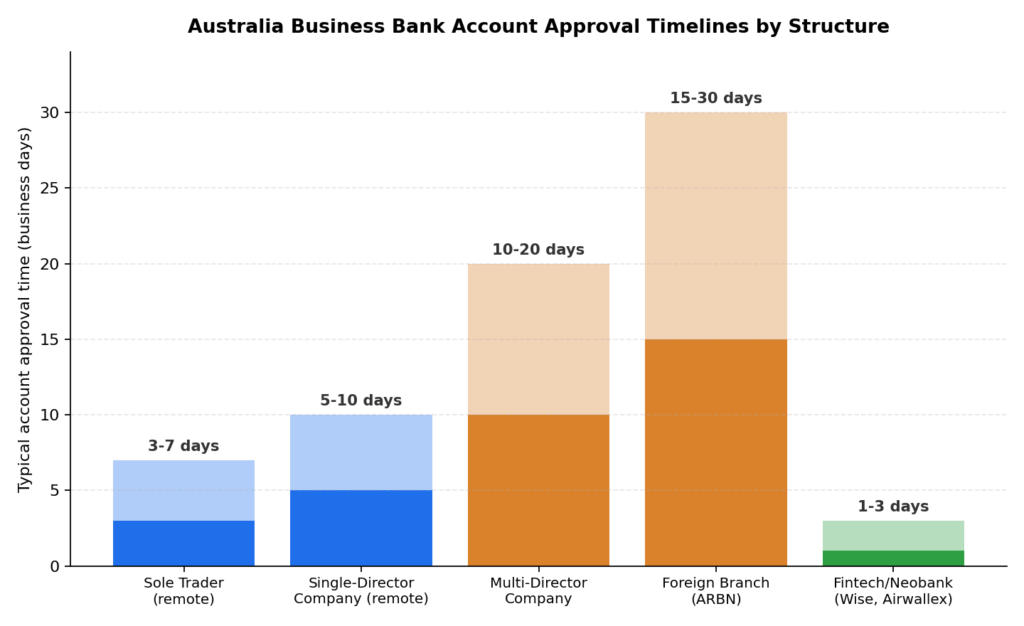
Fintechs generally onboard an Australia business account in one to three business days once your ABN/ACN and identity documents are ready, compared with two to five weeks — or longer — at a traditional bank for a multi-director or foreign-branch structure. Many founders open a fintech account first to start operating immediately, then layer in a traditional Australia business bank account once the company has trading history.
How Long Does It Actually Take?
The chart below reflects typical ranges reported by founders and advisory firms assisting with Australia business account applications in 2026. Simpler structures with complete, low-risk documentation move fastest; multi-director companies and foreign branches take meaningfully longer because every signatory must clear identity verification.
Common Reasons Applications Get Delayed or Rejected
- Incomplete beneficial ownership disclosure. Any individual owning 25% or more of the Australia business entity must be declared and identity-verified.
- Missing certified translations or apostilles for foreign incorporation documents and IDs.
- Vague business activity descriptions. “Consulting services” tells a compliance officer nothing; be specific about what the Australia business actually does, who it invoices, and where funds originate.
- No local signatory, which forces every director into the in-person verification queue.
- High-risk jurisdiction flags. Ownership structures involving certain jurisdictions trigger enhanced due diligence and longer review, regardless of the bank chosen.
Practical Tips to Speed Up Approval
- Register the company and ABN before contacting any bank — applications submitted without these are simply not processed.
- Appoint at least one Australian-resident signatory if you can; it removes the biggest single delay in Australia business banking.
- Prepare a one-page business summary covering activities, expected transaction volumes, and the source of initial funds — banks ask for this anyway, so front-load it.
- Get documents certified early. Certification and apostille turnaround from overseas notaries can itself take one to two weeks.
- Apply to a fintech in parallel so the Australia business can start transacting while the traditional bank application is under review.
- Be transparent about FATCA/CRS status. If any beneficial owner is a US person or tax resident of another CRS jurisdiction, disclose this upfront rather than have it surface mid-review.
Tax and Compliance Basics Once the Account Is Open
Opening the account is the milestone, but keeping an Australia business compliant is ongoing. At minimum, expect to manage:
- GST registration if turnover is projected to exceed the threshold, with quarterly or monthly Business Activity Statements.
- Company tax return filings with the Australian Taxation Office, even in a pre-revenue year.
- Director ID numbers for any Australian-resident directors, a mandatory ASIC requirement.
- Ongoing beneficial ownership updates whenever the Australia business’s ownership structure changes.
Working with a local accountant or company-formation service familiar with non-resident founders is genuinely worth the cost here — most of the “banking horror stories” founders share online about their Australia business setup trace back to paperwork gaps that a local adviser would have caught in the first week.
Frequently Asked Questions
Can a non-resident open an Australia business bank account without visiting Australia? Often yes, particularly for sole traders and single-director companies through banks with strong digital onboarding, or through fintechs like Wise and Airwallex. Multi-director companies and foreign branches more often require at least one signatory to verify identity in person or via a certified process.
Do I need an Australian director to open an Australia business account? Not always, but it significantly speeds up the process and is often the deciding factor in whether a traditional bank can complete verification remotely.
Is a fintech account a substitute for a full Australia business bank account? For early operations, often yes. But lending, merchant services, and some investor due diligence checklists still expect a relationship with a licensed Australian bank eventually.
How much does it cost to set up an Australia business bank account? Most major banks and fintechs don’t charge for account opening itself, though monthly account-keeping fees, FX margins, and document certification/apostille costs (often the biggest line item for overseas founders) should be budgeted separately.
Final Word
An Australia business bank account is not just a compliance checkbox — it’s the financial backbone that lets a foreign-founded company actually operate, get paid, and look credible to the investors and partners evaluating it. Get the entity structure right first, understand which identity-verification path applies to your ownership setup, and choose between a traditional bank and a fintech based on how quickly the Australia business needs to start moving money. Founders who sequence these steps correctly typically have a working account — traditional or fintech — within one to four weeks, rather than the months it can take when the paperwork is assembled reactively.