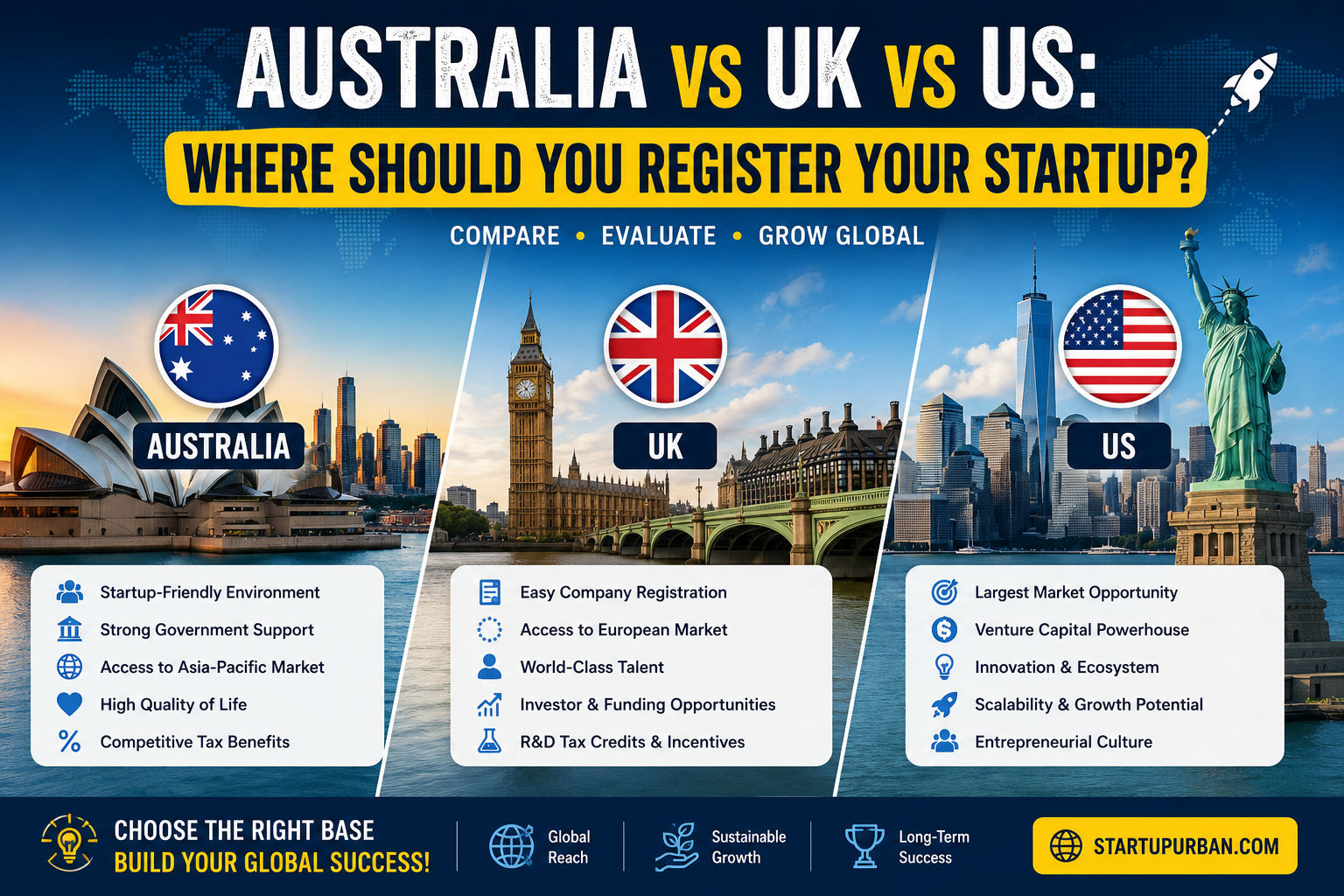
Choosing a home base for your startup is one of the first “irreversible” decisions a founder makes. It shapes how much tax you pay, how easily you can raise capital, how investors perceive your company, and how much paperwork sits between you and actually building your product. For founders comparing Australia, the United Kingdom, and the United States, this decision usually comes down to a trade-off between simplicity, tax efficiency, and access to venture capital.
This guide breaks down exactly where to register a startup across Australia, UK, and US — covering cost, tax rates, timelines, investor expectations, and which jurisdiction fits which kind of founder.
Quick Comparison: Startup Registration at a Glance
| Factor | Australia (Pty Ltd) | United Kingdom (Ltd) | United States (Delaware C-Corp) |
|---|---|---|---|
| Regulator | ASIC | Companies House | Delaware Division of Corporations |
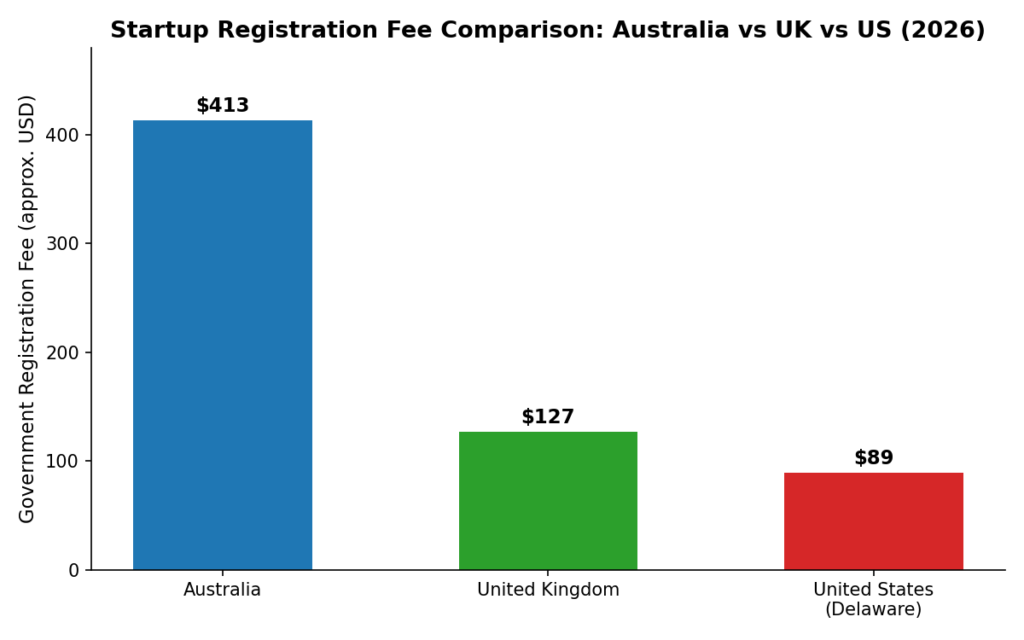
| Government filing fee | A$636 | £100 | ~US$89–$140 |
| Time to register | Same day–1 day | Usually within 24 hours | 1–5 business days (same-day expedite available) |
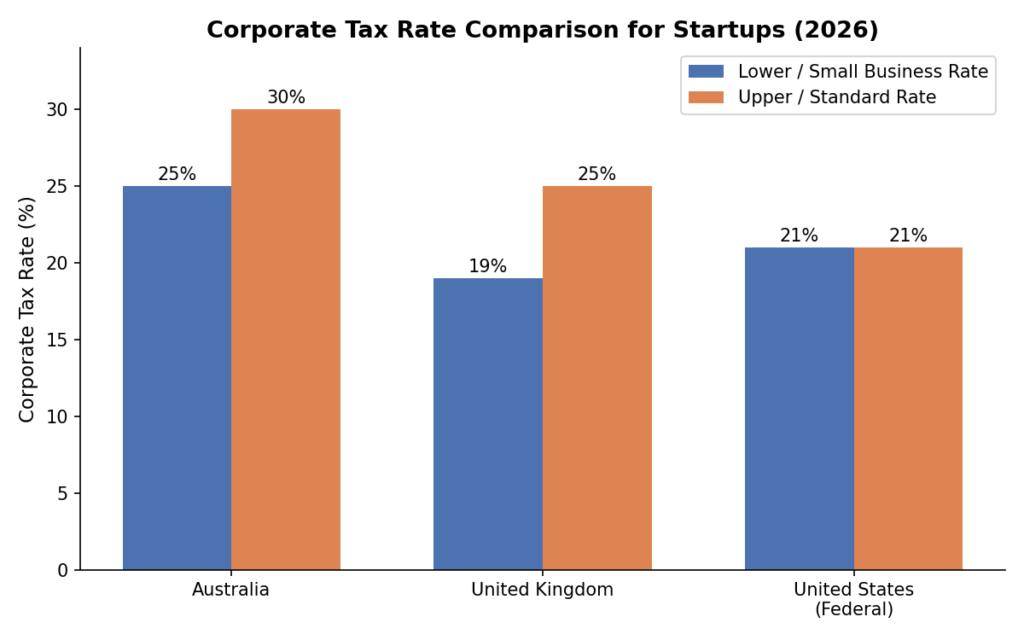
| Corporate tax rate | 25%–30% | 19%–25% | 21% federal (+ state, if applicable) |
| Annual compliance fee | A$342 review fee | £50 confirmation statement | US$400+ franchise tax minimum |
| Best suited for | Local trading businesses, ANZ-first founders | UK/EU-facing startups, SEIS/EIS-eligible ventures | Startups targeting VC funding, US market entry |
| Investor familiarity | Moderate | Moderate–high (Europe) | Very high (global VC standard) |
As the table shows, every one of these countries offers a fast, relatively low-cost path to forming a company. The real differences show up later — in tax bills, fundraising conversations, and compliance obligations.
Why This Decision Matters So Much for a Startup
A startup isn’t just a business idea; it’s a legal entity that has to survive audits, investor due diligence, and cross-border banking. Where you register your startup determines:
- Which investors will even consider funding you. Many US venture capital funds have internal mandates that only let them invest in Delaware C-Corps.
- How much of your profit you actually keep, once corporate tax, dividend tax, and compliance fees are factored in.
- How fast you can open a business bank account, hire staff, and issue equity to co-founders.
- Whether you qualify for founder-friendly tax breaks like the UK’s SEIS/EIS schemes or the US Qualified Small Business Stock (QSBS) exemption.
Because these implications compound over years, picking the wrong jurisdiction for your startup can mean re-incorporating later — a process that resets vesting schedules, complicates cap tables, and costs real legal money.
Registering a Startup in Australia
Australia is a practical, low-friction place to register a startup, particularly for founders building for the domestic or Asia-Pacific market.
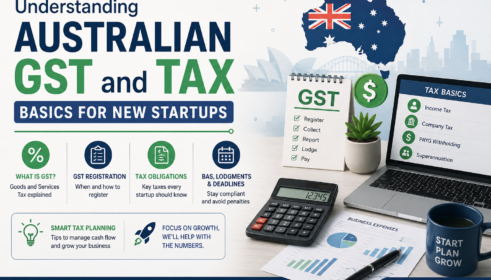
How it works: Most founders register a proprietary limited company (Pty Ltd) through the Australian Securities and Investments Commission (ASIC). As of the 2026–27 financial year, the standard ASIC registration fee for a Pty Ltd is A$636, with an annual review fee of A$342. You’ll also need an Australian Business Number (ABN), which is free, and — if trading under a different name than the registered company name — a separate business name registration.
Tax treatment: A startup structured as a Pty Ltd pays a base company tax rate of 25% if it qualifies as a “base rate entity” (broadly, turnover under A$50 million with mostly passive-income exclusions), or 30% for larger companies. This is considerably lower than Australia’s top personal marginal tax rate of 45%, which is one reason many sole traders convert to a Pty Ltd structure once profits climb past roughly A$80,000 a year.
Speed and simplicity: Registration can often be completed the same day online, and directors need a Director ID before incorporation — a free but mandatory step.
Where it falls short for a startup chasing venture capital: Australia’s venture capital market, while growing, is far smaller than the US or UK. A startup incorporated purely in Australia may still need to set up a US or UK holding entity later if it wants to raise a Series A from international investors, which adds cost and complexity down the line.
Best for: Founders building for the Australian or APAC market first, bootstrapped startups, and businesses that plan to stay privately funded or rely on local grants (such as R&D Tax Incentive claims, which are exclusive to Australian-registered companies).
Registering a Startup in the United Kingdom
The UK remains one of the most founder-friendly places in Europe to register a startup, largely because of its tax incentives for early-stage investors.
How it works: UK company formation happens through Companies House. As of February 2026, the standard digital incorporation fee is £100 (up from £50), with same-day digital incorporation available for £156. The process is fast — most companies are live within 24 hours — and can be completed entirely online.
Tax treatment: UK Corporation Tax operates on a sliding scale: 19% for profits up to £50,000, rising to 25% for profits above £250,000, with Marginal Relief smoothing the rate in between. Dividends are taxed separately and more favorably than salary, which lets founders optimize how they extract money from the business.
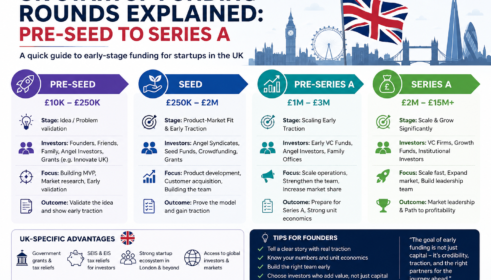
The real draw for founders — SEIS and EIS: The UK’s Seed Enterprise Investment Scheme (SEIS) and Enterprise Investment Scheme (EIS) give angel investors substantial income tax relief for investing in early-stage UK companies. This single feature makes the UK exceptionally attractive to a pre-seed or seed-stage startup trying to raise from angel investors, because it effectively de-risks the investment for them. To qualify for SEIS/EIS, however, the startup must be a UK-registered limited company — another reason many founders shortlist the UK specifically for fundraising reasons rather than tax optimization alone.
Ongoing obligations: Every UK startup must file an annual confirmation statement (£50), annual accounts with Companies House, and a Corporation Tax return (CT600) with HMRC, even in years with no profit.
Best for: Startups targeting the UK/European market, founders who expect to raise a pre-seed or seed round from UK-based angels, and businesses that want SEIS/EIS eligibility as a fundraising lever.
Registering a Startup in the United States (Delaware)
For any startup with ambitions of raising institutional venture capital, Delaware is still the default answer — and for a reason that has little to do with tax and everything to do with legal infrastructure.
How it works: Founders typically incorporate as a Delaware C-Corporation, even if the company has no physical presence in Delaware. The filing fee for a Certificate of Incorporation is roughly US$89–$140 depending on share structure, with same-day expedited filing available for an extra fee. More than two-thirds of Fortune 500 companies, and the large majority of Y Combinator-backed startups, are incorporated in Delaware.
Tax treatment: The federal corporate tax rate is a flat 21%, filed via Form 1120. On top of that, Delaware charges an annual franchise tax — a minimum of roughly $400 per year for most early-stage startups using the Assumed Par Value Capital Method, though it can run into thousands of dollars for companies with a very large number of authorized shares under the Authorized Shares Method.
Why VCs prefer it: Delaware’s Court of Chancery has over a century of case law specifically covering corporate governance, shareholder disputes, and fiduciary duty — meaning investors know exactly how their rights will be enforced if something goes wrong. Standard startup equity documents (SAFEs, stock option pools, 83(b) elections) are also built around Delaware C-Corp law, so using any other structure can complicate a future funding round.
QSBS advantage: A startup incorporated as a Delaware C-Corp can offer Qualified Small Business Stock (QSBS) treatment under Section 1202, which can exempt founders and early investors from federal capital gains tax on up to $10 million (or more) in gains at exit — a powerful incentive that neither Australia nor the UK replicates in the same way.
Where it gets expensive: A US-incorporated startup with no US operations still has to file annual reports, pay franchise tax, maintain a registered agent, and often register as a “foreign corporation” in whichever state it actually operates from — creating dual-state compliance costs.
Best for: Startups explicitly building for venture-scale growth, founders planning to raise from US-based VC funds, and companies aiming for QSBS tax benefits at exit.
Tax and Compliance Snapshot for a Startup in Each Country
| Category | Australia | UK | US (Delaware) |
|---|---|---|---|
| Corporate tax rate | 25%–30% | 19%–25% | 21% federal (flat) |
| Dividend/capital gains treatment | Franking credits reduce double taxation | Lower dividend tax rates (8.75%–33.75%) | QSBS can exempt up to $10M+ in gains |
| Annual compliance fee | A$342 | £50 | $400+ franchise tax |
| Special founder incentives | R&D Tax Incentive | SEIS / EIS angel relief | QSBS (Section 1202) |
| VAT/GST threshold | A$75,000 turnover | £90,000 turnover | No federal VAT; state sales tax varies |
How Investors Judge a Startup’s Country of Registration
Investors researching where to put capital into a startup aren’t just evaluating the product — they’re evaluating the legal wrapper around it. A US-based VC fund will often require a startup to be a Delaware C-Corp before signing a term sheet, simply because their fund’s own legal structure and LP agreements assume that format. A UK angel investor claiming SEIS/EIS relief needs the startup to be UK-incorporated to claim that relief at all. An Australian grant body or R&D incentive program requires the startup to be an Australian resident company.
In other words, the “best” country to register a startup in isn’t universal — it’s a function of who you expect to write your first check.
Decision Framework: Which Country Fits Your Startup?
- Choose Australia if: you’re building primarily for the Australian/APAC market, want to access the R&D Tax Incentive, or plan to stay bootstrapped or locally funded.
- Choose the UK if: you expect to raise from UK or European angel investors and want SEIS/EIS eligibility, or you’re targeting the UK/EU market directly.
- Choose the US (Delaware) if: you’re chasing venture-scale growth, plan to raise from US VCs, or want QSBS tax advantages at a future exit.
Many startups eventually operate a layered structure — for example, an Australian operating subsidiary under a US Delaware holding company — once they raise international capital. This is common, but it’s more expensive to set up retroactively than to plan for from day one.
Frequently Asked Questions
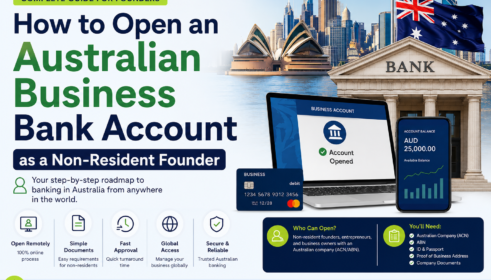
Can a non-resident register a startup in Australia, UK, or US? Yes, all three jurisdictions allow non-resident directors and shareholders, though Australia requires at least one director to be an Australian resident (or meet specific exemptions), while the UK and Delaware do not.
Which country is cheapest to register a startup in? On raw government filing fees, Delaware and the UK are typically cheaper upfront than Australia, though ongoing compliance costs vary and often narrow that gap over a startup’s first year.
Does registering in Delaware mean paying US taxes on worldwide income? Not automatically — tax residency and liability depend on where the startup actually operates and generates income, not just where it’s incorporated. This is a complex area and founders should get jurisdiction-specific tax advice before assuming either way.
Final Word
There’s no single “correct” answer to where a startup should register — only the answer that matches your funding strategy, target market, and long-term exit plans. A startup chasing Silicon Valley VC money almost always ends up as a Delaware C-Corp. A startup building for the UK/European market with angel-stage ambitions benefits enormously from SEIS/EIS in the UK. And a startup focused on the Australian market, local grants, and steady bootstrapped growth is usually best served staying as an Australian Pty Ltd.
Whichever jurisdiction you choose, get the paperwork right the first time. Re-incorporating a startup after investors are already on the cap table is one of the more expensive and time-consuming mistakes a founder can make — far more expensive than the registration fee itself.