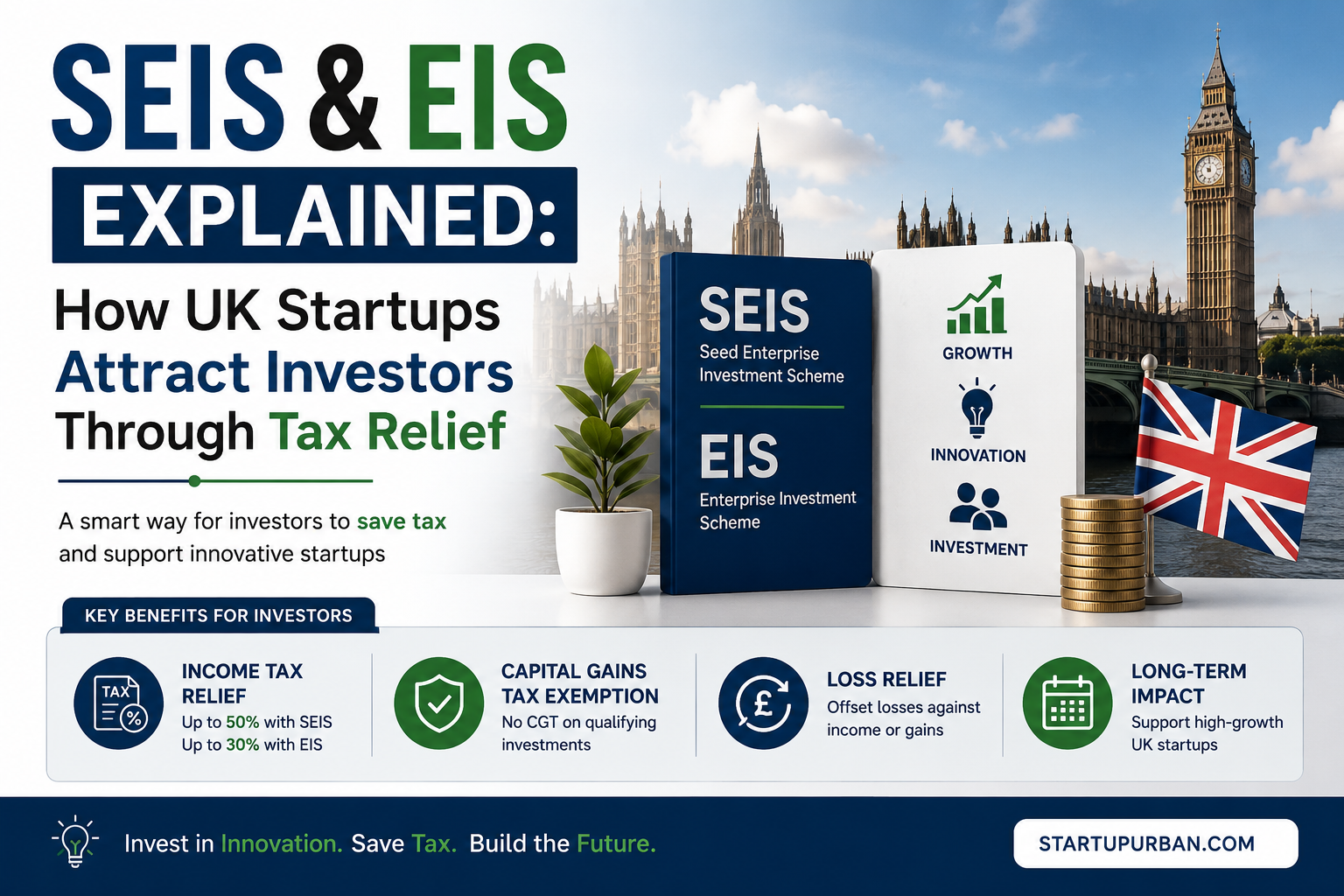
Raising early-stage capital is one of the hardest parts of building a company, and this is exactly where two government-backed schemes step in to change the odds for UK Startups. The Seed Enterprise Investment Scheme (SEIS) and the Enterprise Investment Scheme (EIS) were designed by HM Revenue & Customs to encourage private individuals to back young, high-risk businesses by offering them generous tax relief in return. For founders trying to close a funding round, and for investors trying to reduce the risk of backing an unproven venture, these two schemes have become the backbone of early-stage investing in Britain.
This article breaks down what SEIS and EIS actually are, how they differ, why they matter so much to UK Startups, and how both founders and investors can make the most of them.
Why Tax Relief Schemes Exist for UK Startups
Investing in a brand-new company is inherently risky. Most early-stage ventures fail within their first five years, and even the ones that survive rarely deliver a return quickly. Without some form of incentive, many private investors would simply avoid the asset class altogether and put their money into safer, more liquid investments instead.
The UK government recognised this problem decades ago. To keep capital flowing into innovative young businesses, it introduced SEIS in 2012 and expanded on the older EIS framework (which has existed since 1994). Both schemes reduce the effective risk for investors by allowing them to claim back a portion of their investment through income tax relief, and by shielding them from capital gains tax if the investment performs well. In exchange, the money flows directly into UK Startups that might otherwise struggle to raise a single pound.
What Is SEIS?
The Seed Enterprise Investment Scheme is aimed squarely at the earliest stage of a company’s life. It exists to help brand-new UK Startups raise their first meaningful round of outside capital, often before they have any revenue or even a finished product.
Key features of SEIS include:
- Investors can claim 50% income tax relief on investments up to £200,000 per tax year.
- Any capital gains reinvested into an SEIS-eligible company can qualify for 50% capital gains tax reinvestment relief.
- Shares held for at least three years are exempt from capital gains tax entirely.
- Loss relief is available if the company fails, softening the downside significantly.
- A company can raise a maximum of £250,000 through SEIS in its lifetime.
Because the relief is so generous, HMRC applies strict qualifying conditions. The company must be less than three years old, have fewer than 25 employees, and hold gross assets below £350,000 before the investment.
What Is EIS?
Once a company has outgrown SEIS or needs to raise larger sums, EIS becomes the natural next step. It follows the same underlying logic but scales up the numbers considerably, making it the go-to scheme for growth-stage UK Startups that have already proven some early traction.
Key features of EIS include:
- Investors can claim 30% income tax relief on investments up to £1 million per tax year (or £2 million if the excess goes into knowledge-intensive companies).
- Capital gains tax deferral relief is available on gains reinvested into EIS-qualifying shares.
- Shares held for at least three years are exempt from capital gains tax on disposal.
- Loss relief remains available, just as it does under SEIS.
- A company can raise up to £5 million per year and £12 million over its lifetime (or £10 million and £20 million respectively for knowledge-intensive companies).
EIS-eligible companies must generally be under seven years old (ten for knowledge-intensive companies) at the time of the first EIS investment, with fewer than 250 employees and gross assets under £15 million.
SEIS vs EIS: A Side-by-Side Comparison
The table below summarises how the two schemes differ, which is useful for any founder or investor mapping out a fundraising strategy for UK Startups.
| Feature | SEIS | EIS |
|---|---|---|
| Target stage | Very early stage | Early to growth stage |
| Max investment per investor/year | £200,000 | £1,000,000 (£2m for knowledge-intensive) |
| Income tax relief | 50% | 30% |
| Capital gains reinvestment relief | 50% exemption | Deferral only |
| Max company raise (lifetime) | £250,000 | £12,000,000 |
| Max company age at investment | Under 3 years | Under 7 years (10 for knowledge-intensive) |
| Max employees | Fewer than 25 | Fewer than 250 |
| Max gross assets | £350,000 | £15,000,000 |
| CGT exemption after 3 years | Yes | Yes |
| Loss relief available | Yes | Yes |
Many UK Startups actually use both schemes in sequence — raising an SEIS round first to get off the ground, then moving to EIS once they have a working product and some traction to show investors.
Why Investors Care About These Schemes
For an investor, the appeal of SEIS and EIS goes far beyond a simple tax deduction. Consider an investor putting £100,000 into an SEIS-eligible company:
| Scenario | Without SEIS | With SEIS |
|---|---|---|
| Initial investment | £100,000 | £100,000 |
| Income tax relief (50%) | £0 | £50,000 saved |
| Effective net cost | £100,000 | £50,000 |
| If company fails completely | Loses £100,000 | Loses roughly £22,500 after loss relief |
| If company succeeds (tax-free gain) | Full CGT applies | No CGT after 3 years |
This dramatically changes the risk-reward profile of backing early UK Startups. A failed investment under SEIS can cost an additional-rate taxpayer as little as 27.5p for every £1 invested once income tax relief and loss relief are both applied, while a successful exit can be entirely tax-free. It’s easy to see why SEIS and EIS have become such a central part of the UK’s angel investing culture.
Approximate Capital Raised Through SEIS and EIS Over Time
While exact figures vary by tax year and are published periodically by HMRC, the general trend shows steady growth in the amount of capital channelled into UK Startups through both schemes since their introduction.
Capital Raised (Illustrative Trend, £ millions)
2015  |████████████            (~600)
2017  |███████████████         (~750)
2019  |██████████████████      (~900)
2021  |████████████████        (~800, pandemic dip)
2023  |███████████████████████ (~1,150)
2025  |█████████████████████████ (~1,250)
The dip around 2021 reflects the broader slowdown in investment activity during the pandemic years, but the recovery afterward shows just how resilient investor appetite for early-stage British businesses has remained. Government data consistently shows that SEIS and EIS together support thousands of small companies every year, making them one of the most impactful tools for early-stage finance in the country.
How UK Startups Can Qualify
Not every business is eligible for SEIS or EIS. HMRC excludes certain “excluded trades” from both schemes, including:
- Property development and dealing in land
- Financial services such as banking, insurance, and money lending
- Legal or accountancy services
- Farming and market gardening
- Operating hotels or nursing homes
- Coal and steel production
Beyond the trade restrictions, a company seeking SEIS or EIS status must also be a genuine trading company (not a shell), must not be listed on a recognised stock exchange, and must not be controlled by another company. Founders of UK Startups are strongly advised to apply for HMRC Advance Assurance before opening a funding round, since this gives investors confidence that the shares they buy will actually qualify for relief.
The Application Process, Step by Step
- Check eligibility — Confirm the company’s trade, age, size, and asset levels meet SEIS or EIS rules.
- Apply for Advance Assurance — Submit a business plan, financial forecasts, and a description of how funds will be used to HMRC.
- Issue shares — Once investment is received, the company issues qualifying shares to investors.
- Submit a compliance statement — After the shares have been held for at least four months (or trading has started), the company files form SEIS1 or EIS1.
- Distribute compliance certificates — HMRC issues SEIS3 or EIS3 certificates, which investors use to claim relief on their tax return.
Skipping Advance Assurance is possible but risky, since many investors will not commit funds without it. For young founders trying to build trust quickly with a new group of angel investors, this step is often the difference between a smooth raise and a stalled one.
Common Mistakes Founders Make
Even well-intentioned founders can accidentally disqualify their company from SEIS or EIS relief. Frequent mistakes include:
- Raising funds before applying for Advance Assurance, then discovering the trade is excluded.
- Structuring share classes incorrectly, which can breach the “no preferential rights” rule.
- Allowing a single investor (or connected group) to hold more than 30% of the company’s shares.
- Using investment funds for purposes outside the qualifying trade.
- Missing the four-month waiting period before filing compliance statements.
Getting professional advice from an accountant familiar with SEIS and EIS is almost always worth the cost, particularly for founders raising money for the first time and unfamiliar with HMRC’s compliance requirements.
A Quick FAQ for Founders and Investors
Can a company use SEIS and EIS at the same time? No — a company must complete its SEIS round before raising under EIS, though many businesses do both in sequence as they grow.
Do investors need to be UK residents? No, but they must have UK income tax liability to claim the relief, since the benefit is applied against tax owed in the UK.
What happens if HMRC later decides a company doesn’t qualify? Relief already claimed by investors can be withdrawn, which is why Advance Assurance is such an important safeguard before funds change hands.
Why This Matters for the Wider Startup Ecosystem
SEIS and EIS are not just a tax quirk — they are one of the primary reasons the UK has developed such an active angel investing community compared to many other countries. By lowering the effective risk of investing in unproven businesses, these schemes funnel private capital toward exactly the kind of high-growth, high-risk ventures that banks are usually unwilling to fund. For UK Startups operating in competitive sectors like fintech, biotech, and deep tech, SEIS and EIS money is often the only realistic source of funding available before a company can demonstrate enough traction for venture capital.
Final Thoughts
SEIS and EIS remain two of the most powerful tools available to early-stage British businesses. For founders, they open the door to investors who might otherwise stay on the sidelines. For investors, they turn a high-risk asset class into something far more palatable by softening the downside and rewarding the upside. As long as HMRC continues to support these reliefs, they will likely remain central to how UK Startups fund their earliest and most fragile stages of growth.
Anyone considering raising through SEIS or EIS — or investing through them — should speak to a qualified tax adviser, since individual circumstances can significantly change how much relief applies.