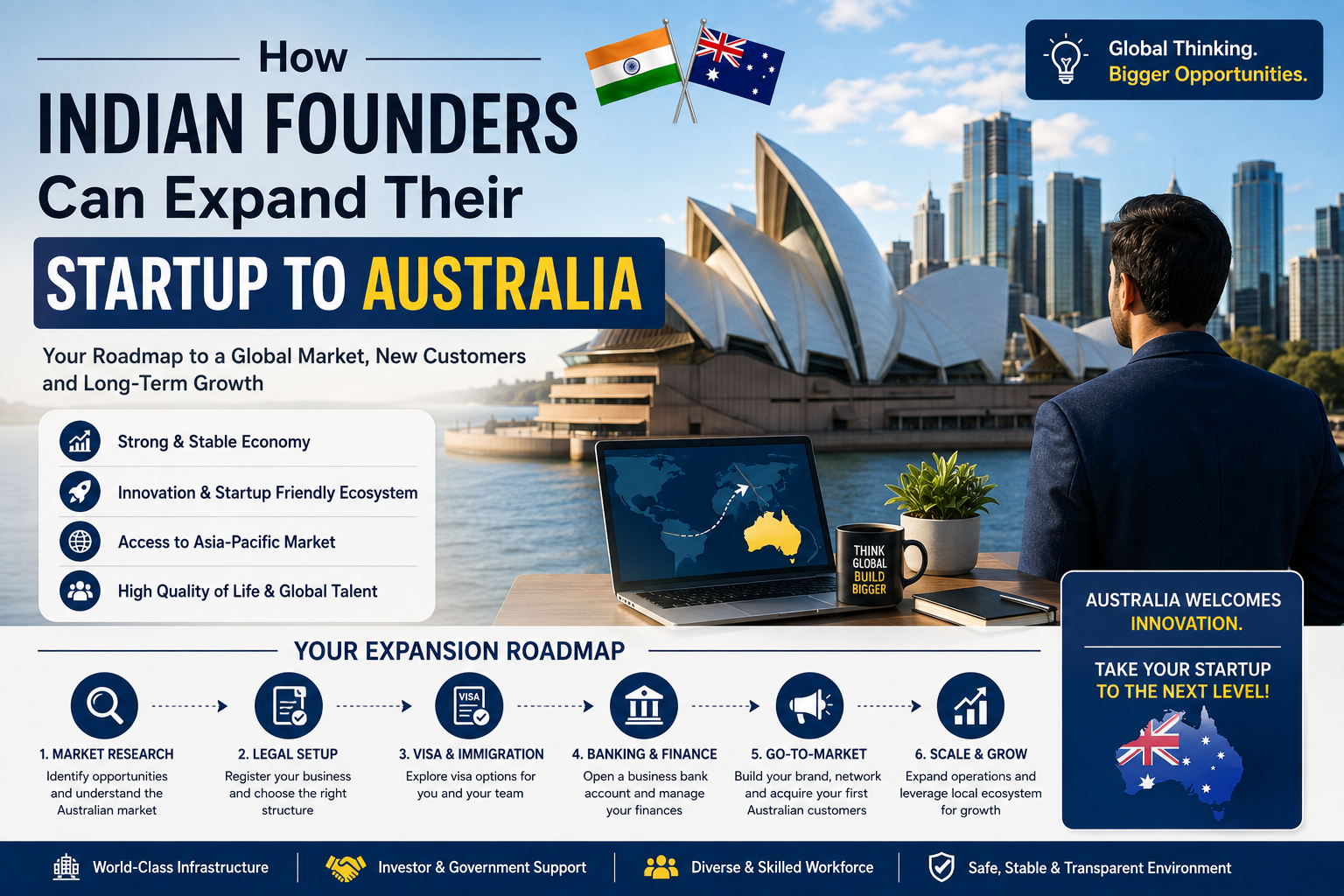
India’s startup ecosystem has matured into one of the largest in the world, and a growing number of founders are now looking outward for their next phase of growth. Among the destinations gaining serious attention, Australia stands out as a stable, English-speaking, high-income market with strong ties to Asia. For any founder who wants to expand startup to Australia from India, the opportunity is real, but it requires careful planning around visas, company structure, taxation, and market entry strategy.
This guide breaks down exactly how Indian entrepreneurs can build a presence in the Startup Australia ecosystem, what it costs, which visa pathways are realistic in 2026, and how to avoid the mistakes that trip up first-time founders entering this market.
Why Australia Is Attractive to Indian Founders
Australia offers a rare combination of economic stability, purchasing power, and geographic proximity to India. Flight times from major Indian cities to Sydney or Melbourne are shorter than to the US East Coast, time zones overlap comfortably with Indian business hours, and the Indian diaspora in Australia has grown into one of the largest migrant communities in the country. This diaspora is not just a customer base — it is a network of engineers, product managers, and investors who already understand the Indian founder mindset.
Beyond demographics, Australia’s economy is service-heavy, digitally advanced, and open to foreign-owned businesses. A founder building in fintech, SaaS, healthtech, edtech, or climate tech will find receptive early customers, a regulator that is generally predictable, and a startup community that actively welcomes overseas talent. This is precisely why the phrase Startup Australia now appears in the plans of so many Indian founders scouting for their first international market.
Search interest around Startup Australia has climbed steadily over the past few years, and the trend is not limited to founders — investors researching cross-border deal flow are increasingly typing the same phrase into Google. That overlap between founder research and investor research is exactly what makes a well-written Startup Australia resource valuable: it sits at the intersection of two high-intent audiences who are both trying to understand the same market from different angles.
The Business Case: Market Snapshot
Before committing capital, most founders want to see the numbers. The table below summarizes why Australia continues to rank highly for international market entry.
| Factor | Australia Snapshot (2026) |
|---|---|
| Population | ~26.8 million |
| GDP per capita | Among the highest in the Asia-Pacific region |
| Ease of doing business | Ranked highly for regulatory transparency |
| Startup company registration (Pty Ltd) | AUD 636 ASIC fee |
| Standard corporate tax rate | 25% (base rate entities) or 30% (standard rate) |
| GST registration threshold | AUD 75,000 annual turnover |
| Time to incorporate | 1–3 weeks end to end |
| Indian diaspora | One of the largest overseas Indian communities globally |
This combination of a small but wealthy population, transparent regulation, and an established Indian community is what continues to draw founders who want to expand startup to Australia from India rather than jumping straight to the US or UK. The underlying data also explains why so many market-entry decks now open with a Startup Australia slide before they even mention the US or the UK — the numbers simply support it as a credible first international market.
Step-by-Step: How to Expand Your Startup to Australia
Expanding into a new country is rarely a single decision — it is a sequence of smaller, connected decisions. Here is the practical sequence most Indian founders follow when they move from “considering Australia” to “operating in Australia.”
- Validate demand before you incorporate. Run paid pilots, LinkedIn outreach, or a soft product launch targeting Australian users before spending on legal structure. Many founders in the Startup Australia community recommend closing at least one paying Australian customer before registering an entity. This early validation step is one of the most consistent pieces of advice shared across founder groups and Startup Australia forums, because it keeps legal spend proportional to actual demand.
- Choose your entity structure. Most Indian founders either register a new Australian Proprietary Limited (Pty Ltd) company or register their existing Indian company as a foreign company under Part 5B.2 of the Corporations Act. A fresh Pty Ltd is usually simpler for early-stage teams.
- Appoint a resident director. Australian company law generally requires at least one director who ordinarily resides in Australia. Founders without an Australian-resident co-founder typically use a professional resident director service.
- Register for an ABN, ACN, and GST. The Australian Business Number (ABN) and Australian Company Number (ACN) are the foundation of doing business locally. GST registration becomes mandatory once turnover crosses AUD 75,000.
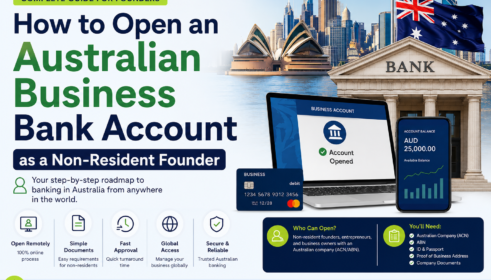
- Open a local bank account. Some banks allow remote onboarding for non-resident directors, while others require an in-person visit, so plan this step early.
- Select the right visa pathway if you or your team plan to relocate physically (details below).
- Localize pricing, support, and marketing for the Australian market rather than copy-pasting the Indian go-to-market playbook.
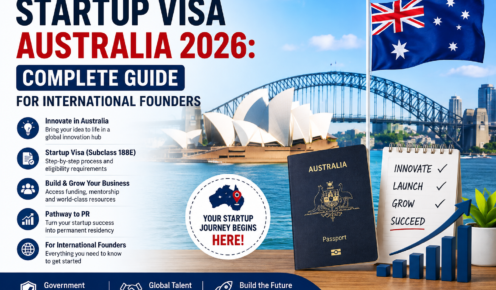
Visa and Immigration Pathways for Founders
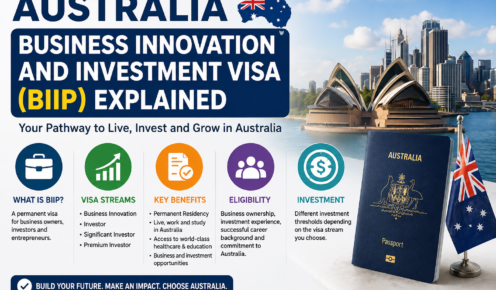
Australia does not have a single visa simply labeled “entrepreneur visa.” Instead, founders typically evaluate a shortlist of pathways depending on their profile, business stage, and long-term goals. The Business Innovation and Investment Program that many founders previously relied on stopped accepting new applications from mid-2024, so 2026 pathways look different from what older blog posts describe.
| Visa Pathway | Best Suited For | Key Notes (2026) |
|---|---|---|
| National Innovation Visa (Subclass 858) | High-achieving founders, researchers, and specialists | Invitation-only; based on Expression of Interest, not a standard points test |
| Subclass 482 (Skills in Demand, self-sponsorship route) | Founders who can sponsor themselves through their own operating Australian business | No fixed capital minimum; requires a genuine, lawfully operating business |
| Subclass 132 Business Talent | Established founders with a strong business track record or venture capital backing | Historically required turnover and net-asset thresholds; verify current figures with Home Affairs |
| Subclass 888 (transitional) | Founders who already hold a relevant Subclass 188 visa | Only relevant to existing visa holders progressing toward permanent residency |
| Short-stay business visitor visas | Founders scouting the market, meeting partners, or attending events | Does not permit ongoing work in Australia |
Because visa rules change frequently and eligibility criteria are strict, it is worth budgeting for a registered migration agent rather than relying on generic articles. A wrong pathway choice can cost months of delay for a founder trying to expand startup to Australia from India on a tight runway. Founders often underestimate how much the visa question and the Startup Australia business question are intertwined — a stronger operating business genuinely improves the strength of several visa applications, not just the investment-based ones.
Funding and the Investor Landscape
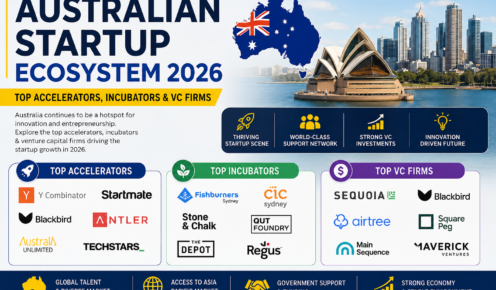
Australia’s venture capital market is smaller than the US or even India’s, but it is well capitalized relative to population size, and it is actively looking for founders solving problems with regional or global reach. Indian founders who already have traction in India often use that data as proof points when pitching Australian investors.
Relative size of early-stage funding sources available to founders entering the Startup Australia ecosystem (illustrative):
Angel Networks        ████████████░░░░░░░░  40%
Local VC Funds         ██████████░░░░░░░░░░  33%
Government Grants       ██████░░░░░░░░░░░░░░  17%
Accelerator Programs     ███░░░░░░░░░░░░░░░░  10%
Government-backed grants and R&D tax incentives are worth particular attention — Australia’s R&D Tax Incentive can meaningfully offset early engineering costs for companies that establish a genuine Australian presence, which is another reason serious founders formalize their Startup Australia entity rather than operating informally.
Investors evaluating deal flow in this region are also getting more comfortable backing Indian-founded companies that have already proven a model at home. A founder who can show revenue traction in India, paired with a credible Startup Australia go-to-market plan, is often a more fundable story than a purely local first-time founder, because the India traction functions as validated proof of execution.
Taxation and Compliance Essentials
Getting the compliance basics right early prevents expensive corrections later. Indian founders expanding into Australia should plan around the following:
- Corporate tax: Most small and early-stage companies qualify for the 25% base rate; larger or non-qualifying entities pay 30%.
- GST: Mandatory once turnover passes AUD 75,000, though many founders register voluntarily earlier to claim input tax credits.
- Payroll tax: State-based, applies once wage bills cross a state threshold — relevant once you start hiring locally.
- India–Australia tax treaty: Helps prevent double taxation on income earned across both countries, but structuring should be reviewed with a cross-border tax advisor.
- Annual ASIC review: Every registered Pty Ltd company must complete an annual review and pay a recurring fee to stay compliant.
None of these obligations are unique to Startup Australia companies founded by overseas nationals, but foreign-owned entities do face extra scrutiny during setup — particularly around ABN verification — so it pays to budget both time and a modest professional-fee buffer into the first year.
Common Mistakes Indian Founders Make
- Incorporating before validating demand. Legal setup is the easy part; customer validation is what actually de-risks the expansion.
- Underestimating the resident director requirement. Many founders discover this requirement only after starting the registration process.
- Copying the Indian pricing model. Purchasing power and buyer expectations in Australia are different, and pricing needs local calibration.
- Ignoring visa timelines. Immigration pathways can take months; founders who wait until they need to travel often lose momentum.
- Skipping local banking relationships. Payment friction with Australian customers can quietly kill early deals.
- Treating Startup Australia as a copy-paste market. Even founders with strong India traction sometimes assume the Australian buyer behaves identically to the Indian buyer, and that assumption alone accounts for a large share of failed first attempts.
A Realistic Timeline
| Phase | Typical Duration | Focus |
|---|---|---|
| Market validation | 4–8 weeks | Pilot customers, feedback loops |
| Entity setup (Pty Ltd, ABN, ACN) | 1–3 weeks | Legal foundation |
| Banking and compliance | 2–5 weeks | Bank account, GST, resident director |
| Visa pathway (if relocating) | 3–12 months | Depends heavily on chosen pathway |
| Local go-to-market | Ongoing | Sales, partnerships, marketing localization |
Final Thoughts
Australia will never be the biggest market an Indian founder can target, but it consistently ranks among the most stable, most trustworthy, and most livable ones — and that combination matters more than raw size for early-stage companies choosing their first international base. Founders who treat this as a genuine market entry, rather than a side project, tend to see disproportionate returns: cleaner enterprise contracts, credible government-backed funding, and a diaspora network that opens doors faster than cold outreach ever could.
If you are serious about building inside the Startup Australia ecosystem, start with validation, get your entity structure right, and treat the visa process as a parallel track rather than a blocker. Done correctly, the decision to expand startup to Australia from India can become one of the highest-leverage moves in your company’s growth story — and a strong entry point into the wider Startup Australia founder and investor community that is only getting more active each year.