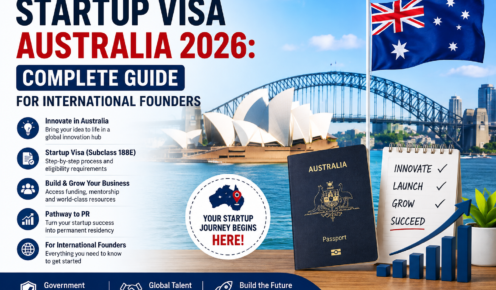
For years, the Australia Business Innovation Visa program — officially known as the Business Innovation and Investment Program (BIIP) — was the go-to route for founders, entrepreneurs, and investors who wanted to build a life and a business in Australia. If you’ve been researching the Australia Business Innovation Visa to plan an offshore expansion, relocate your startup, or move capital into a new market, there’s something critical you need to know upfront: the program has changed dramatically, and the version of the Australia Business Innovation Visa most guides describe online is no longer accepting new applicants.
This guide breaks down exactly what the BIIP was, why it closed, what has replaced it in 2026, and what founders and investors should do next if Australia is still on their radar.
What Was the Australia Business Innovation and Investment Program?
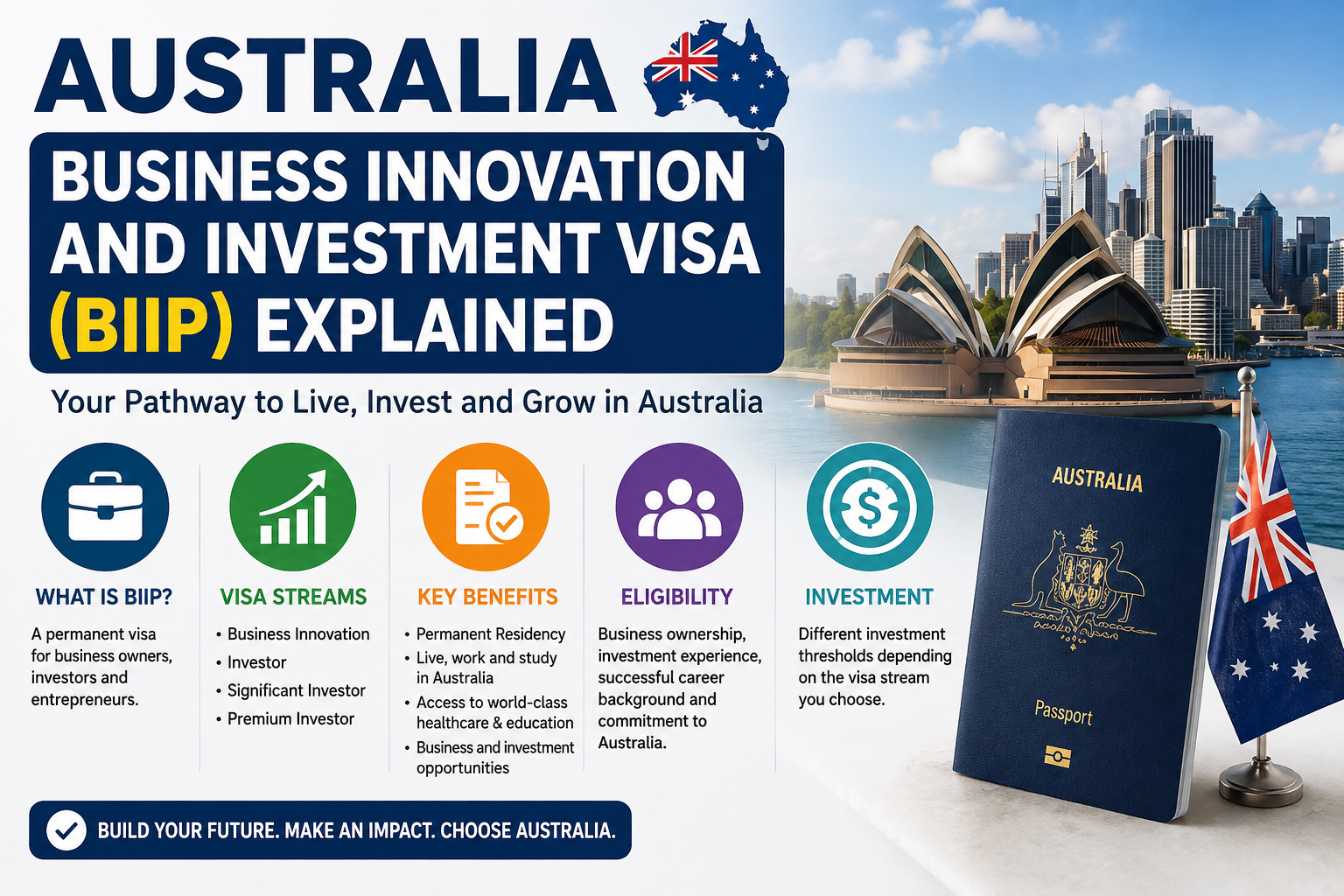
The BIIP sat under the Subclass 188 (Provisional) and Subclass 888 (Permanent) visa classes. It was designed to bring in people who could contribute meaningfully to the Australian economy — either by starting and running a business, injecting capital into managed funds, or backing early-stage ventures directly. Anyone searching for this visa category over the last decade would have found four core streams under this umbrella:
- Business Innovation stream — for people who already owned and operated a business and wanted to establish or manage a new one in Australia.
- Investor stream — for those willing to make a designated investment in an Australian state or territory government bond.
- Significant Investor stream (SIV) — for high-net-worth individuals investing at least AUD 5 million into complying investments, including venture capital and eligible managed funds.
- Entrepreneur stream — for founders backed by a minimum level of committed funding for an innovative business idea or startup.
Each stream carried its own points test, business turnover requirements, and net asset thresholds. The table below summarizes how the streams compared before the program’s closure.
Table 1: Former BIIP Streams at a Glance (Historical Reference)
| Stream | Primary Requirement | Minimum Investment/Asset Threshold | Visa Pathway |
|---|---|---|---|
| Business Innovation | Ownership/management of a qualifying business | AUD 1.25M net business and personal assets | 188 → 888 |
| Investor | State/territory government bond investment | AUD 2.5M | 188 → 888 |
| Significant Investor (SIV) | Complying investment fund allocation | AUD 5M | 188 → 888 |
| Premium Investor | Investment in priority sectors | AUD 15M | 188 → 888 (fast-tracked) |
| Entrepreneur | Backing for an innovative business idea | No fixed minimum; required committed funding | 188 → 888 |
Note: These figures reflect the requirements that applied while the BIIP accepted applications. They are provided for historical and research context only.
Why the Australia Business Innovation Visa Program Closed
Here is the part most outdated articles about the Australia Business Innovation Visa miss entirely: the Australian Government permanently closed the BIIP to new applications on 31 July 2024. This wasn’t a pause — it was a structural overhaul of how Australia attracts business migrants.
A government review found that the economic contribution of many BIIP visa holders fell short of the outcomes the program was designed to deliver. Investment tended to flow into passive assets like property and government bonds rather than into productive, job-creating ventures. As part of Australia’s broader Migration Strategy, the government decided to retire this investment-led framework in favor of a more targeted, achievement-based approach.
If you take away one fact from this article, make it this: no new Expressions of Interest, applications, or state/territory nominations are being accepted for the Subclass 188 visa. If you did not lodge before the cut-off date, this pathway is not available to you in 2026.
What Replaced the Australia Business Innovation Visa Program
Rather than leaving a gap, the government launched a replacement in December 2024: the National Innovation Visa (Subclass 858). This visa consolidates the aims of the old Australia Business Innovation Visa program and the former Global Talent visa into one invitation-only, achievement-based pathway.
Key differences founders and investors should understand:
- Invitation-only — you cannot simply apply; the Department of Home Affairs must invite you based on your track record.
- Achievement-based, not investment-based — unlike the old investment-led streams, the Subclass 858 does not require a fixed capital injection. It instead evaluates internationally recognized accomplishment in priority sectors.
- Priority sectors — technology, advanced manufacturing, renewable energy, agri-food, medical science, and other areas the government has flagged as nationally significant.
- Permanent from the outset — there is no provisional stage; eligible applicants move directly to permanent residency.
Separately, the Subclass 132 Business Talent visa remains open in 2026 for high-value business owners who want a direct-to-permanent-residency route without going through a provisional stage, making it the closest living relative to what the old business migration framework once offered to established business owners.
Table 2: Business & Investment Pathways in Australia — 2026 Snapshot
| Pathway | Status in 2026 | Best Suited For | Investment Required |
|---|---|---|---|
| BIIP (Subclass 188/888) | Closed to new applicants since 31 Jul 2024 | N/A — legacy holders only | N/A |
| National Innovation Visa (Subclass 858) | Open, invitation-only | Founders/researchers with exceptional achievement | None (merit-based) |
| Business Talent (Subclass 132) | Open | Established business owners with strong turnover history | Business-value based, no fixed fund requirement |
| Employer Sponsored (Subclass 186/482) | Open | Founders hiring themselves through their own company | N/A |
| Skilled Independent (Subclass 189/190) | Open | Founders with in-demand skills, points-tested | N/A |
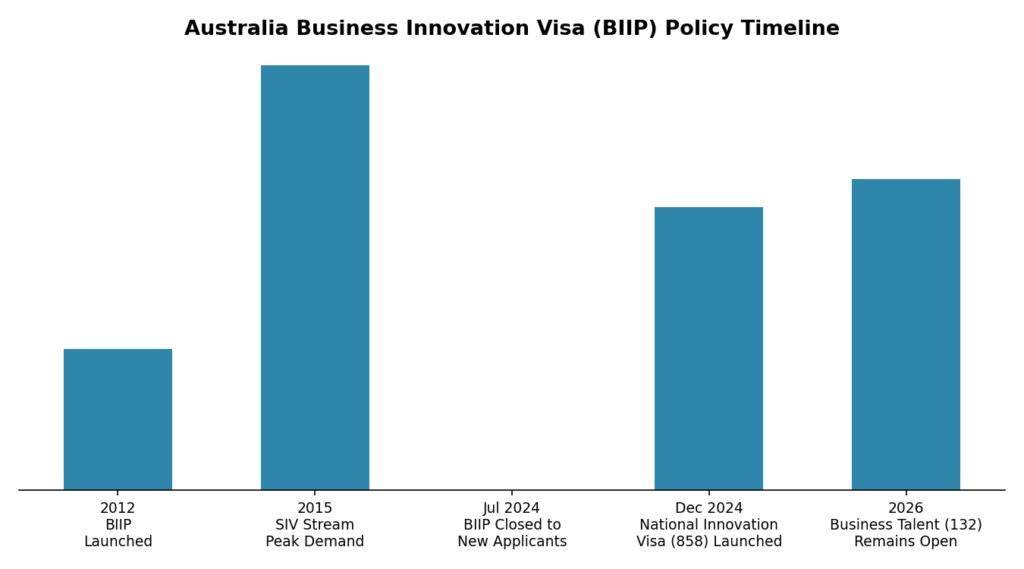
The chart below illustrates how quickly the policy landscape shifted, moving from a capital-first program to a merit-first one.
If You Already Hold a BIIP Visa
Not everyone researching the Australia Business Innovation Visa is starting from zero. If you already hold — or previously held — a Subclass 188 visa, you may still have a live pathway:
- Extension applications for the Business Innovation and Significant Investor streams are still being processed for existing holders under the rules that applied when they first applied.
- Subclass 888 (Permanent) remains available for eligible people transitioning from an existing 188 visa, provided they meet the residence and investment maintenance requirements tied to their original stream.
- Applications lodged before 31 July 2024 continue to be assessed under the criteria in force at the time of lodgement — the closure does not retroactively change the rules for people already in the system.
If this applies to you, the most reliable next step is to check your case against the Department of Home Affairs’ official BIIP closure and transition guidance, or speak with a MARA-registered migration agent, rather than relying on older third-party explainers that haven’t been updated since the closure.
Historical Investment Thresholds
Even though the program is closed, understanding the old thresholds helps explain why the government pivoted away from this model — and why the new National Innovation Visa looks so different. The chart below shows how investment requirements scaled by stream under the legacy Australia Business Innovation Visa framework.
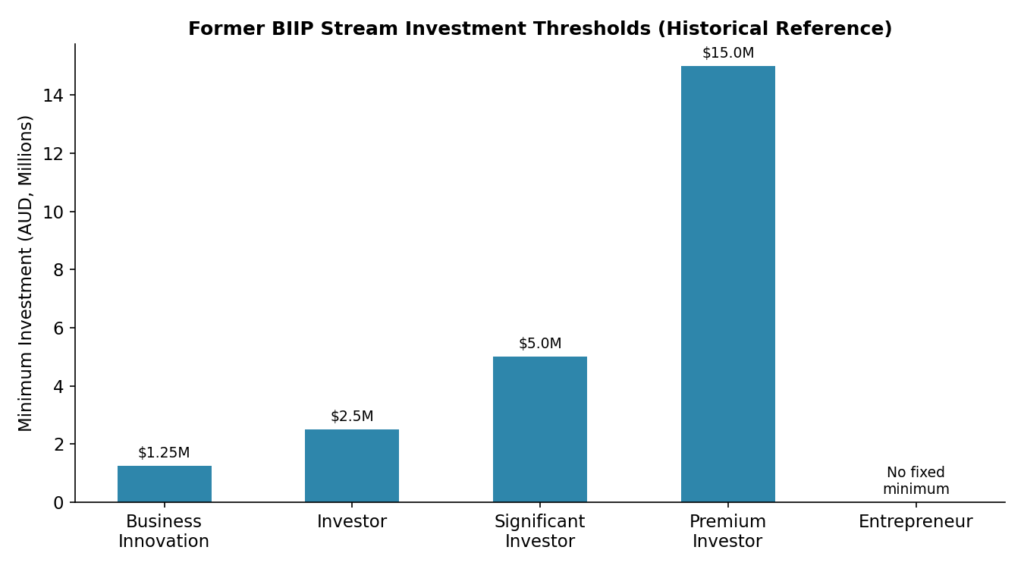
As the chart shows, the Premium Investor tier required six times the capital of the standard Investor stream, yet delivered a comparatively modest fast-track benefit — one of several imbalances the 2023 government review flagged when recommending the program’s retirement.
Practical Steps for Founders Considering Australia in 2026
If your startup or investment thesis still points toward Australia, treat 2026 as a planning year rather than an application year. Start by mapping your profile against the eligibility criteria for the National Innovation Visa and the Business Talent visa side by side — the two differ enough in structure that most founders will clearly fit one or the other, not both. Documented traction matters more than it used to: publication records, patents, revenue growth, prior fundraising, and sector recognition now carry more weight than a bank statement ever did under the old model.
It’s also worth building relationships with Austrade or state investment attraction agencies early, since invitation-based pathways often start with a warm introduction rather than a cold application. Founders relocating a team, not just themselves, should look closely at the employer-sponsored routes, which can move faster than either merit-based pathway when a genuine local hiring need exists. Finally, set a realistic timeline: invitation rounds are periodic, not continuous, so plan your cash runway and market-entry strategy around the visa timeline rather than the other way around.
Frequently Asked Questions
Is the Australia Business Innovation Visa still open in 2026? No. The BIIP, including all four streams, closed permanently to new applications on 31 July 2024. Anyone researching this pathway today should focus on its replacement, the National Innovation Visa (Subclass 858), or the still-open Business Talent visa.
Can I still apply for the Significant Investor stream? No. The Significant Investor stream, along with every other BIIP stream, stopped accepting new Expressions of Interest and applications from the closure date. Existing holders progressing to permanent residency are the only group still moving through this stream.
What is the closest current equivalent to the old Australia Business Innovation Visa? The Subclass 132 Business Talent visa is the closest surviving pathway for established business owners, while the National Innovation Visa (Subclass 858) is the closest equivalent for high-achieving founders and investors without a fixed capital requirement.
Do I need a migration agent to navigate this? It isn’t mandatory, but given how recently the Australia Business Innovation Visa landscape changed, a MARA-registered agent can help you avoid relying on outdated guidance and match you to the pathway that fits your actual profile in 2026.
Key Takeaways for Founders and Investors
- The Australia Business Innovation Visa (BIIP) closed permanently to new applicants on 31 July 2024 — treat any guide that doesn’t mention this with caution.
- Its replacement, the National Innovation Visa (Subclass 858), is invitation-only and rewards demonstrated achievement rather than committed capital.
- The Business Talent visa (Subclass 132) remains the most direct option for established business owners.
- Existing BIIP holders retain a pathway to permanent residency through Subclass 888, under their original stream’s rules.
- Always cross-check third-party explainers against the Department of Home Affairs’ official pages, since this is one of the fastest-moving areas of Australian migration policy.
If you’re building a startup with global ambitions and Australia is part of your expansion plan, the smartest move in 2026 is to stop searching for a way back into the old Australia Business Innovation Visa program and start building a case — achievements, traction, and sector relevance — for the pathways that are actually open today.