Building a company alone is hard. Building a company without the right network is even harder. That’s why so many founders — first-timers and repeat entrepreneurs alike — spend almost as much time searching for the best US startup communities online as they do refining their product. The right startup communities can shorten your learning curve, connect you to early customers, and put you in the same room (virtual or physical) as the investors who write the checks.
This guide breaks down the most valuable startup communities operating in the United States today, compares them side by side, and shows you how to actually get value out of them instead of just lurking.
Why Startup Communities Matter More Than Ever
In 2026, capital is more selective and attention is more fragmented than at any point in the last decade. Founders can no longer rely on a single accelerator demo day or a lucky cold email to get noticed. Instead, traction increasingly comes from consistent visibility inside active startup communities — places where builders, operators, and investors already gather to trade ideas.
Startup communities solve three problems at once:
- Distribution — early users and beta testers who are willing to try unfinished products.
- Talent — co-founders, freelancers, and early hires who understand startup pace.
- Capital — angels and fund scouts who source deals directly from active communities instead of waiting for warm introductions.
Founders who treat startup communities as a core growth channel — not a side hobby — consistently report faster iteration cycles and shorter fundraising timelines.
What Makes a Startup Community Worth Your Time
Not all startup communities are created equal. Before you join, evaluate a platform against these criteria:
- Signal-to-noise ratio — can you find quality conversations without wading through spam?
- Investor presence — do actual investors participate, or is it founders talking only to other founders?
- Niche focus — general startup communities are useful, but niche communities (SaaS, hardware, bootstrapped, AI) often convert better.
- Cost of entry — free, paid, or application-only?
- Real-world overlap — does the online community translate into in-person meetups, demo days, or conferences?
With that framework in mind, here’s a breakdown of the platforms worth your attention.
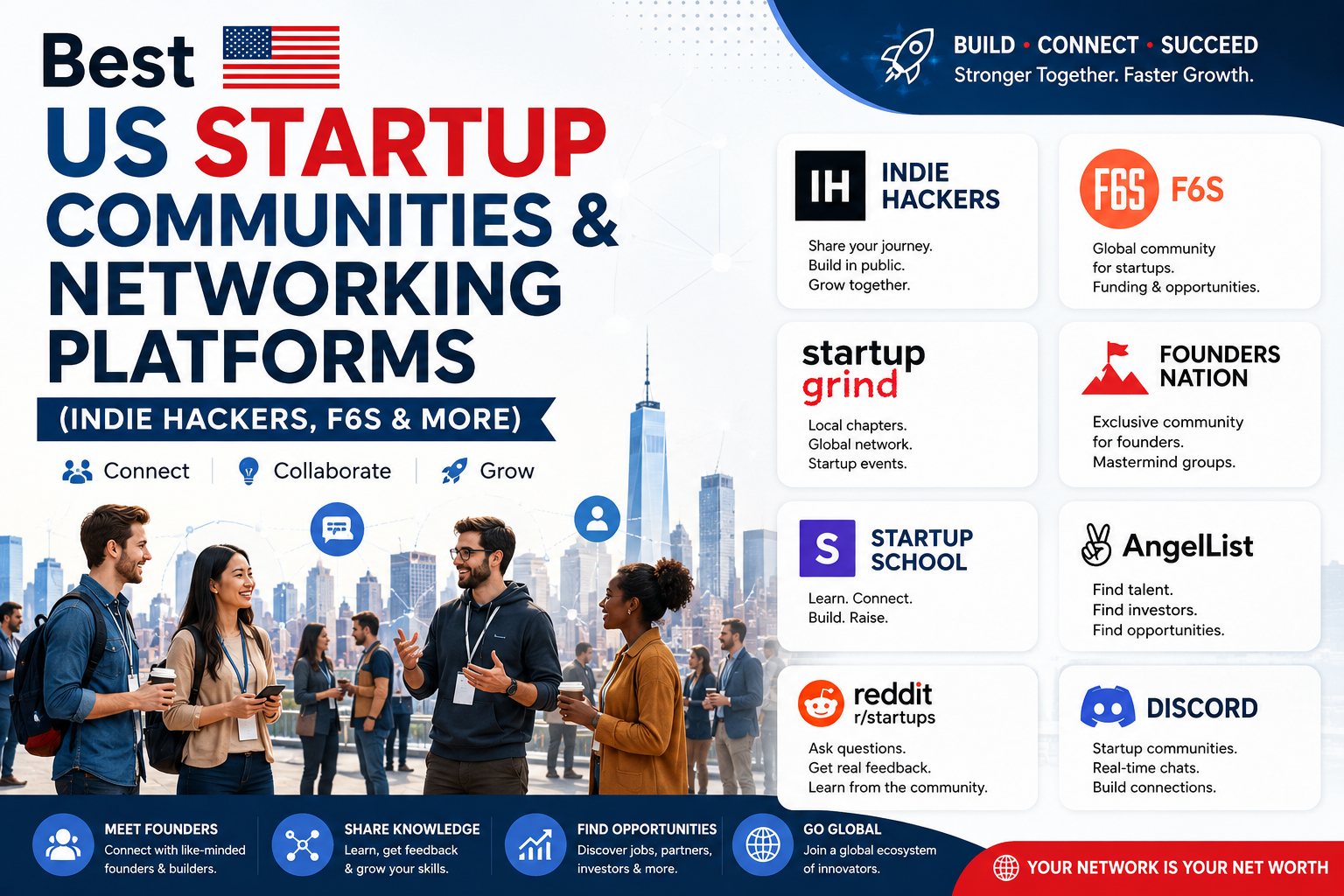
Top US Startup Communities & Networking Platforms
1. Indie Hackers
Indie Hackers remains one of the most respected startup communities for bootstrapped and solo founders. Owned by Stripe, the platform combines public forums, private groups, and detailed “revenue journey” case studies where founders share real numbers. It’s less flashy than venture-backed startup communities, but the transparency is what keeps people coming back.
Best for: solo founders, SaaS builders, and anyone pursuing profitability over hypergrowth.
2. F6S
F6S is one of the largest startup communities globally, connecting founders with accelerators, grants, corporate innovation programs, and investors. Unlike purely social platforms, F6S functions more like a startup operating system — you build a profile, apply to programs, and get matched with relevant opportunities.
Best for: founders actively applying to accelerators or seeking non-dilutive funding.
3. Y Combinator’s Startup School & Bookface Alumni Network
Y Combinator runs two tiers of startup communities: the free, public Startup School (open to anyone) and the private Bookface network reserved for YC alumni. Startup School alone has produced companies that went on to raise significant venture rounds, largely because the surrounding startup communities push founders to ship weekly and report progress publicly.
Best for: early-stage founders wanting structured accountability.
4. Product Hunt
Product Hunt isn’t purely a networking platform, but its comment sections and Maker communities function as genuine startup communities where builders trade feedback before and after launch day. Many founders use it as their first real-world distribution test.
Best for: launch-day visibility and early user feedback.
5. Reddit’s r/startups and r/Entrepreneur
Reddit doesn’t get enough credit as home to some of the most active startup communities online. Subreddits like r/startups and r/Entrepreneur have millions of combined members, and unlike curated platforms, the discussion is unfiltered — which means brutally honest feedback on ideas, pricing, and pitch decks.
Best for: fast, candid feedback and market validation.
6. Wellfound (formerly AngelList Talent)
Wellfound blends hiring with community. While best known as a job board for startups, its investor directories and syndicate networks make it one of the more capital-adjacent startup communities available online.
Best for: hiring and investor discovery in one place.
7. Founders Network & Founder Groups on Slack/Discord
Beyond the big-name platforms, thousands of niche startup communities live on Slack and Discord — from vertical-specific groups (fintech, climate tech, healthtech) to city-based founder circles. Founders Network, for example, is an invite-only community of 5,000+ founders who mentor each other.
Best for: peer mentorship and warm investor introductions.
8. LinkedIn Founder Groups & Creator Communities
LinkedIn has quietly become one of the more underrated startup communities for B2B founders specifically. Founder-led content, combined with niche LinkedIn groups, drives real pipeline for SaaS and services companies targeting enterprise buyers.
Best for: B2B founders building an audience alongside their product.
Comparison Table: Best US Startup Communities Online
| Platform | Best For | Cost | Investor Access | Community Type |
|---|---|---|---|---|
| Indie Hackers | Bootstrapped founders | Free | Low-Medium | Forum + case studies |
| F6S | Accelerator applications | Free/Paid programs | Medium-High | Directory + matching |
| YC Startup School | Structured growth | Free | Medium | Cohort-based |
| Product Hunt | Launch feedback | Free | Low | Maker community |
| Reddit r/startups | Candid validation | Free | Low | Open forum |
| Wellfound | Hiring + fundraising | Free/Paid | High | Talent + investor network |
| Founders Network | Mentorship | Invite-only | High | Private network |
| LinkedIn Groups | B2B pipeline | Free | Medium | Social + content |
Engagement Snapshot: Where Founders Spend Their Time
The table below approximates relative founder engagement levels across major startup communities, based on publicly available traffic and membership data trends observed through 2025–2026.
| Platform | Relative Monthly Active Founders | Investor Participation | Ease of Entry |
|---|---|---|---|
| Reddit r/startups | Very High | Low | Instant |
| Indie Hackers | High | Medium | Instant |
| F6S | High | High | Fast |
| LinkedIn Groups | Medium-High | Medium | Instant |
| Wellfound | Medium | High | Fast |
| YC Startup School | Medium | Medium | Instant |
| Founders Network | Low | High | Application |
As the data shows, the largest startup communities aren’t always the ones with the deepest investor access. High-volume startup communities like Reddit are excellent for validation, while smaller, application-gated startup communities like Founders Network trade reach for quality.
How to Actually Get Value From Startup Communities
Joining a dozen startup communities won’t move the needle if you’re a passive member. Here’s how founders who genuinely benefit from startup communities operate differently:
- They give before they ask. Answering questions and sharing real numbers builds credibility inside startup communities long before you need a favor.
- They pick 2–3 communities, not twenty. Spreading yourself across every platform dilutes your presence. Depth beats breadth in most startup communities.
- They show up consistently. Weekly participation compounds; startup communities reward founders who are recognizable, not anonymous.
- They track what converts. Not every community will drive users or investors — measure which startup communities actually produce results for your specific stage and niche.
Startup Communities for Investors, Too
It’s worth noting that startup communities aren’t just for founders. Angel investors and scouts increasingly use the same platforms — F6S, Wellfound, and niche Slack groups — to source deal flow before it hits mainstream channels. This is exactly why founders researching startup communities online often overlap with the investor audience: both groups are searching for the same signal, just from opposite sides of the table.
Frequently Asked Questions
Are startup communities actually worth the time investment? For most early-stage founders, yes — but only if you engage rather than lurk. Passive members rarely see the customer, hiring, or funding benefits that active participants report. The founders who complain that startup communities “don’t work” are usually the ones who joined, posted once, and disappeared.
Do I need to pay to access good startup communities? No. Most of the platforms listed above — Indie Hackers, Reddit, LinkedIn groups, and YC’s Startup School — are completely free. Paid or application-only options like Founders Network trade a higher barrier to entry for tighter vetting and stronger investor access.
How many startup communities should a founder join? Two or three, chosen deliberately, will outperform ten joined half-heartedly. Pick one broad, high-traffic community for validation and feedback, and one niche or application-based community aligned with your industry or funding stage.
Can startup communities replace a formal accelerator? Not entirely, but they can replicate many of the same benefits — structured accountability, peer feedback, and investor visibility — at a fraction of the cost and without giving up equity. Many founders use active participation in startup communities as a stepping stone toward, or even an alternative to, a traditional accelerator program.
What’s the biggest mistake founders make with startup communities? Treating them as a broadcast channel instead of a conversation. The founders who get the most out of startup communities spend more time commenting, answering, and helping other members than they do promoting their own product.
A Quick Note on Trends Shaping Startup Communities in 2026
Two shifts are worth watching. First, AI-focused sub-communities are emerging inside almost every major platform on this list — dedicated channels, tags, and even entire spin-off Discords built specifically around AI-native startups. Second, more startup communities are experimenting with paid, curated tiers that promise higher signal in exchange for a membership fee, a response to the noise that free, open communities inevitably accumulate at scale. Founders evaluating where to spend their limited time should watch both trends closely, since the startup communities that adapt fastest to these shifts tend to retain the highest-quality members — and the highest-quality members are exactly who you want in your corner.
Final Thoughts
There’s no single “best” answer among US startup communities — the right choice depends on your stage, your niche, and whether you need capital, customers, or co-founders first. Bootstrapped builders will get more out of Indie Hackers, while founders chasing accelerator funding should prioritize F6S and YC’s Startup School. Whatever mix of startup communities you choose, the underlying principle stays the same: consistent, generous participation beats sporadic self-promotion every time.
If you’re just starting to explore startup communities, pick one general platform (Reddit or Indie Hackers) and one niche or application-based community (F6S or a vertical Slack/Discord group), and commit to showing up weekly for 90 days before judging the results.