
Bath is one of the UK’s most visited and most historic cities, but until fairly recently, getting a fast, reliable broadband connection there could be surprisingly hit-or-miss. Like many cities built on centuries-old streets, parts of Bath have relied on ageing copper telephone lines that struggle to deliver consistent speeds. Truespeed, a full-fibre broadband provider headquartered in Bath, has spent the past decade trying to change that — and its network now reaches far beyond the city itself, following a major 2026 merger that expanded its footprint across the UK.
In an era where fast, dependable internet access has become as essential as electricity or running water, millions of people living in Britain’s smaller towns and rural villages have long been left behind by the country’s biggest broadband providers. Truespeed, founded in Bath in 2014, has built its entire business around closing that gap. What began as a modest regional operator focused on the South West of England has since grown into a significant player in the UK’s full-fibre rollout, and a recent merger has pushed its reach even further across the country.
Truespeed Bath: A UK Broadband Company Built on a Simple Idea
Truespeed’s founding philosophy is refreshingly straightforward: everyone deserves a broadband connection that actually works, regardless of whether they live in a major city or a small village that larger providers have deemed unprofitable to serve. Since its launch, the company has focused its energy on constructing brand-new fibre-optic infrastructure in areas that had historically been ignored by the telecoms giants, particularly across Somerset, Bath, Bristol and South Gloucestershire.
Rather than relying on the UK’s ageing copper telephone network, which has long served as the backbone for many broadband services and is prone to slowdowns and inconsistent speeds, Truespeed builds what is known as “full-fibre” infrastructure. This means a dedicated fibre-optic cable runs directly into each customer’s home or business, rather than fibre only reaching a local cabinet before switching over to old copper wiring for the final stretch. The result is a connection capable of delivering consistently high speeds regardless of how many people in a neighbourhood are online at the same time, a problem often referred to in the industry as “peak-time congestion.”
The company describes itself as a smaller, more agile challenger operating in a market dominated by a handful of giant national providers. That underdog positioning appears to resonate: Truespeed says it has connected more than 27,000 customers to its ultrafast network and reports customer satisfaction scores that outperform the broadband industry average, alongside an “Excellent” rating on the review platform Trustpilot.
Expanding Reach Through a Major Merger
Truespeed’s growth story took a significant turn in 2026. In February of this year, the company announced a strategic combination with Freedom Fibre, another UK full-fibre network operator, and by the end of April the merger had been completed following regulatory approval. The combined organisation now trades as the Freedom Truespeed Group, and it represents a considerably larger footprint than either company held on its own.
According to figures released alongside the merger announcement, the newly combined business now covers more than 412,000 premises that are ready for service, with around 70,000 customers connected across the North West, West Midlands, South West and East of England. This effectively multiplies Truespeed’s original coverage several times over and extends its presence well beyond its traditional South West heartland into new regions, including Cambridgeshire, Essex, Suffolk and Norfolk in the east of the country.
Under the terms of the merger, Freedom Fibre continues to operate as the group’s wholesale, open-access network, working with a range of internet service provider partners. Meanwhile, Truespeed and another brand, LilaConnect, remain the customer-facing names that everyday consumers will continue to see and interact with. Group chief executive Nathan Vautier described the deal as a way to build a stronger platform with greater scale and financial strength to compete in an increasingly consolidated UK broadband market, while stressing that day-to-day service for existing customers would not be disrupted during the integration process.
This kind of consolidation reflects a broader trend playing out across Britain’s “alt-net” sector — the collection of smaller, independent fibre-broadband builders that emerged over the past decade to compete with dominant national names such as BT’s Openreach and Virgin Media. Many of these smaller networks have faced intense pressure in recent years, from rising construction costs to fierce competitive pricing, and mergers like this one are increasingly seen as a way for regional players to achieve the scale needed to survive and keep expanding.
What Customers Actually Get
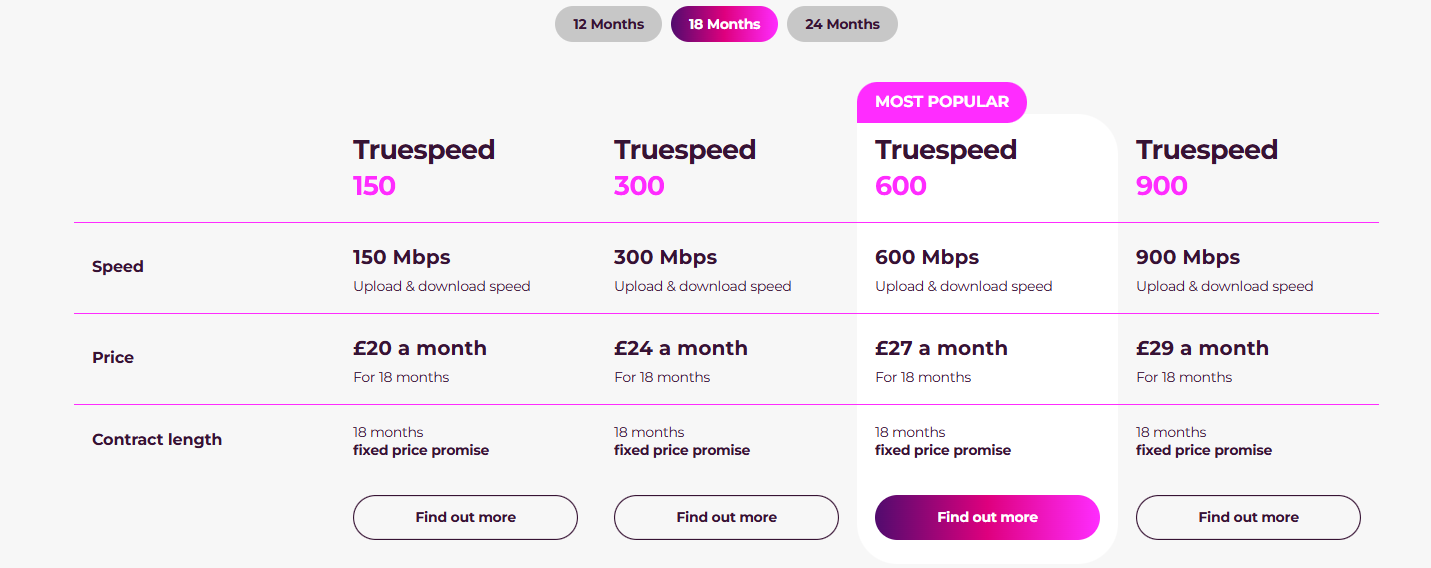
For households considering a switch, Truespeed offers a tiered range of full-fibre packages, with download and upload speeds starting at 150 Megabits per second and rising to 900 Megabits per second for its top-tier plan. Because the connection is symmetrical, meaning upload speeds match download speeds, the service is particularly well suited to households that rely heavily on video calls, cloud backups or uploading large files, tasks that can be painfully slow on traditional asymmetrical broadband connections.
Pricing is presented as a central selling point. The company promotes a “Fixed Price Promise,” under which the monthly rate a customer signs up for stays the same for the length of their contract, with no mid-contract price increases — a practice that has drawn criticism when used by some larger providers, several of which link annual price rises to inflation measures plus an additional percentage. Truespeed also offers a 30-day, no-questions-asked money-back guarantee, along with what it calls “One Touch Switching,” a service designed to handle the process of moving a customer away from their existing provider so they do not need to contact their old supplier themselves.
On the hardware side, Truespeed supplies customers with a router it brands the Truespeed Hub 7, built around the newer Wi-Fi 7 wireless standard. The company states this hardware offers substantially faster in-home wireless performance and greater bandwidth than older Wi-Fi 6 routers, allowing more devices to be connected simultaneously without a noticeable drop in performance, a growing concern for households now filled with smart TVs, security cameras, gaming consoles and other connected devices.
Community Roots and Regional Partnerships
Beyond its infrastructure and pricing, Truespeed has worked to position itself as a company embedded in the communities it serves rather than a remote, faceless utility. It has struck partnerships with regional sporting institutions, including a multi-year agreement with Bath Rugby that made Truespeed the club’s official broadband and public Wi-Fi provider and saw ultrafast Wi-Fi installed across the club’s historic Recreation Ground. The company has also connected Bath Cricket Club, supporting the venue’s live-streaming capabilities and general operations.
The business currently employs more than 200 people directly and works with numerous additional contractors to plan, build and maintain its network, according to figures published on its corporate site. It has also been shortlisted for industry recognition, including a nomination at the Connected Britain Awards for Broadband Provider of the Year.
Truespeed’s Home City: What Full-Fibre Broadband Means for Bath
Bath holds a special place in Truespeed’s story — it is where the company is headquartered, and it remains one of the clearest examples of how the provider approaches a city market. Alongside the surrounding Bath & North East Somerset area, neighbourhoods such as Combe Down, Keynsham and Saltford have been brought onto the full-fibre network, giving residents an alternative to the copper-based services that once dominated the city.
For a UK city that draws millions of tourists a year and hosts a growing base of remote workers, freelancers and small businesses, dependable broadband has become a genuine economic issue rather than a lifestyle upgrade. A hospitality business in central Bath relying on cloud-based booking systems, or a household with someone working remotely for a company based in London or further afield, both depend on a connection that will not buckle during the evening rush when everyone in the street is streaming or video-calling at once. Truespeed’s pitch to Bath residents rests on exactly that promise: a dedicated fibre line into each property, rather than a shared connection that slows as demand rises.
The company’s visibility in Bath has also been reinforced through local partnerships, most notably with Bath Rugby and Bath Cricket Club, which have put the Truespeed name in front of tens of thousands of local sports fans across the city and the wider UK each season.
Why This Matters for the UK Broadband Market
The UK’s broadband landscape has changed dramatically over the past decade. Government targets have pushed for the vast majority of the country to have access to full-fibre connections, and dozens of smaller “alt-net” companies sprang up to help deliver on that ambition, often focusing on rural or semi-rural areas that the dominant national operators were slower to reach. However, building physical fibre infrastructure is expensive, and not every smaller operator has managed to scale sustainably. Industry observers have watched closely as consolidation has begun to reshape the sector, with mergers and acquisitions increasingly seen as the mechanism through which smaller networks gain the financial footing to keep expanding and to compete on price and service quality with much larger rivals.
Truespeed’s merger with Freedom Fibre is a clear example of this pattern. By combining Freedom Fibre’s wholesale network capabilities with Truespeed’s established retail and customer-facing operations, the newly formed Freedom Truespeed Group is positioning itself to be a more durable competitor, with both broader geographic reach and a more efficient underlying business structure. For consumers, particularly those in smaller towns and villages that have historically had limited broadband choice, this kind of consolidation could mean access to modern, reliable full-fibre connections reaching areas that might otherwise have waited years longer for an upgrade.
Whether the newly enlarged group can maintain the community-focused, customer-service-driven reputation that helped Truespeed stand out as a smaller regional player remains to be seen as integration proceeds. But for now, the company’s expansion marks a notable step in the ongoing effort to bring genuinely fast, reliable internet to parts of the United Kingdom that have waited far too long for it.
The Bigger Picture: Why Rural Connectivity Still Lags Behind
It is worth remembering why companies like Truespeed emerged in the first place. For years, the economics of broadband rollout favoured densely populated cities and large towns, where a single stretch of cable could serve thousands of households at relatively low cost per connection. Sparsely populated villages, by contrast, often required the same length of expensive fibre cable to reach only a handful of homes, making them far less commercially attractive to the country’s largest network builders. This left many rural and semi-rural communities relying on slow, unreliable copper-based connections long after nearby cities had already moved on to full-fibre speeds.
The rise of “alt-net” providers such as Truespeed was, in many ways, a direct response to this imbalance. By deliberately targeting the towns and villages that larger operators were reluctant to prioritise, these smaller companies helped accelerate the pace at which full-fibre coverage spread across the UK, even if their overall market share remained modest compared with national giants. Truespeed’s own figures suggest its network now reaches well over 170,000 residential and business premises, a number that has only grown following its merger with Freedom Fibre.
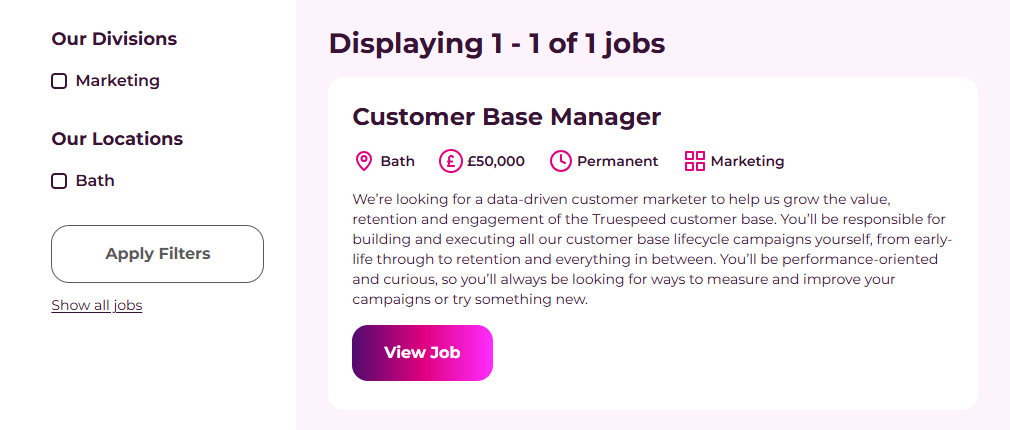
Vacancy
What to Watch Next
As the Freedom Truespeed Group moves through the process of integrating its systems, teams and customer operations, industry watchers will be paying close attention to how well the enlarged company balances growth with the personal, locally focused service that smaller providers often use to differentiate themselves from national rivals. Continued investment in network expansion, transparent pricing, and consistent customer support are likely to remain the key battlegrounds as competition in the UK’s full-fibre market continues to intensify. For now, though, the merger stands as one of the clearer signs yet that Britain’s alternative broadband sector is entering a new, more consolidated phase, one that could ultimately determine which regional providers survive and thrive in the years ahead.
Frequently Asked Questions About Truespeed Broadband in the UK
Is Truespeed available in Bath? Yes. Truespeed is headquartered in Bath and the city, along with surrounding areas such as Bath & North East Somerset, is part of its established South West UK network.
What speeds does Truespeed offer? Truespeed’s full-fibre packages in the UK currently range from 150 Megabits per second up to 900 Megabits per second, with symmetrical upload and download speeds.
Is Truespeed the same company as Freedom Fibre? Following a merger completed in April 2026, Truespeed and Freedom Fibre now operate together as the Freedom Truespeed Group. Freedom Fibre runs the wholesale network, while Truespeed remains the customer-facing broadband brand in areas including Bath and the wider South West.
Does Truespeed increase prices during a contract? No. Truespeed markets a “Fixed Price Promise,” meaning the monthly price a UK customer agrees to at sign-up does not rise for the duration of their contract term.