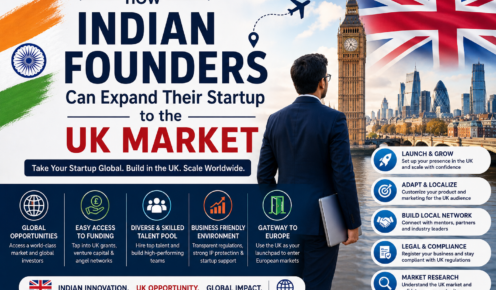

For years, Indian founders eyeing an overseas launch defaulted to the United States. That is changing fast. With a new trade agreement in force, a founder-friendly visa route, and a market that already speaks the language of Indian business, the UK has quietly become one of the most practical places for an Indian company to plant its first international flag. If you are trying to figure out how to expand a startup to UK from India, 2026 is arguably the best window in a decade to do it.
This guide walks through the real mechanics — legal structure, visas, funding, and go-to-market — with data you can act on, not just inspiration. Whether you’re a bootstrapped SaaS founder testing your first international customer or a Series A company planning a full UK office, the steps below apply in roughly the same order: validate, incorporate, secure the right visa, get compliant, then raise and localise.
Why the UK Makes Sense for Indian Startups Right Now
Three forces have converged to make the UK unusually attractive for Indian founders this year.
1. The India-UK trade agreement is live. The Comprehensive Economic and Trade Agreement (CETA) between India and the UK came into force on 15 July 2026. Under the deal, roughly 99% of Indian goods entering the UK now qualify for zero or reduced tariffs, and a parallel Double Contributions Convention means employees moving between the two countries avoid paying social security twice for up to five years — a direct win if you plan to relocate staff.
2. The visa route no longer demands a fixed investment. The old £50,000 minimum-investment rule that scared off bootstrapped founders is gone under the current Innovator Founder visa framework. What matters now is whether an approved endorsing body believes your idea is innovative, viable, and scalable.
3. English-language market with deep India ties. No translation layer, a legal system many Indian founders already understand from a common-law background, and one of the largest Indian diaspora populations in Europe waiting to be your first customers, hires, and advocates.
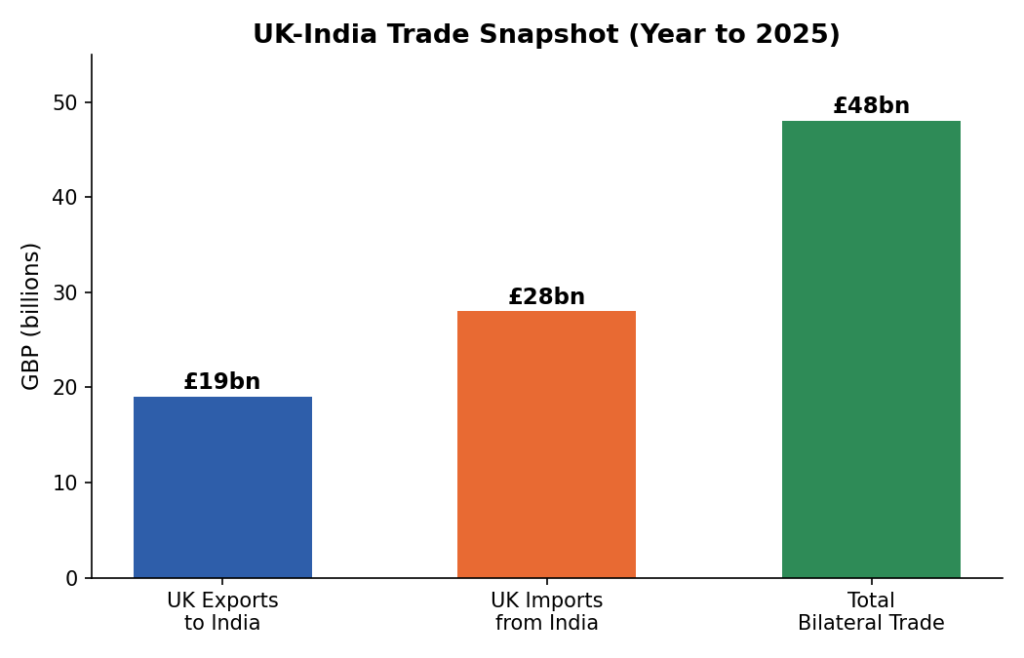
UK-India Trade Snapshot
| Metric | Figure (approx.) |
|---|---|
| UK exports to India (year to Sept 2025) | £19 billion |
| UK imports from India (year to Sept 2025) | £28 billion |
| Total UK-India trade (2025) | £48 billion |
| Indian goods entering UK duty-free/reduced under CETA | 99% |
| UK goods entering India duty-free/reduced under CETA | 90% |
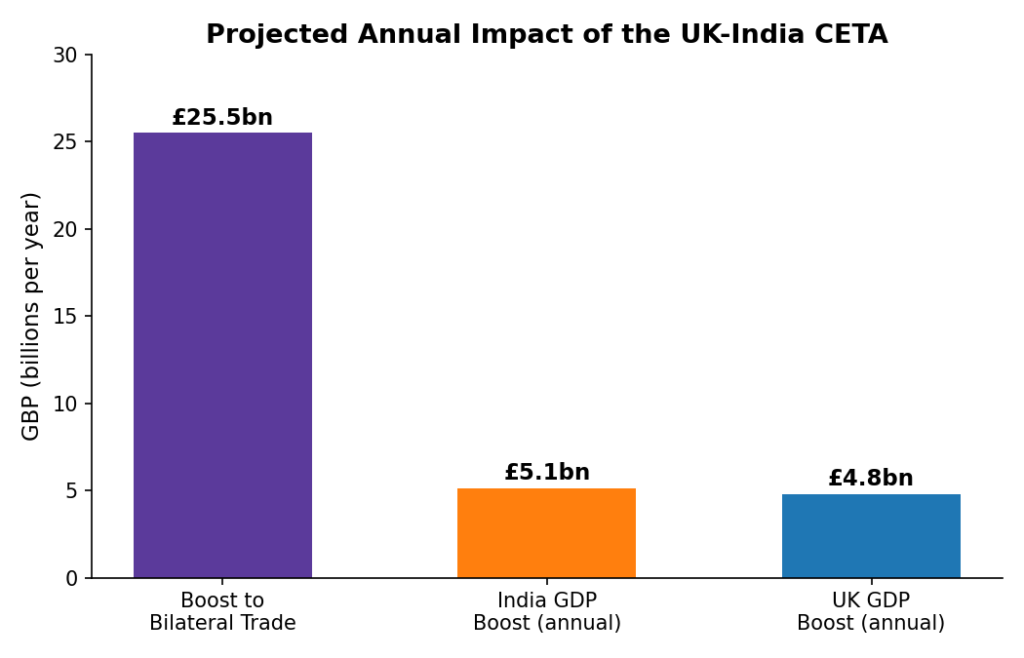
Projected Annual Economic Impact of CETA
| Impact Area | Projected Annual Gain |
|---|---|
| Boost to bilateral trade | £25.5 billion |
| India GDP uplift | £5.1 billion |
| UK GDP uplift | £4.8 billion |
Figures sourced from UK government and parliamentary trade briefings, 2026.
Step 1: Validate Demand Before You Book a Flight
Before any paperwork, confirm the UK actually needs what you’re selling. Founders who skip this step tend to over-invest in incorporation and visas for a market that ignores them.
- Run a paid pilot with UK customers while still operating from India — most SaaS, fintech, and services businesses can sell cross-border without a local entity at first.
- Study 8–10 direct or adjacent competitors already operating in the UK to understand pricing norms and buyer expectations.
- Talk to at least 15–20 potential UK customers or partners before committing capital to a physical presence.
Only once you have signal — inbound demand, a signed pilot customer, or investor interest tied to a UK presence — does it make sense to formalise the expansion.
Step 2: Choose the Right Legal Structure
Most Indian founders expanding to the UK choose one of three structures. Each has different tax, liability, and control implications.
| Structure | Best For | Setup Time | Key Consideration |
|---|---|---|---|
| UK Private Limited Company (subsidiary) | Founders raising UK/EU capital or hiring locally | 1–2 days (Companies House) | Separate legal entity; clean cap table for UK investors |
| Branch of Indian company | Testing the market with minimal restructuring | 2–4 weeks | Parent company remains fully liable for branch obligations |
| UK Establishment via a holding structure | Startups planning to flip HQ or raise a global round | 4–8 weeks with legal counsel | More complex, but attractive to international VCs |
A private limited company (Ltd) registered with Companies House is the most common route — it is inexpensive, fast, and the structure most UK investors and enterprise customers expect to see.
Step 3: Pick the Right Visa Route
This is where most founders get stuck. The UK closed its old Sole Representative visa to new applicants back in 2022, so the pathway has changed. Here’s the current landscape for founders planning to relocate.
| Visa Route | Who It’s For | Investment Needed | Path to Settlement |
|---|---|---|---|
| Innovator Founder visa | Founders actively running an innovative, scalable UK business | No fixed minimum — must show sufficient funds for the plan | 3 years |
| UK Expansion Worker (Global Business Mobility) | Sending a senior employee to open a UK branch of an Indian company | Company must hold a sponsor licence | No direct settlement path |
| Global Talent visa | Founders recognised as leaders in tech, research, or the arts | None | 3–5 years |
| Skilled Worker visa | Hiring your own UK-based team once established | Sponsor licence required | 5 years |
For most solo or co-founder teams, the Innovator Founder visa is the practical route. You’ll need endorsement from a Home Office-approved endorsing body before applying — as of 2026 there are only a handful of active bodies, so budget 4–8 weeks for that stage alone. Applicants must also show at least £1,270 in personal savings held for 28 consecutive days, meet an English-language requirement, and score 70 points across endorsement, language, and financial criteria.
If you’re not relocating yourself and simply want to send a trusted employee to set up the UK branch, the UK Expansion Worker route under Global Business Mobility is the direct replacement for the now-closed Sole Representative visa — though it requires your company to first obtain a sponsor licence and doesn’t offer a direct settlement path.
Step 4: Get the Banking and Compliance Basics Right
Once incorporated, a handful of operational steps unlock everything else:
- Open a UK business bank account. Digital-first banks (Wise Business, Revolut Business) approve non-resident founders faster than traditional high-street banks, which often want an in-person meeting.
- Register for Corporation Tax and, if applicable, VAT with HMRC within three months of starting to trade.
- Set up UK payroll (PAYE) the moment you make your first UK hire, even a part-time one.
- Get business insurance — public liability and professional indemnity are expected by most enterprise UK customers before they’ll sign a contract.
- Understand rules of origin under CETA if you’re moving physical goods, since preferential tariffs only apply to products genuinely made or substantially transformed in India.
Step 5: Raise Capital From UK and India-Focused Investors
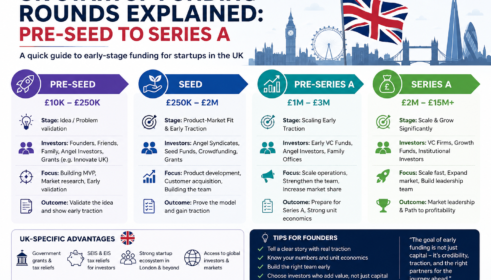
The UK has one of Europe’s deepest venture capital pools, and a growing number of funds specifically back the India-UK corridor. When approaching UK investors, founders should be ready to show:
- A UK-incorporated entity or a credible plan to incorporate on close
- Early UK revenue or a signed letter of intent from a UK customer
- A cap table that a UK fund can invest into cleanly (this is where the Ltd subsidiary structure pays off)
| Investor Type | What They Look For | Typical Check Size |
|---|---|---|
| UK seed/angel networks | Early traction, strong founding team | £50K–£500K |
| India-UK corridor VC funds | Founders with an India base and UK growth ambitions | £500K–£3M |
| Growth-stage UK/EU VCs | Proven UK revenue, expansion metrics | £3M+ |
| Government-backed schemes (e.g., Innovate UK grants) | Innovation-led ventures, R&D intensity | Grant-based, non-dilutive |
Step 6: Localise, Don’t Just Translate
A common mistake Indian founders make is assuming the UK is “India with different currency.” It isn’t. Successful expansion requires:
- Pricing in GBP with UK-standard payment terms (Net 30 is common in B2B; UK buyers expect invoicing discipline)
- UK-specific compliance — GDPR (which UK data protection law closely mirrors), UK-specific consumer rights language, and sector regulations (FCA for fintech, MHRA for healthtech)
- A UK-based advisor or non-executive director who can open doors with customers and investors who still prefer a local face on the board
Common Pitfalls to Avoid
- Incorporating too early, before there’s real UK demand, and burning runway on compliance instead of sales
- Underestimating endorsing-body timelines for the Innovator Founder visa — leave at least two months of buffer
- Ignoring the Double Contributions Convention, which can meaningfully reduce payroll costs when moving Indian employees temporarily to the UK
- Copy-pasting the India pricing model instead of researching what UK buyers actually pay for comparable products
- Skipping legal review of rules of origin under CETA if the business involves physical goods, which can void tariff benefits if paperwork is wrong
- Treating the endorsing body interview as a formality — endorsing bodies reject a meaningful share of applications each year for weak scalability evidence, so rehearse your pitch as seriously as you would for an investor
- Forgetting Life in the UK obligations if you’re on a path to settlement; the test and residency tracking matter more than most founders expect until year two or three
Final Thoughts
The path to expand a startup to UK from India is more structured today than it has been in years — a live trade agreement, a visa route that doesn’t require a fixed investment, and a market that already understands Indian business culture. The founders who win this window won’t be the ones who move fastest; they’ll be the ones who validate demand first, choose the right entity and visa route deliberately, and treat UK compliance as seriously as they treat product-market fit. Start with a pilot, prove revenue, and let the paperwork follow the traction — not the other way around.