Gross Domestic Product, or GDP, is simply the total value of all goods and services a country produces in a year. Think of it as the size of a country’s economic pie. When the pie grows, there is more money moving around — more jobs, more income, more business opportunities, and usually a better standard of living for ordinary people.
GDP grows in two basic ways: a country either produces more goods and services, or the goods and services it already produces become more valuable. Governments, businesses, and even everyday consumers all play a role in this growth. In this article, we will break down exactly how a country can increase its GDP, using simple language, real-world examples, and the latest research and data from organizations like the International Monetary Fund (IMF) and the United Nations.
By the end, you will understand the GDP formula, the ten key levers that drive economic growth, and a real case study — India — one of the fastest-growing large economies in the world today.
The GDP Formula, Explained Simply
Economists calculate GDP using what is called the expenditure approach. It sounds technical, but it is really just adding up everything that is spent in an economy in a year:
GDP = C + I + G + (X − M)
Here is what each letter means, in plain words:
| Symbol | What It Means | Everyday Example |
| C | Consumer Spending — money households spend on goods and services | Buying groceries, phones, clothes |
| I | Business Investment — money companies spend on growth | Building a new factory or buying machines |
| G | Government Spending — money the state spends on public projects | Building highways, schools, hospitals |
| X − M | Net Exports — exports minus imports | Selling software abroad, importing less oil |
Table 1: The four components of GDP under the expenditure approach
In most large economies, consumer spending is the biggest slice of the pie, often accounting for well over half of total GDP, followed by business investment, government spending, and finally net exports. The chart below shows an illustrative breakdown for a large, consumption-driven economy.
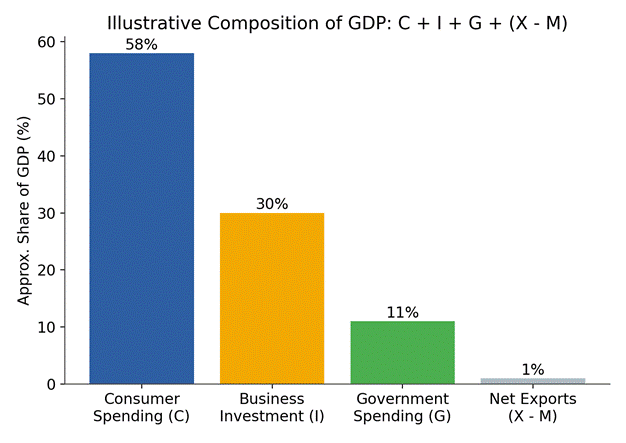
Figure 1: Illustrative composition of GDP by component
Ten Ways a Country Can Increase Its GDP
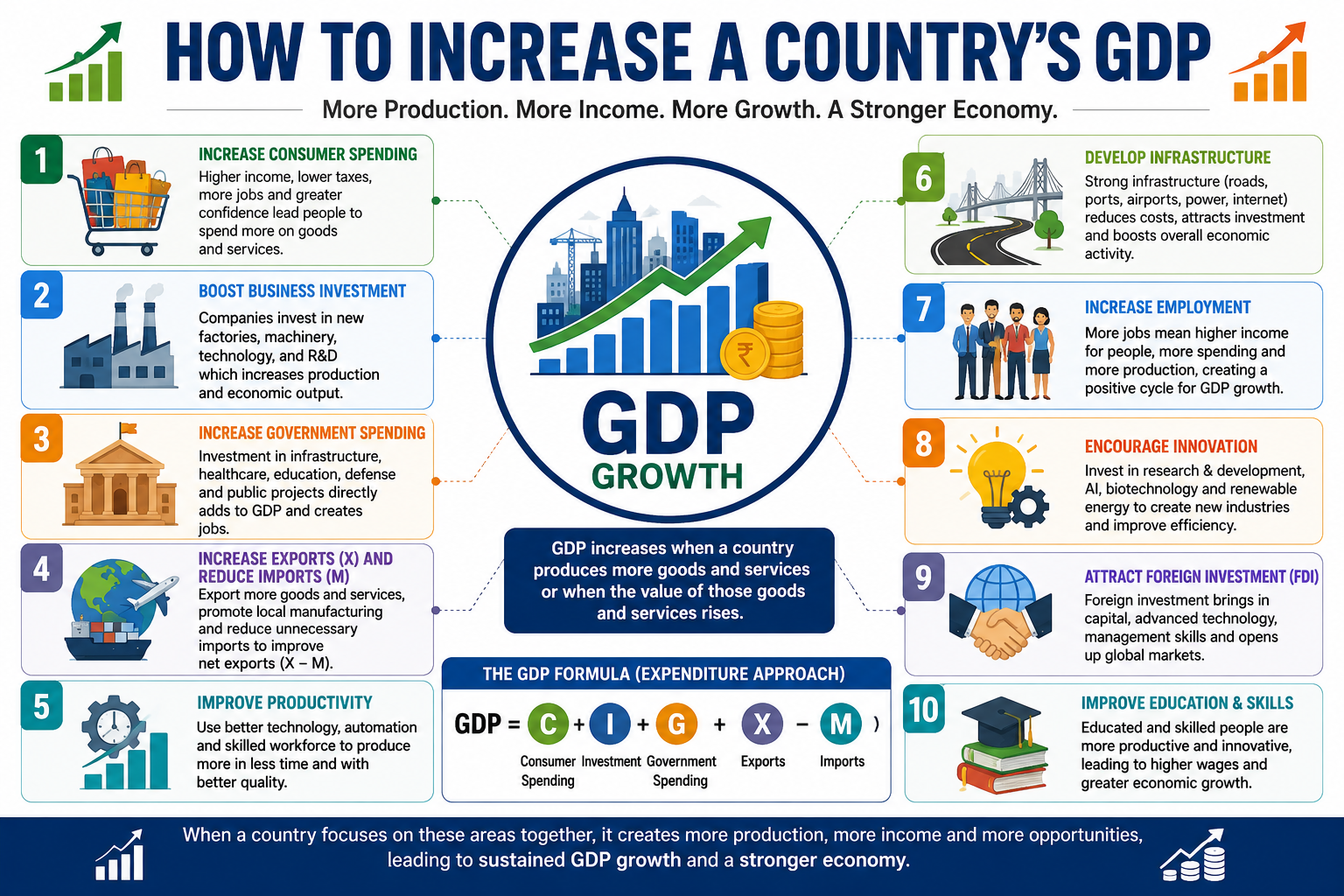
Now let’s go through the ten main levers policymakers, businesses, and citizens can pull to grow the economy. Each one connects back to the C + I + G + (X − M) formula above.
1. Increase Consumer Spending (C)
When households have more money and more confidence, they spend more. This spending directly adds to GDP because businesses sell more, earn more, and often hire more staff in response. Consumer spending is usually the single largest slice of GDP in most economies, which is why economists watch retail sales and consumer-confidence surveys so closely — they are early signals of where the whole economy is heading.
- Higher household income
- Lower taxes, leaving people with more take-home pay
- More employment opportunities
- Greater consumer confidence in the future
Example: When more people buy cars, smartphones, or homes, every one of those purchases adds to GDP because it counts as spending on finished goods and services.
There is also a multiplier effect at work here. When a household spends money at a local restaurant, that money becomes income for the restaurant owner, who then spends part of it on staff wages, suppliers, and rent. Each of those recipients spends a portion of what they receive too, so a single rupee or dollar of spending can ripple through the economy several times over before it settles. This is one reason governments sometimes cut taxes or hand out stimulus payments during a slowdown — the goal is to restart this spending cycle quickly.
2. Increase Business Investment (I)
Businesses drive growth when they put money into expanding their operations rather than just maintaining them. This creates jobs today and higher output tomorrow.
- Building new factories
- Purchasing machinery and equipment
- Investing in technology and research
- Starting new businesses and start-ups
Example: A car company opening a new manufacturing plant does not just build cars — it also creates construction jobs, buys steel and electronics from suppliers, and adds directly to national output.
Business investment tends to be more volatile than consumer spending because it depends heavily on confidence about the future. If interest rates are high, borrowing to build a new factory becomes expensive, so companies often delay expansion plans. If interest rates are low and demand looks strong, businesses are more willing to take the risk of investing. This is why central banks pay such close attention to investment levels when they set interest rates — investment is one of the most powerful, but also most sensitive, engines of GDP growth.
3. Increase Government Spending (G)
Public spending on infrastructure and services counts directly as part of GDP, and it also makes the rest of the economy more efficient by reducing business costs.
- Building highways, railways, and airports
- Investing in healthcare and education
- Defense and public-safety spending
- Public infrastructure and utility projects
Example: If a government spends ₹50,000 crore building new highways, that spending is counted directly in GDP, and the finished roads later lower transport costs for every business that uses them.
Government spending has a double benefit. In the short term, it counts directly toward GDP, the same way any other purchase does. In the long term, well-targeted spending — on things like roads, power grids, schools, and hospitals — makes the whole economy more productive for years afterward, because businesses and workers can move goods, people, and ideas more efficiently. This is why economists distinguish between ‘productive’ government spending, which builds lasting economic capacity, and spending that offers only a short-term boost without lasting benefits.
4. Increase Net Exports (X − M)
A country earns more from the rest of the world when it sells more than it buys. Exporting high-value goods and services, while limiting unnecessary imports, strengthens GDP and the currency.
- Export more goods and services
- Reduce reliance on unnecessary imports
- Promote domestic manufacturing to replace imports
Example: When a country like India exports more software services and pharmaceuticals than it imports, that trade surplus adds directly to GDP.
Exporting is powerful because it brings in money from outside the domestic economy rather than simply moving money between people who already live in the country. A country does not need to stop importing altogether — imports of raw materials or machinery can actually help a country produce more later. The real goal is a healthy balance: importing what genuinely adds value, such as advanced equipment or specialized components, while steadily growing the export of goods and services where the country has a natural or developed advantage.
5. Improve Productivity
Productivity means producing more output from the same amount of labor and capital. This is one of the most powerful long-term growth engines because it does not depend on simply adding more workers or more spending.
- Better technology and equipment
- A more skilled workforce
- Automation of repetitive tasks
- Digital transformation of business processes
Globally, labor productivity growth has been a major focus for policymakers: according to United Nations tracking of the Sustainable Development Goals, worldwide labor productivity growth rebounded to about 1.5% in 2024 after nearly stalling in the previous two years, though it still sits below the pre-pandemic (2015–2019) average of 1.8%.
Think of productivity this way: if a factory worker could sew one shirt per hour by hand, and a new machine lets that same worker produce five shirts per hour, output has grown five-fold without hiring a single extra person. That is productivity growth, and it is considered the healthiest form of GDP growth because it does not require constantly adding more workers, more raw materials, or more debt — it comes from working smarter.
6. Develop Infrastructure
Good infrastructure is like the circulatory system of an economy — it moves goods, people, and information efficiently. Poor infrastructure raises costs and slows everything down.
- Better roads and railways
- Modern ports for trade
- Reliable airports
- Stable electricity and internet connectivity
Recent international research supports this: a 2025 analysis by the Centre for Economic Policy Research found that many countries could gain roughly a third more economic value from their public spending simply by allocating it more efficiently toward infrastructure, health, education, and research rather than less productive areas.
Infrastructure works quietly in the background of almost every economic transaction. A farmer cannot get produce to market without decent roads. A factory cannot run without reliable power. An online business cannot operate without internet connectivity. Because infrastructure lowers the cost of doing almost everything else in the economy, investment in it tends to pay for itself many times over across decades, even though the upfront cost can look enormous.
7. Increase Employment
More people working means more goods produced, more income earned, and more spending in shops and businesses — a cycle that reinforces itself.
- Higher production levels
- Higher household income
- Higher consumer spending
This is why unemployment is such a closely watched number: the global unemployment rate fell to a record low of about 5.0% in 2024, according to United Nations economic tracking, though a large share of workers worldwide are still in informal jobs that are less stable and less productive.
It is worth noting that the quality of employment matters as much as the quantity. A country with millions of low-paying, unstable informal jobs will see a smaller GDP boost than one with the same number of people in stable, well-paying formal jobs, because formal employment tends to come with higher wages, benefits, and job security — all of which support stronger and more predictable consumer spending.
8. Encourage Innovation
New ideas and new technologies let an economy produce more value without simply using more raw resources. Innovation opens entirely new industries that did not exist before.
- Research & Development (R&D)
- Artificial Intelligence and automation
- Biotechnology breakthroughs
- Renewable energy technology
Analysts tracking the 2025-2026 global economy have pointed out that a surge of investment linked to artificial intelligence has become one of the factors supporting steadier global growth heading into 2026.
Innovation is different from ordinary investment because it does not just add more of the same — it creates entirely new products, services, and even industries that did not exist before. Streaming platforms, ride-hailing apps, and electric vehicles are all examples of innovations that opened brand-new revenue streams and job categories rather than simply expanding an existing one. Economies that consistently fund research and protect ideas through patents and intellectual-property laws tend to attract more of this kind of growth over time.
9. Attract Foreign Investment (FDI)
When foreign companies build factories, offices, or research centers in a country, they bring in capital that a domestic economy might not have generated on its own.
- Fresh capital inflows
- New job creation
- Technology transfer from abroad
- New export opportunities
India offers a clear recent example. Gross foreign direct investment into India rose from about US$43.4 billion to US$51.8 billion between April–September of two consecutive fiscal years, a jump of roughly 19%, while net FDI more than doubled over the same period.
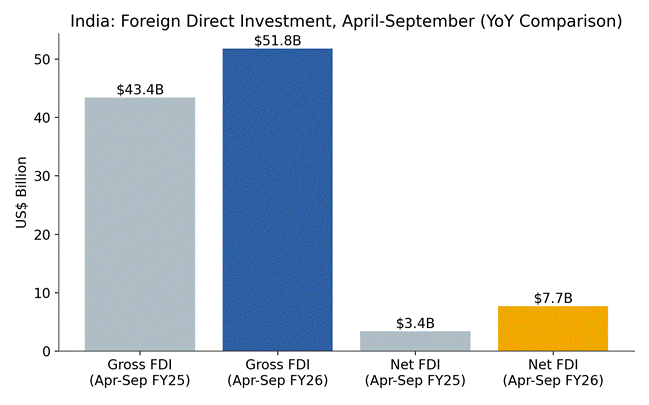
Figure 2: India’s FDI inflows, April–September, year-on-year comparison
10. Improve Education and Skills
A more skilled workforce produces higher-quality goods and services and commands higher wages, which lifts both output and consumer spending at the same time.
- Higher wages for skilled workers
- Better-quality products and services
- Greater overall economic output
Education is often called an ‘investment in human capital,’ and for good reason: a country’s workforce is its most valuable long-term asset. A software engineer trained to build modern applications, a nurse trained in advanced medical care, or a technician trained to operate automated machinery all produce far more economic value than an untrained worker doing the same job. Because skills take years to build, the payoff from education spending shows up gradually — but it tends to be one of the most durable drivers of GDP growth a country can invest in.
The Long-Term Growth Mechanism (In Simple Terms)
Economists also study long-run growth using what is known as the Solow growth model. Don’t worry about the technical formula — the idea behind it is simple: an economy keeps adding capital (machines, buildings, technology) until the amount it invests each year just balances out the amount lost to depreciation, population growth, and other factors. Economists call this balance point the ‘steady state.’
In plain terms: a country cannot grow forever just by pouring in more machines and buildings. Eventually, the biggest driver of long-run growth becomes technology and productivity — that is, working smarter, not just working with more stuff. This is exactly why items 5 (productivity) and 8 (innovation) from the list above matter so much for sustained, long-term GDP growth rather than short bursts of growth.
Case Study: How India Is Growing Its GDP
India is one of the best real-world examples of many of these growth levers being used together. According to the IMF’s most recent World Economic Outlook update, India’s economy was projected to grow around 7.3% in the 2025 fiscal year, making it the fastest-growing major economy in the world, ahead of China’s roughly 4.8% and the United States’ roughly 1.9-2.0%.
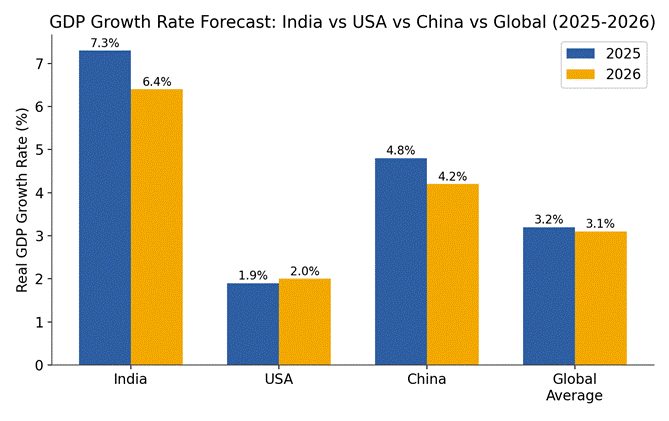
Figure 3: GDP growth rate comparison — India, USA, China, and the global average (2025-2026 forecasts)
India’s growth strategy touches almost every lever discussed in this article:
- Expanding manufacturing through initiatives like ‘Make in India’
- Growing exports of IT services, pharmaceuticals, and electronics
- Investing heavily in infrastructure — roads, railways, ports, and renewable energy
- Attracting record foreign direct investment
- Improving education and workforce skills
- Supporting start-ups and innovation hubs
- Increasing labor-force participation
- Modernizing agriculture with new technology
The IMF’s November 2025 review of India’s economy noted that the country’s growth had been supported by sound macroeconomic policy and reform, with the economy expanding 7.8% in the April-June quarter alone — its fastest pace in five quarters — even while facing steep new U.S. tariffs on its exports. Strong domestic consumption and resilient services exports were highlighted as the key drivers keeping growth on track.
This case shows an important lesson: GDP growth rarely comes from just one policy. It comes from combining consumer demand, business investment, government spending on infrastructure, exports, and productivity gains all at once.
Quick Reference: The Ten Growth Levers
| # | Lever | Which GDP Component It Boosts |
| 1 | Increase consumer spending | C |
| 2 | Increase business investment | I |
| 3 | Increase government spending | G |
| 4 | Increase net exports | X − M |
| 5 | Improve productivity | All components |
| 6 | Develop infrastructure | I, G |
| 7 | Increase employment | C, I |
| 8 | Encourage innovation | I, X − M |
| 9 | Attract foreign investment | I, X − M |
| 10 | Improve education & skills | C, I, X − M |
Table 2: How each growth lever connects to the GDP formula
Challenges and Limits to GDP Growth
Growing GDP is not automatic, and it is not without trade-offs. Understanding the obstacles is just as important as understanding the growth levers themselves.
Inflation Risk
If demand grows faster than an economy’s ability to produce goods and services, prices rise instead of output. This is why central banks often raise interest rates when growth looks too fast — to cool spending down before inflation gets out of control.
Debt Sustainability
Government spending can boost GDP in the short term, but if it is funded by excessive borrowing, rising public debt can eventually crowd out productive investment and raise borrowing costs for the whole economy. According to IMF fiscal monitoring, global public debt is projected to surpass 100% of GDP within the next few years, which is why many economists argue for ‘spending smarter’ rather than simply spending more.
External Shocks
Trade tensions, tariffs, wars, and global financial swings can all disrupt growth plans overnight. India’s recent growth, for example, has had to absorb the impact of steep new U.S. tariffs on its exports, even as domestic demand stayed strong enough to keep overall growth on track.
Inequality and Quality of Growth
GDP measures the total size of the economy, but it does not show how that growth is shared. A country can post strong GDP growth while wages for the majority of workers stay flat, if the gains are concentrated in a small number of industries or among a small share of the population. This is why many economists now track GDP growth alongside measures like median household income and employment quality, not GDP alone.
Frequently Asked Questions
Is a higher GDP always better?
Generally, yes — higher GDP usually means more jobs, higher incomes, and more government revenue for public services. But GDP alone does not capture environmental costs, income inequality, or quality of life, so most economists recommend looking at GDP alongside other indicators.
Can GDP grow too fast?
Yes. Growth that outpaces an economy’s productive capacity tends to show up as inflation rather than real gains in output, which is why central banks try to keep growth on a steady, sustainable path rather than the fastest possible path.
Which growth lever matters most?
There is no single answer — it depends on the country’s stage of development. Emerging economies often get the fastest gains from infrastructure, education, and attracting foreign investment, while advanced economies increasingly depend on innovation and productivity growth to keep expanding, since they already have well-developed infrastructure and high employment levels.
Conclusion
A country’s GDP grows when people spend more, businesses invest more, governments build useful infrastructure, and exports outpace imports. Underneath all of that, the deepest and most lasting driver of growth is productivity — getting more value out of the same workers, land, and capital through better skills, better technology, and constant innovation.
India’s current growth story shows what happens when many of these levers are pulled together: rising manufacturing, record foreign investment, expanding exports, and a young, increasingly skilled workforce. No single policy creates sustained GDP growth on its own — it is the combination, applied consistently over years, that builds a larger, stronger economy.