
Choosing where to incorporate is one of the first big decisions any founder makes, and it shapes almost everything that follows — how much tax the company pays, how easily it can raise money, and how investors will view the cap table. This question comes up constantly in founder forums: should a startup UK entity be the default choice, or does it make more sense to incorporate in the United States or India instead? There is no single right answer, but there is a right answer for your specific situation, and this guide walks through the practical differences so you can make that call with confidence.
Why Jurisdiction Matters More Than Founders Expect
New founders often treat incorporation as paperwork to get out of the way before the “real work” starts. In practice, the jurisdiction you pick affects:
- How much of your revenue goes to corporate tax
- Whether venture capital funds can invest in you at all
- How long it takes to open a business bank account
- What compliance and reporting burden your team carries every year
- How easily you can hire internationally or move the company later
A startup UK company, a US Delaware C-Corp, and an Indian Private Limited company are structurally different animals, even though they all technically do the same job of giving your business a legal identity.
Registering a Startup in the UK
The UK remains one of the fastest and cheapest places in the world to incorporate. A startup UK business is typically set up as a Private Limited Company (Ltd) through Companies House, and the process is almost entirely digital.
Key features of a startup UK company formation:
- Registration can be completed in as little as 24 hours, often the same day
- Filing fee is around £50 for standard online registration
- No minimum capital requirement — you can start with £1 of share capital
- Corporate tax rate is 19% for profits under £50,000 and 25% for profits above £250,000, with marginal relief in between
- Directors and shareholders can be non-UK residents
- Companies House filings (annual accounts, confirmation statement) are relatively light compared to India’s compliance load
For founders building a startup UK entity primarily to serve the UK or EU-adjacent market, or to access UK-based accelerators like Techstars London or Entrepreneur First, this is usually the simplest path. The UK also has the SEIS/EIS scheme, which gives early investors meaningful tax relief — a strong incentive for angel investors backing an early-stage startup UK company.
Registering a Startup in the US
The United States, and Delaware specifically, is the default choice for founders targeting venture capital from Silicon Valley or global funds. Roughly two-thirds of Fortune 500 companies are incorporated in Delaware, and most US VCs will only invest in a Delaware C-Corp.
Key features of US incorporation:
- Delaware registration can be completed in 1–3 business days through a registered agent
- Franchise tax and registered agent fees run a few hundred dollars a year, even with zero revenue
- Federal corporate tax rate is a flat 21%, plus state-level taxes depending on where you actually operate
- Delaware’s Court of Chancery has decades of case law specifically for corporate disputes, which investors find reassuring
- Non-US founders can incorporate in Delaware without living in the US, though banking can be harder to set up remotely
The tradeoff is ongoing compliance: US entities need a registered agent, annual franchise tax filings, and — if you have non-US shareholders — more complex tax reporting (Form 5471, FBAR, etc.). Many founders who begin with a startup UK entity later “flip” to a Delaware C-Corp once they raise a US-led funding round, since US investors are simply more comfortable with Delaware paperwork.
Registering a Startup in India
India offers the largest domestic market of the three and the fastest-growing startup ecosystem by volume, but registration and ongoing compliance are noticeably heavier.
Key features of Indian incorporation:
- A Private Limited Company is registered through the Ministry of Corporate Affairs (MCA), typically taking 7–15 working days
- Minimum two directors and two shareholders required
- Corporate tax rate is around 25.17% (including surcharge and cess) for most domestic private companies, with a concessional 15% rate available for new manufacturing companies under Section 115BAB
- The Startup India initiative offers tax holidays on profits for three consecutive years within the first ten years, plus easier access to government funding schemes
- GST registration, ROC filings, and statutory audits add ongoing compliance overhead that a comparable startup UK company would not face at the same revenue stage
India makes the most sense for founders whose primary customer base, workforce, or manufacturing operations are domestic, or who want to tap central and state government incentive schemes.
Side-by-Side Comparison Table
| Factor | UK (Ltd) | US (Delaware C-Corp) | India (Pvt Ltd) |
|---|---|---|---|
| Avg. registration time | 1 day | 1–3 days | 7–15 days |
| Filing cost | ~£50 | ~$100–$300 + agent fees | ~₹6,000–15,000 |
| Corporate tax rate | 19–25% | 21% federal + state | ~25.17% |
| Min. directors/shareholders | 1 | 1 | 2 / 2 |
| VC familiarity (Western funds) | Moderate | Very high | Low–moderate |
| Non-resident founder friendly | Yes | Yes (banking harder) | Requires resident director |
| Early-investor tax incentive | SEIS/EIS | QSBS (Sec. 1202) | Startup India tax holiday |
| Annual compliance burden | Light | Light–moderate | Heavy |
Note: tax rates and thresholds change with each budget cycle in all three countries — always confirm current figures with a local accountant before filing.
Visual: Corporate Tax Rate Comparison
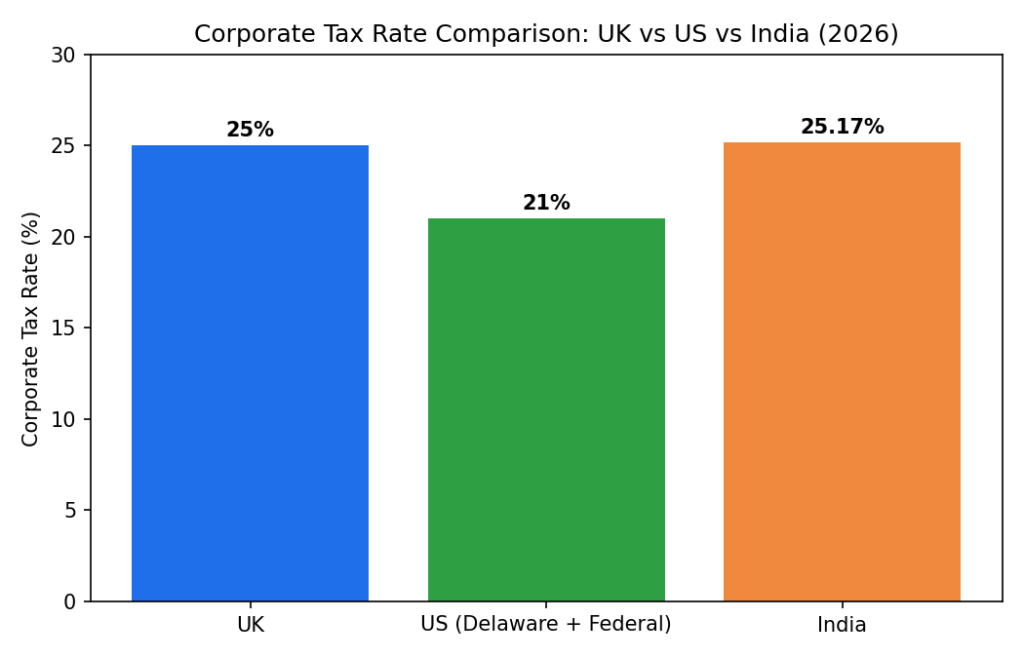
(Chart: — bar chart comparing UK 25%, US 21% federal, India 25.17% corporate tax rates)
Visual: Registration Speed Comparison
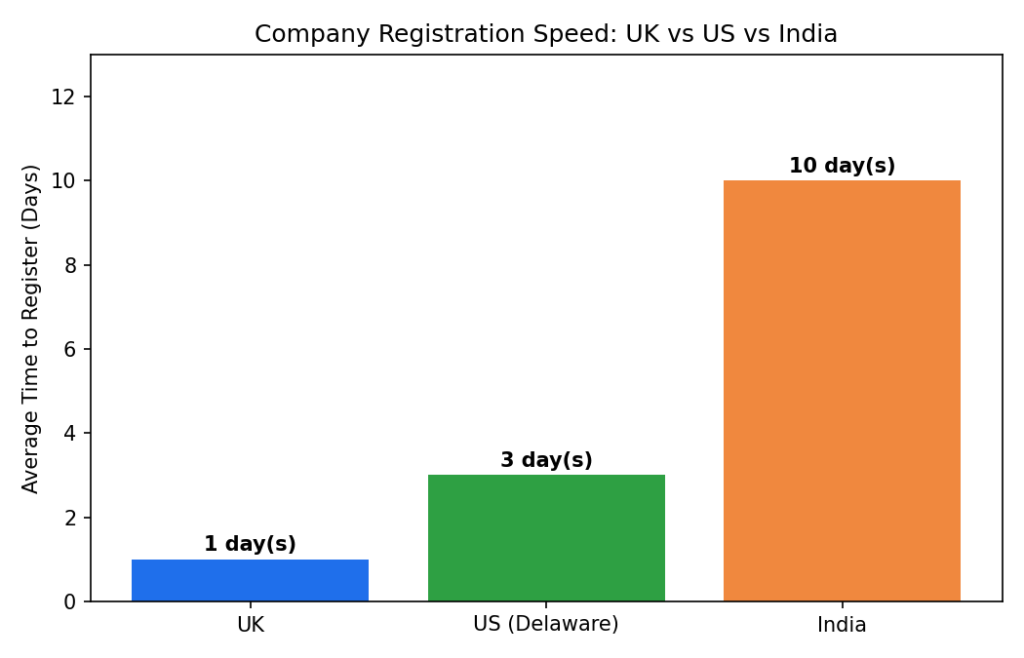
(Chart: — bar chart comparing UK ~1 day, US ~3 days, India ~10 days average registration time)
Which Structure Do Investors Actually Prefer?
This depends entirely on who you’re raising from:
- US-based VCs overwhelmingly prefer Delaware C-Corps because of familiar legal precedent, standard SAFE/priced-round templates, and straightforward exit mechanics.
- UK and European angels/VCs are comfortable with a startup UK Ltd structure and often prefer it for SEIS/EIS eligibility, which directly reduces their risk.
- Indian VCs and government-backed funds naturally prefer an Indian Pvt Ltd, especially for schemes tied to Startup India recognition.
If you expect to raise primarily from US funds, incorporating a startup UK entity first and flipping to Delaware later is common — but the flip itself costs legal fees and time, so some founders choose to incorporate directly in Delaware if US fundraising is clearly the plan from day one.
Tax Planning Considerations
Tax residency and corporate tax rate are not the same question as where a company is registered. A startup UK company can still owe tax elsewhere if it has a permanent establishment in another country. Founders commonly get this wrong by assuming incorporation location alone determines their full tax picture.
A few points worth flagging:
- UK founders benefit from SEIS/EIS relief, R&D tax credits (extremely valuable for early-stage tech companies), and no minimum capital lock-in.
- US founders should look closely at Qualified Small Business Stock (QSBS) rules, which can exempt a large portion of capital gains on exit if the company remains a C-Corp for over five years.
- Indian founders should evaluate whether their business qualifies for the Startup India tax holiday, which requires DPIIT recognition and specific eligibility criteria around innovation and turnover caps.
Practical Scenarios
Scenario 1 — SaaS founder selling globally, planning to raise a US Series A within 18 months: Delaware C-Corp from day one avoids a costly flip later.
Scenario 2 — Two co-founders building for the UK/EU market, bootstrapping with UK angel money: A startup UK Ltd company makes the SEIS/EIS relief available immediately and keeps compliance light.
Scenario 3 — Founder building a domestic Indian marketplace with government scheme eligibility in mind: Indian Pvt Ltd company with DPIIT/Startup India recognition unlocks tax holidays and access to India-specific funding programs.
Common Mistakes Founders Make
- Incorporating in Delaware “because that’s what everyone does,” without a US-focused go-to-market plan, and paying unnecessary franchise tax and compliance costs
- Registering a startup UK company but ignoring SEIS/EIS paperwork, which forfeits the single biggest incentive for early UK angel checks
- Underestimating India’s ongoing compliance load — ROC filings, statutory audits, and GST returns are non-negotiable even for pre-revenue companies
- Assuming incorporation location fixes your tax residency, when in reality tax authorities look at where management and control actually sit
Final Verdict
There’s no universal winner between a startup UK entity, a Delaware C-Corp, or an Indian Pvt Ltd — the right choice tracks your target investor base and primary market:
- Choose UK if your early capital and customers are UK/EU-based, or you want SEIS/EIS-eligible fundraising with minimal admin.
- Choose US (Delaware) if you’re targeting US venture capital and expect to raise institutional rounds early.
- Choose India if your market, workforce, and government scheme eligibility are primarily domestic.
Many successful companies actually start as a startup UK entity or Indian Pvt Ltd and restructure into a Delaware C-Corp later once fundraising strategy becomes clearer — so the “wrong” first choice is rarely fatal, just an added cost to fix.
Frequently Asked Questions
Can a non-resident found and own 100% of a company in any of these three countries? In the UK, yes — there is no residency requirement for directors or shareholders. In the US, non-residents can own 100% of a Delaware C-Corp, though opening a US bank account typically requires either a visit or a fintech provider that supports remote onboarding. In India, current rules require at least one resident director, so a fully non-resident founding team will need to appoint a local director or nominee to complete registration.
Is it possible to change jurisdiction later without starting over? Yes, this is common and is usually called a “flip.” A company incorporated in one country transfers its assets, IP, and cap table into a newly formed holding entity elsewhere, with existing shareholders receiving equivalent shares in the new parent. It works, but it involves legal fees, tax analysis in both jurisdictions, and shareholder consent, so it’s rarely trivial.
Does registration location affect where the company pays tax? Not entirely. Tax authorities generally look at where a company is actually managed and controlled, not just where the certificate of incorporation was issued. A company registered in one country but run day-to-day from another can end up with tax obligations in both places, so this is worth reviewing with an accountant early rather than after the fact.
Which option is cheapest to maintain long-term? On pure annual cost, the UK tends to be the lightest, followed by the US (mainly Delaware franchise tax and registered agent fees), with India carrying the highest ongoing compliance cost due to mandatory audits and more frequent statutory filings.