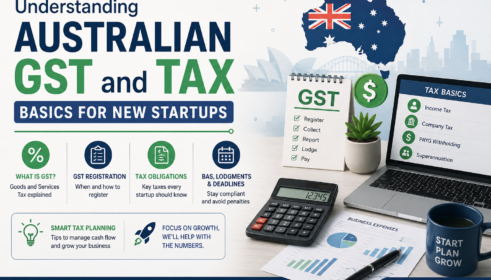
Starting a company in Australia means dealing with one acronym almost immediately: GST. Whether you’re bootstrapping a SaaS product from a spare bedroom in Sydney or raising a pre-seed round for a marketplace app in Melbourne, the Australia GST system will shape your pricing, your invoicing, your cash flow, and — eventually — the questions your investors ask during due diligence. This guide breaks down what founders actually need to know about Australian GST and the broader tax landscape, without the jargon-heavy language of an ATO handbook.
What Is GST, and Why Should Founders Care?
Goods and Services Tax (GST) is a broad-based consumption tax of 10% applied to most goods, services, and other items sold or consumed in Australia. It was introduced in 2000 and is administered by the Australian Taxation Office (ATO). Unlike corporate income tax, which is calculated on profit, GST is calculated on turnover — meaning it applies whether your startup is profitable or not.
For a new founder, understanding Australia GST early avoids two expensive mistakes: under-collecting GST you legally owed (leading to a surprise liability later) or over-complicating your pricing before you’ve hit the threshold that actually requires registration.
Investors researching a startup’s financials will often check GST compliance as a proxy for operational maturity. A company that has ignored its Australian GST obligations signals sloppy bookkeeping — a red flag during due diligence, even at seed stage.
Do You Need to Register for GST?
This is the first real decision point. You must register for Australia GST if:
- Your business has a GST turnover of $75,000 or more per year (for non-profits, the threshold is $150,000)
- You provide taxi, limousine, or ride-sourcing services (regardless of turnover)
- You want to claim fuel tax credits for your business
If your turnover is below $75,000, registration is optional — but many early-stage startups register voluntarily anyway, for reasons covered below.
GST Registration Thresholds at a Glance
| Business Type | Annual Turnover Threshold | Registration Required? |
|---|---|---|
| Standard business/company | $75,000 | Mandatory once threshold is reached |
| Non-profit organisation | $150,000 | Mandatory once threshold is reached |
| Ride-sourcing / taxi services | Any amount | Mandatory regardless of turnover |
| Business below threshold | Under $75,000 | Optional |
Why Some Startups Register for GST Before They Have To
A lot of founders assume GST registration is purely a compliance burden to delay as long as possible. In practice, early registration often makes sense:
- Input tax credits. If you’re registered, you can claim back the GST you pay on business expenses — software subscriptions, cloud hosting, legal fees, equipment. For a startup burning cash on tooling before revenue arrives, this can meaningfully improve runway.
- Investor and enterprise credibility. B2B customers and investors often expect a registered entity issuing proper tax invoices. Not being registered can look like you’re pre-revenue in a way that raises questions.
- Avoiding a scramble later. Retroactively registering after you’ve already blown past $75,000 in turnover means back-paying GST you may not have collected from customers — effectively eating the cost yourself.
How Australia GST Actually Works in Practice
Once registered, the mechanics are fairly mechanical:
- You charge 10% GST on top of your taxable sales (this is your “GST collected” or output tax).
- You claim back the GST you paid on business purchases (your “GST credits” or input tax).
- The difference between what you collected and what you paid gets reported and settled with the ATO.
This reporting happens via a Business Activity Statement (BAS), typically lodged monthly, quarterly, or annually depending on your turnover and preference.
BAS Lodgment Frequency
| Annual GST Turnover | Default Lodgment Cycle | Can You Choose Monthly? |
|---|---|---|
| Under $20 million | Quarterly | Yes, optional |
| $20 million or more | Monthly | Mandatory |
| Voluntarily registered, under $75,000 | Annually (usually) | Yes, optional |
GST-Free and Input-Taxed Supplies
Not everything attracts Australia GST. Understanding these categories matters for pricing and invoicing accuracy:
- GST-free supplies include most basic food items, many medical and health services, education courses, and exports of goods and services. If your startup sells internationally, exported services to non-resident customers are typically GST-free — an important detail for SaaS companies selling offshore.
- Input-taxed supplies include financial services and residential rent. GST isn’t charged on these, but you also can’t claim GST credits on related expenses.
- Taxable supplies are everything else — the default category most startups fall into.
Supply Category Comparison
| Category | GST Charged on Sale? | Can Claim GST Credits on Related Costs? | Common Examples |
|---|---|---|---|
| Taxable supply | Yes (10%) | Yes | SaaS subscriptions, consulting, most retail |
| GST-free supply | No | Yes | Basic food, exports, education, some health services |
| Input-taxed supply | No | No | Residential rent, financial services |
Tax Invoices: The Detail Founders Get Wrong
Once you’re registered, any sale over $82.50 (including GST) generally requires a valid tax invoice if the buyer wants to claim a GST credit. A valid tax invoice must include:
- Your business name and ABN (Australian Business Number)
- The words “Tax Invoice”
- Date of issue
- Description of goods or services
- The GST amount (either shown separately or stated as included)
- Total price
Getting this wrong doesn’t just create admin headaches — it can delay B2B customers from paying you, since many companies won’t process an invoice that doesn’t meet ATO requirements.
GST vs Income Tax: Don’t Confuse the Two
A common early-stage mistake is treating GST collected as company revenue. It isn’t. GST you collect from customers belongs to the ATO — you’re essentially collecting it on the government’s behalf. Spending it as if it were operating cash is one of the fastest ways a young company ends up with a tax debt it can’t service.
Separately, your startup will also owe income tax on actual profit, currently at a 25% company tax rate for base rate entities (companies with aggregated turnover under $50 million that derive no more than 80% of income from passive sources), or 30% for larger companies. This is entirely separate from your Australia GST obligations and calculated annually.
Quick Comparison: GST vs Company Income Tax
| Feature | GST | Company Income Tax |
|---|---|---|
| What it taxes | Consumption/turnover | Net profit |
| Standard rate | 10% | 25% (base rate) / 30% (standard) |
| Reporting frequency | Monthly/quarterly/annual (BAS) | Annually |
| Who ultimately bears the cost | The end customer | The company |
| Applies even if unprofitable? | Yes | No |
Australia GST for International and Digital-First Startups
Founders building software, apps, or digital services rarely sell only within Australia — and this is where Australia GST rules get genuinely relevant to strategy, not just bookkeeping.
If you’re selling to customers outside Australia, exported services and most exported goods are typically GST-free, provided the customer is outside Australia and the service is used or enjoyed offshore. This matters for SaaS founders pricing for a US or UK customer base: you generally shouldn’t be adding 10% Australia GST on top of an export sale, and doing so unnecessarily can make your pricing less competitive against local alternatives.
The reverse also applies. If your startup is based overseas but sells digital products or services to Australian consumers, you may be caught by Australia’s GST rules for “low value imported goods” and inbound digital services — sometimes referred to informally as the “Netflix tax.” Non-resident businesses selling digital products, streaming, apps, or online services to Australian consumers can be required to register for Australian GST once turnover from those Australian sales hits the same $75,000 threshold, even without a physical presence in the country.
For a startup with global ambitions, this means Australia GST isn’t a one-time registration decision — it’s something to revisit every time you expand into a new market or shift from B2B to B2C, since the rules differ depending on whether your customer is a business (who can usually self-assess GST) or an individual consumer (where you’re generally expected to charge it upfront).
Cross-Border GST Snapshot
| Scenario | Australia GST Treatment | Founder Action |
|---|---|---|
| Australian business selling to overseas customer (export) | Generally GST-free | Confirm customer location and usage offshore |
| Overseas business selling digital goods to Australian consumers | May require Australian GST registration at $75,000 AUD turnover | Track Australian-sourced revenue separately |
| Australian business selling to another Australian GST-registered business | Standard 10% GST, buyer claims credit | Issue a compliant tax invoice |
| Low-value imported goods sold to Australian consumers | GST usually collected at point of sale | Register if selling directly into Australia |
Practical Compliance Checklist for New Founders
- Register for an ABN before you register for GST — you can’t do the latter without the former
- Track turnover monthly so you’re not surprised when you cross $75,000
- Use accounting software (Xero, MYOB, QuickBooks) that automates BAS calculations
- Set aside GST collected in a separate account rather than treating it as spendable cash
- Reconcile GST credits on business expenses every reporting period, not just at tax time
- Keep every tax invoice for five years, as required by the ATO
- Talk to a registered tax agent or accountant once revenue becomes material — DIY compliance gets riskier as complexity grows
What Investors Actually Look For
During due diligence, investors and their advisors typically check:
- Whether GST registration status matches turnover (a company past $75,000 that isn’t registered is a compliance gap)
- Whether BAS lodgments have been consistent and on time
- Whether GST liabilities are properly reflected in the balance sheet, not buried in cash reserves
- Whether the cap table and financials are clean enough that GST and income tax don’t become a distraction during a term sheet negotiation
Clean Australia GST compliance won’t win you a round on its own, but sloppy compliance can absolutely slow one down or trigger uncomfortable renegotiation of terms.
Final Thoughts
For most founders, Australian GST isn’t complicated once the fundamentals are clear: register when required (or earlier, if it benefits you), charge and report the correct amount, keep GST collected separate from operating funds, and issue compliant tax invoices. Where it gets genuinely complex — cross-border sales, mixed supplies, group structures, R&D tax incentive interactions — bring in a registered tax agent rather than guessing.
Getting the basics of Australia GST right early isn’t just about avoiding ATO penalties. It’s part of building a company that looks credible to customers, partners, and the investors you’ll eventually be pitching.