
Founders and investors share one question as 2026 closes: where is the money really going? Studying us startup trends with hard data answers it better than any headline. Through the first nine months of the year, US venture investment reached a record $515.8 billion, according to the PitchBook-NVCA Venture Monitor, and almost 83% of it went to artificial intelligence companies. That single fact shapes every theme in this guide to US startup trends 2026.
Below we cover the funding picture, the sectors investors are backing, the changes in deal structure, and what each of these US startup trends means for your next move, whether you are writing a pitch deck or a check.
Key takeaways
- Record funding is real, but it is concentrated in AI and in very large rounds.
- Investor interest has moved from models to infrastructure, energy, defense and physical AI.
- Small and mid-sized rounds are scarcer, so capital efficiency matters more.
- Exits lag deployment, which keeps pressure on valuations and fund formation.
- The smartest reading of US startup trends focuses on concentration, not just totals.
The Big Picture: Record Funding, Narrow Distribution
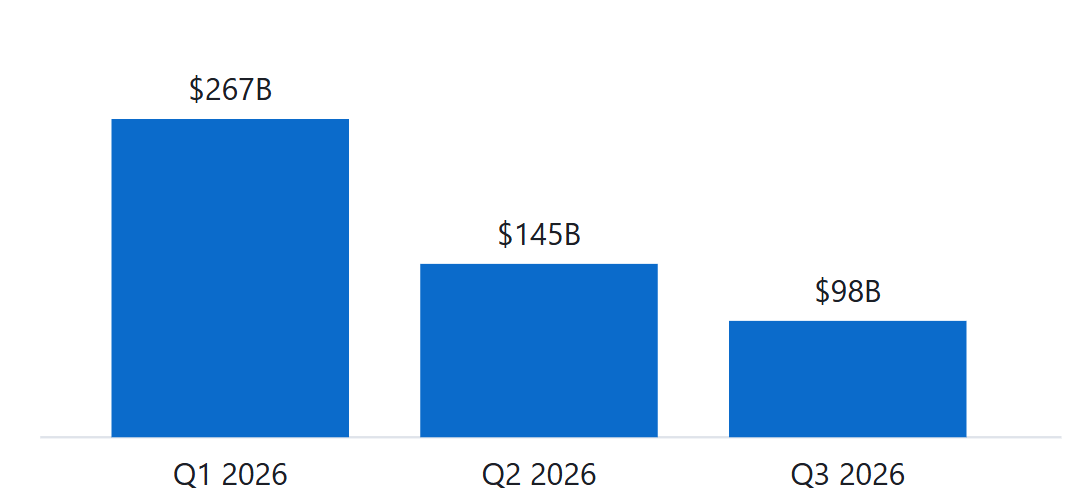
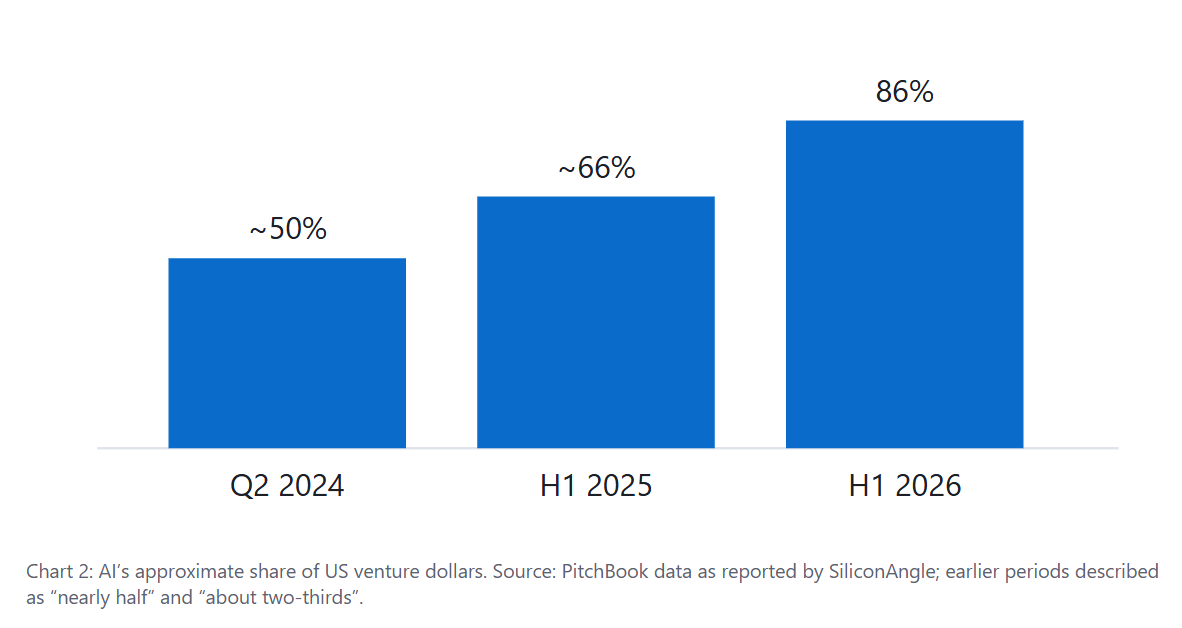
The headline total is impressive. PitchBook reported $412.7 billion deployed in the first half of 2026, nearly 30% more than all of 2025, and KPMG’s Venture Pulse shows the third quarter added $98.4 billion across 3,626 deals. Yet the most important of all US startup trends is concentration. AI companies took about $355.9 billion of first-half dollars, roughly 86%, and rounds of $100 million or more accounted for 87.5% of capital deployed.
Two companies illustrate the point. In the first quarter OpenAI raised $122 billion and Anthropic $30 billion, alongside $20 billion for xAI and $16 billion for Waymo. Remove those megadeals and the market looks far more ordinary, which is why many founders say the record year does not match their own fundraising experience. Understanding that gap is the starting point for reading US startup trends honestly.$267BQ1 2026$145BQ2 2026$98BQ3 2026Chart 1: Approximate US venture investment by quarter, 2026. Sources: PitchBook (Q1), KPMG Venture Pulse (Q2, Q3). Figures are rounded; methodologies differ slightly.
| Period | US VC invested | What drove it |
|---|---|---|
| Q1 2026 | ~$267B | OpenAI, Anthropic, xAI and Waymo megarounds |
| Q2 2026 | ~$145B | Anthropic, Project Prometheus ($12B), Anduril ($5B) |
| Q3 2026 | $98.4B (3,626 deals) | Compute, energy, manufacturing and physical AI |
| First 9 months | $515.8B | Record; ~83% went to AI |
Trend 1: AI Moves From Models to Infrastructure
AI is not one trend but several. Early in the cycle money chased foundation models and chat applications. KPMG’s Q3 report notes that investor interest has widened into infrastructure, computing power and energy, plus manufacturing and physical AI. Among the US startup trends 2026 investors discuss most, this shift from software to the physical layer is the clearest. Data centers need power, chips need fabrication capacity, and robots need factories, and each of those needs startups to build it.
For founders, the lesson is to say where your company sits in the AI stack. Investors now ask whether you build models, tools, applications, or supply compute and energy. Startups tied to a clear cost advantage or a scarce input stand out in current US startup trends because they do not depend on a single model provider.~50%Q2 2024~66%H1 202586%H1 2026Chart 2: AI’s approximate share of US venture dollars.
Trend 2: Defense Tech and Dual-Use Companies
Anduril’s $5 billion raise in the second quarter shows that defense technology has moved from niche to mainstream. Investors view autonomy, sensing and secure communications as durable categories with government customers and long contracts. Among the US startup trends worth tracking, dual-use companies that sell to both commercial and public-sector buyers are gaining attention. Expect continued capital for drones, space systems, cybersecurity and advanced manufacturing into 2027, and that pattern will shape US startup trends for years.
Trend 3: AI Coding Tools and Autonomous Agents
Cognition AI’s $1 billion round highlights appetite for AI coding products and software agents. Software development is the first large profession where AI output is easy to measure, so revenue can grow quickly and investors can underwrite it. In the list of US startup trends, agentic software that completes tasks, rather than merely suggesting them, is the category most pitch decks now claim. The risk is crowding. When every deck says “agents,” differentiation comes from distribution, proprietary data and customer retention.
Trend 4: SaaS Rebuilt Around AI
Carta found that more than 60% of venture dollars on its platform went to AI companies in Q1 2026, its highest share on record, and that 83% of software-as-a-service capital went to AI startups. One of the quieter US startup trends is the disappearance of the “plain” SaaS round. Software that does not show an AI-driven productivity gain or cost reduction now has to work harder to earn a term sheet.
| Theme | 2026 evidence | Investor logic | Founder takeaway |
|---|---|---|---|
| Frontier models | OpenAI $122B, Anthropic $30B (Q1) | Winner-take-most scale | Hard to compete; build on top or specialize |
| AI infrastructure and energy | KPMG cites compute and energy interest | Scarce inputs, durable demand | Show a cost or supply edge |
| Physical AI and manufacturing | Waymo $16B; rising Q3 interest | Real-world moats | Prove unit economics early |
| Defense and dual-use | Anduril $5B (Q2) | Long contracts, strategic demand | Plan for procurement cycles |
| AI coding and agents | Cognition AI $1B (Q2) | Measurable productivity | Differentiate on distribution and data |
| AI-native SaaS | 83% of SaaS capital to AI (Carta, Q1) | Faster growth, new budgets | Lead with outcomes, not features |
Trend 5: The Barbell Market for Round Sizes
Deal size tells the sharpest story. Rounds under $100 million took 43.8% of capital in 2024 but only 12.5% in the first half of 2026. This barbell is among the defining US startup trends of the year: a few enormous rounds on one end, a thinner and more selective market on the other. PitchBook had forecast a surge in early-stage activity, and many seed and Series A investors remain active, but they are underwriting for efficiency rather than blitzscaling.
| Round size | Share of US capital, 2024 | Share, H1 2026 |
|---|---|---|
| Under $100M | 43.8% | 12.5% |
| $100M or more | 56.2% | 87.5% |
Source: PitchBook-NVCA Venture Monitor as reported by SiliconAngle; the 2024 mega-round share is the arithmetic complement.
Trend 6: Liquidity, Exits and the Fund-Raising Squeeze
Deployment is racing ahead of liquidity. SiliconAngle’s coverage of the Q3 Venture Monitor stressed that exits have failed to keep pace with record deal value. When distributions to limited partners are slow, new fund formation suffers, and that eventually reduces the number of checks available to early-stage founders. PitchBook has pointed to secondaries as a pressure valve, and they are now a standard part of the conversation in US startup trends. Corporate venture arms also pulled back, joining just 21% of deals in the first half, their smallest share in a decade.
For investors, this means selectivity and a sharper focus on paths to exit. For founders, it means preparing for longer timelines, considering secondary sales for employees, and keeping the company default-alive in case the next round slips. That is the practical lesson of today’s US startup trends.
Trend 7: Geography Matters Again
Remote-first culture promised a more distributed startup map. The 2026 numbers say otherwise: about 68% of Q2 US venture dollars landed in the Bay Area, according to reporting on PitchBook data. Talent density around AI labs, chip designers and top-tier investors keeps pulling capital toward a handful of places. Founders elsewhere can still raise, but one of the more uncomfortable US startup trends is that proximity to capital and talent clusters still carries weight.
The Macro Backdrop
J.P. Morgan’s innovation economy update describes a mixed environment: the effective federal funds rate near 3.6%, consumer inflation between roughly 3.6% and 3.9% in the middle quarters, and real GDP growth estimated at 1.5% for Q3. Persistent inflation limits how fast rates can fall, which keeps public-market valuations, and therefore IPO windows, uncertain. These conditions explain why investors favor companies with pricing power, strong gross margins and credible revenue, a theme that runs through many US startup trends.
What Investors Are Looking For in 2026
Across the sources above, a consistent checklist emerges. Reviewing it against your own company is a practical way to apply US startup trends rather than just read about them.
- Revenue traction: AI-era buyers expect fast adoption, so growth in paying customers matters more than waitlists.
- Defensibility: proprietary data, distribution or hardware advantages beat a thin layer over someone else’s model.
- Capital efficiency: with sub-$100 million rounds scarce, burn multiples are scrutinized.
- Clear AI cost structure: inference and compute costs must fit inside healthy margins.
- Exit realism: investors want a credible route to liquidity within a fund’s life.
What Founders Should Do Now
First, position your company inside the biggest US startup trends without pretending to be something you are not. If you are not an AI company, explain how AI improves your cost, speed or reach. Second, when you study US startup trends, size your raise to your milestones; a $3 million round that gets you to real revenue beats a $10 million round that gets you only to another round. Third, build relationships before you need them. In a concentrated market, warm introductions carry extra value, and investors track which founders they have followed for a year.
Fourth, protect runway. If exits remain slow, a tougher funding climate can arrive quickly for companies outside the favored themes. Finally, read the primary data yourself. The PitchBook-NVCA Venture Monitor, KPMG Venture Pulse and Carta’s State of Private Markets are public starting points, and tracking them quarterly keeps your view of US startup trends current.
Risks Worth Watching
Concentration cuts both ways. If a handful of AI companies account for most capital, a disappointment at the top could ripple through valuations across the ecosystem. Commentators have also pointed out that headline totals overstate how much reaches typical founders. Investors who ignore this and treat record totals as proof that every company is easier to fund may misjudge the market. Treat the bullish headlines and the bearish ones as two halves of the same story about US startup trends.
Outlook: What to Expect in 2027
If H2 2026 sustains current patterns, expect AI to remain the dominant share of dollars, with the story shifting from model builders toward the companies that power and deploy them. Watch whether exits and secondaries improve, since that determines whether fund-raising loosens. Watch whether the share of sub-$100 million rounds recovers, because that signals a healthier middle of the market. And watch interest rates and inflation, which influence IPO appetite. Track these signals because they will define the next chapter of US startup trends, and the next chapter of US startup trends 2027.
Frequently Asked Questions
What are the biggest US startup trends in 2026?
The biggest US startup trends are AI dominance of funding, a move toward infrastructure, energy and physical AI, growth in defense tech and agents, and a market split between giant rounds and scarce smaller ones.
How much venture capital did US startups raise in 2026?
Through September 2026, US startups raised a record $515.8 billion, per the Q3 PitchBook-NVCA Venture Monitor, with roughly 83% going to AI companies.
Is it harder to raise money outside AI?
Generally yes, and it is one of the clearest US startup trends. Rounds under $100 million fell to 12.5% of capital in the first half, so non-AI founders face more selective investors and should emphasize efficiency and revenue.
Conclusion
The data points in two directions at once: record money and a narrow path for most founders. Reading US startup trends 2026 well means holding both truths together. Investors are betting on AI and the physical systems that support it, on defense and automation, and on teams that can grow efficiently while exits remain slow. Founders who match their story to these US startup trends, while staying honest about their own strengths, will be best placed to raise in the year ahead.