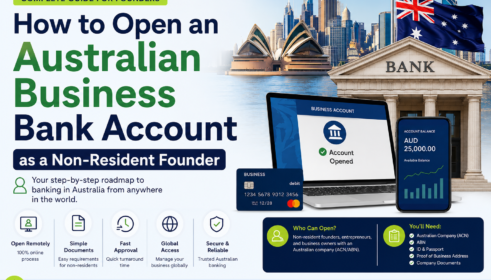
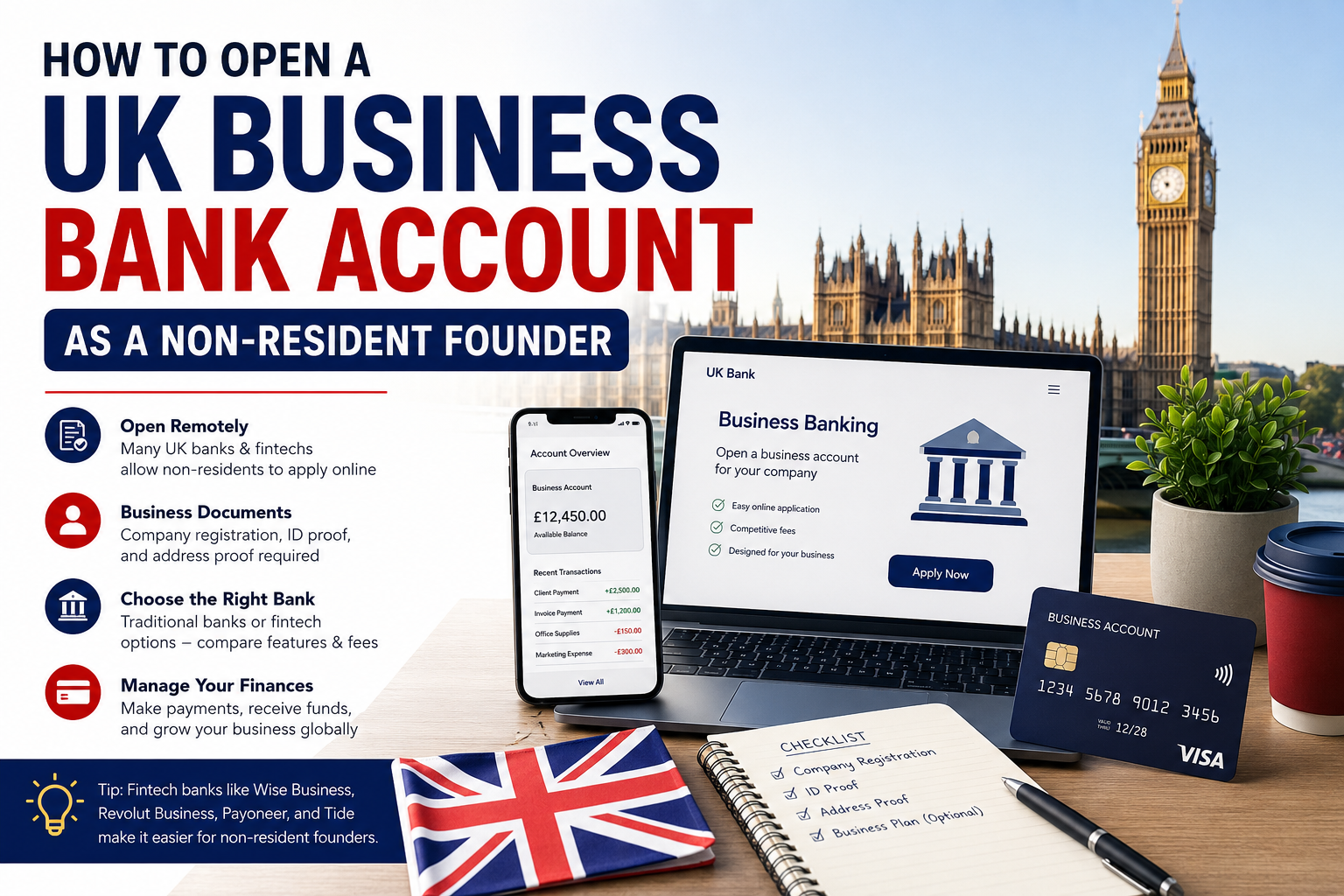
Setting up a UK business bank account from outside the country used to mean flights, branch appointments, and weeks of waiting. That has changed. Between digital-first challenger banks and a wave of fintech providers built specifically for cross-border founders, it is now realistic to get a working UK business bank account without ever setting foot in Britain. What hasn’t changed is the paperwork: UK regulators still expect banks to run tight identity and source-of-funds checks, and non-resident applicants sit under closer scrutiny than local ones. This guide walks through exactly what a non-resident founder needs, which providers are actually worth applying to, how long the process takes, and how to avoid the mistakes that get applications declined.
Why a UK Business Bank Account Matters for Non-Resident Founders
A registered UK company can technically trade using a foreign account or an international payment wallet, but most founders quickly discover the limits of that approach. A dedicated UK business bank account unlocks a sort code and account number that UK clients, marketplaces, and payment processors recognise instantly. Amazon UK, Stripe, and most B2B clients expect local banking details, and invoices that show a UK account tend to close faster than ones that route through an overseas bank.
Beyond credibility, a local account simplifies HMRC obligations. VAT returns, PAYE payments, and Corporation Tax are all easier to reconcile when money moves through GBP rails rather than being converted at every step. For founders who plan to raise from UK-based investors, having a functioning local account also signals operational seriousness during due diligence — investors want to see that the company can actually receive and deploy funds domestically, not just on paper. It also removes a friction point at the exact moment the business starts scaling.
Can Non-Residents Actually Open One?
Yes — but eligibility depends heavily on which type of institution you approach. UK banking law does not prohibit non-resident directors or shareholders from owning a UK-registered company, and it does not prohibit that company from holding a UK business bank account. What creates friction is each bank’s internal risk appetite. Traditional high-street banks historically wanted to see a UK-resident director, a trading history, or an existing personal banking relationship before approving a business account. Digital banks and fintechs, by contrast, built their onboarding specifically around remote verification, so they tend to accept non-resident applicants far more readily. This split explains why so many overseas founders end up applying to two very different types of institution before finding one that fits.
Quick answer: If your company is incorporated at Companies House, has a clear business model, and you can pass identity and source-of-funds checks, opening a UK business bank account as a non-resident is achievable — usually through a fintech provider rather than a legacy high-street bank.
Eligibility Requirements Checklist
Before applying, most providers expect the following to be in place:
- A company actively registered with Companies House (an Ltd is the standard structure)
- A registered office address in the UK (a virtual office is usually acceptable)
- Valid passport or national ID for every director and person with significant control (PSC)
- Proof of residential address in your home country, dated within the last three months
- A clear explanation of the business activity, expected turnover, and where funds originate
- A confirmation statement and, for older companies, filed accounts
Applicants who prepare this documentation before starting the application move through onboarding noticeably faster, since most rejections stem from incomplete files rather than actual ineligibility.
Traditional Banks vs. Digital Banks: A Side-by-Side Comparison
The single biggest decision a non-resident founder makes is which type of provider to approach first. The table below compares the two routes to a uk business bank account across the factors that matter most.
| Factor | Traditional High-Street Banks (Barclays, HSBC, Lloyds, NatWest) | Digital & Fintech Providers (Wise, Revolut, Airwallex, Tide, Payoneer) |
|---|---|---|
| Remote onboarding | Rare — many require an in-branch visit or existing relationship | Fully online, usually from any device |
| Typical approval time | 2–6 weeks, sometimes longer | 1–5 business days |
| UK sort code & account number | Yes, full banking license | Usually yes, via e-money license partnerships |
| Multi-currency support | Limited, extra fees apply | Strong — GBP, EUR, USD and more in one account |
| Monthly fees | £5–£15 | £0–£29 depending on plan |
| Best suited for | Founders with a UK trading history or local presence | Founders operating fully remotely with international clients |
Step-by-Step: Opening Your UK Business Bank Account
- Incorporate your UK company first. You cannot open a UK business bank account without a registered entity. Companies House registration typically takes 24 hours online.
- Secure a UK correspondence address. A registered office service satisfies most providers’ address requirements even if no director lives in the UK.
- Shortlist two or three providers. Apply to one traditional bank and one or two digital providers in parallel to avoid losing weeks if one declines.
- Prepare your document pack. Scan passports, proof of address, incorporation documents, and a short business plan describing your product, clients, and expected monthly turnover.
- Complete video or in-app verification. Most digital providers verify identity through a live selfie check matched against your passport.
- Answer source-of-funds questions honestly and specifically. Vague answers are the most common reason applications stall.
- Activate and test the account with a small inbound and outbound transfer before routing client payments through it.
Documents You’ll Typically Be Asked For
| Document | Purpose | Applies To |
|---|---|---|
| Certificate of Incorporation | Confirms legal existence of the company | The company |
| Passport / national ID | Identity verification | All directors & PSCs |
| Proof of residential address | Address verification (utility bill, bank statement) | All directors & PSCs |
| PSC register / confirmation statement | Ownership transparency | The company |
| Business plan or website | Explains activity and revenue model | The company |
| Source-of-funds evidence | Anti-money-laundering compliance | Directors funding the account |
Common Reasons Applications Get Rejected
Founders applying for a UK business bank account for the first time are often surprised by how strict the KYC process is compared with their home country. The most frequent rejection triggers include:
- Registered office address that looks like a mail-forwarding shell with no real business activity behind it
- Inconsistent information between the application, the company website, and Companies House filings
- Nationality or country of residence on a provider’s restricted list (this varies by bank, so check first)
- Unclear or unusually high projected turnover with no supporting contracts or invoices
- Industry flagged as high-risk, such as crypto, gambling, or certain import/export categories
Addressing these before applying — rather than after a rejection — is the fastest way to secure a UK business bank account on the first attempt.
Costs to Expect
Pricing for a UK business bank account varies widely depending on provider type, transaction volume, and currency needs.
| Provider Type | Setup Fee | Monthly Fee | International Transfer Fee |
|---|---|---|---|
| High-street bank | £0–£100 | £5–£15 | £15–£40 per transfer |
| Digital challenger bank | £0 | £0–£10 | Often included or low-cost |
| Multi-currency fintech account | £0 | £0–£29 | Mid-market rate + small % fee |
Tips to Speed Up Approval
- Apply with a live, professional website and clear service descriptions before submitting your application
- Keep your registered office and trading address consistent across every document
- Have your first few client contracts or invoices ready to demonstrate real revenue
- Choose a provider whose eligible-country list explicitly includes your country of residence
- Respond to compliance follow-up questions within 24 hours to avoid the file going cold
Understanding the KYC and AML Checks Behind the Scenes
Every application for a UK business bank account passes through anti-money-laundering software before a human ever looks at it. The system cross-references your passport data, address, and company details against sanctions lists, politically-exposed-person registers, and adverse media databases. For resident applicants this check is usually quick because domestic data sources return an instant match. For non-residents, the same databases often hold thinner records, which is why compliance teams ask more follow-up questions — not because the applicant is under suspicion, but because the system has less to verify against automatically.
This is also why the quality of your supporting documents matters more than their sheer volume. A single, clearly legible passport scan and a recent utility bill will move an application forward faster than a folder of ten loosely related files. Providers that specialise in international founders have tuned their compliance teams to interpret foreign documents correctly, which is one more reason fintech challengers tend to outperform legacy banks for this specific use case.
How This Affects Fundraising and Investor Confidence
Investors evaluating an early-stage company increasingly treat operational banking as a proxy for founder execution. A startup that has already sorted out incorporation, tax registration, and a working account signals that the team can handle the unglamorous parts of running a business, not just the product vision. During due diligence, investors will often ask to see recent bank statements to confirm runway and burn rate — a request that is far easier to satisfy once the account is fully operational rather than mid-application. Founders raising a UK-based round should treat opening the account as an early milestone on the fundraising timeline, not an afterthought to handle once term sheets are signed.
Frequently Asked Questions
Can a non-resident really open a UK business bank account without visiting the UK?
In most cases, yes. Digital banks and fintech providers built their entire onboarding flow around remote verification, so a physical visit is rarely required outside of certain high-street banks.
Do I need a UK visa to open one?
No. Opening a UK business bank account is tied to your company’s registration and your ability to pass KYC checks, not to your immigration status.
Can I hold multiple currencies in one UK account?
Most fintech providers offer multi-currency wallets alongside the GBP account, letting you hold and convert USD, EUR, and other currencies without a separate international account.
Is it possible to combine a fintech account with a traditional bank later?
Yes. Many non-resident founders start with a digital provider for speed, then add a high-street UK business bank account later once the company has a trading history, using the two accounts for different purposes.
Final Thoughts
Opening a UK business bank account as a non-resident founder is no longer the multi-month ordeal it once was, but it still rewards preparation. Founders who incorporate cleanly, gather their documents in advance, and apply to the right type of provider typically have a working account within a week. Those who skip the groundwork tend to hit avoidable rejections. Treat the application the way you would treat an investor pitch — clear, consistent, and backed by real evidence — and a UK business bank account becomes a straightforward milestone rather than a bottleneck on the way to trading in the UK.