Raising capital is the single biggest hurdle for most early-stage founders, and in 2026 the conversation in Australia has shifted noticeably toward non-dilutive funding. With venture capital rounds taking longer to close and due diligence getting tougher, more founders are turning to Australia startup grants 2026 programs to extend their runway without giving away equity. The good news is that the federal government, along with every state and territory, currently runs dozens of grant, rebate, and tax-offset schemes designed specifically for startups — from pre-revenue R&D vouchers worth a few thousand dollars to commercialisation grants approaching seven figures.
This guide breaks down ten of the strongest Australian government grants and funding schemes available to startups right now, what each one actually pays, who qualifies, and how founders and investors researching the ecosystem can use them strategically. We’ve also included two visual references — a funding comparison chart and an eligibility snapshot table — so you can quickly benchmark which programs are worth your time.
Quick Overview: 2026 Australian Startup Grants at a Glance
| # | Program | Administered By | Funding Available | Best Suited For |
|---|---|---|---|---|
| 1 | R&D Tax Incentive (RDTI) | Federal (AusIndustry/ATO) | Refundable offset up to 43.5% of eligible R&D spend | Any startup doing genuine technical R&D |
| 2 | Accelerating Commercialisation | Federal (AusIndustry) | Up to $1,000,000 matched | Startups commercialising a novel product |
| 3 | Industry Growth Program | Federal (AusIndustry) | $50,000–$250,000 matched | Startups with a validated prototype |
| 4 | CSIRO Kick-Start | Federal (CSIRO) | $10,000–$50,000 matched | Pre-seed/seed startups needing R&D partners |
| 5 | Export Market Development Grants (EMDG) | Federal (Austrade) | $20,000–$80,000 | Startups exporting goods or services |
| 6 | MVP Ventures Program | NSW Government | $20,000–$75,000 matched | NSW startups moving MVP to first sales |
| 7 | Ignite Ideas Fund | Queensland Government | Up to $200,000–$400,000 matched | QLD startups commercialising IP |
| 8 | LaunchVic Ecosystem Grants | Victorian Government | Varies by round | Victorian founders and ecosystem builders |
| 9 | Innovation Pathways Program | WA Government | Up to $300,000 | WA accelerators and investor-readiness programs |
| 10 | Future Made in Australia Innovation Fund | Federal | Multi-billion dollar pool | Clean energy, green metals & advanced manufacturing startups |
1. R&D Tax Incentive (RDTI) — The Foundation of Australian Startup Funding
The R&D Tax Incentive is arguably the most important program on this list simply because of its scale and reliability. Startups with an aggregated turnover under $20 million can claim a refundable tax offset equal to their company tax rate plus an 18.5% premium, which currently works out to roughly 43.5% of eligible R&D expenditure. Because it’s refundable, even a loss-making, pre-revenue company can receive an actual cash payment from the ATO rather than just a reduction in tax owed — this makes it one of the few programs that genuinely functions like emergency runway extension.
Larger companies with turnover above $20 million still benefit, receiving a non-refundable offset tied to their R&D intensity. Reforms flagged in the 2026–27 Federal Budget will eventually lift the refundable-offset turnover threshold to $50 million and tighten refundability to companies under ten years old, but these changes aren’t due to take effect until 1 July 2028, so the current 43.5% rate remains in place through the 2026–27 income year. Founders should register R&D activities with AusIndustry within ten months of their income year ending to stay eligible.
2. Accelerating Commercialisation — Big-Ticket Matched Funding
Run through AusIndustry, Accelerating Commercialisation offers matched funding of up to $1 million to help startups and small businesses turn novel products, services, or processes into commercial reality. It’s aimed squarely at companies with genuine IP and a credible go-to-market plan rather than early ideation-stage ventures, which makes it a natural next step once a startup has validated its concept through smaller programs like CSIRO Kick-Start. Because the funding is matched dollar-for-dollar, applicants need to demonstrate they can bring co-investment or committed revenue to the table, which also happens to be exactly what institutional investors want to see before writing a cheque.
3. Industry Growth Program — Bridging Prototype to Market
The Industry Growth Program supports startups that have already built and validated a prototype but need capital to commercialise it, with grants ranging from $50,000 to $250,000. It sits in a useful middle ground between small research vouchers and the larger Accelerating Commercialisation grant, and it’s particularly relevant for founders in priority sectors such as advanced manufacturing, medical science, robotics, clean energy, and enabling technologies like AI. Applicants typically also gain access to an adviser who helps refine their growth and investment strategy, which adds practical value beyond the cash itself.
4. CSIRO Kick-Start — Cheap Access to World-Class Research
CSIRO Kick-Start is designed for very early-stage startups and small businesses that want to collaborate with CSIRO researchers but can’t yet afford full commercial research rates. Matched funding of between $10,000 and $50,000 lets founders access CSIRO’s labs, equipment, and scientific expertise at a fraction of standard cost. For deep-tech and hard-science startups in particular, this program is often the fastest and cheapest way to de-risk a technical concept before pursuing larger grants or investor capital.
5. Export Market Development Grants (EMDG) — Funding Global Growth
The EMDG program, administered by Austrade, reimburses Australian SMEs and startups for a portion of their overseas marketing and promotional spend. Round 4 covers activity across the 2025–26 and 2026–27 financial years, with three tiers based on export experience: Tier 1 (new-to-export) pays up to $30,000 per financial year, Tier 2 up to $50,000, and Tier 3 (established exporters entering new markets) up to $80,000. Unlike competitive grants, EMDG is entitlement-based — if a startup meets the eligibility criteria and has sufficient eligible expenditure, funding is essentially guaranteed rather than judged against other applicants. It’s worth noting that Round 4 applications are currently closed, having reached their funding allocation, so founders planning to export should watch for the next round opening and prepare documentation early.
6. MVP Ventures Program — NSW’s Bridge from Prototype to First Sale
For startups headquartered in New South Wales, the MVP Ventures Program provides matched funding to help commercialise a minimum viable product and secure early paying customers. The 2025–26 program runs two streams: a general stream offering $20,000 to $50,000 with a 50% co-contribution, and a targeted stream for women-led, regionally based, or Aboriginal and Torres Strait Islander-owned businesses offering $20,000 to $75,000 with a lower 25% co-contribution requirement. Funding rounds open several times a year, and because it’s competitive and merit-based, strong evidence of customer traction — letters of intent, pilot agreements, or early pre-orders — significantly improves an application’s odds.
7. Ignite Ideas Fund — Queensland’s Commercialisation Engine
Queensland’s flagship startup grant, delivered through Advance Queensland, supports the commercialisation of innovative new products and services developed by Queensland-headquartered startups. Funding is split into two tiers, with Tier 1 offering up to roughly $200,000 and Tier 2 extending to around $400,000 for more capital-intensive commercialisation projects. Applicants need a clear path to market and are assessed on the scale of the opportunity, the strength of the underlying IP, and the economic benefit the project would generate for Queensland specifically.
8. LaunchVic Ecosystem Grants — Backing Victoria’s Startup Pipeline
LaunchVic, Victoria’s state startup development agency, doesn’t operate a single static grant so much as a rolling portfolio of funding rounds aimed at strengthening the broader startup ecosystem — from founder education and accelerator programs to sector-specific initiatives in areas like climate tech and health innovation. Funding amounts vary considerably by round and program design, so Victorian founders are best served by monitoring LaunchVic’s active opportunities directly rather than assuming a fixed dollar figure. What makes LaunchVic valuable isn’t just direct capital — it’s the connections into Melbourne’s investor and accelerator network that come attached to many of its programs.
9. Innovation Pathways Program — WA’s Investment-Readiness Push
Western Australia’s Innovation Pathways Program (formerly known as X-TEND WA) primarily funds the organisations that support startups — accelerators, investor-education initiatives, and entrepreneur training programs — rather than paying individual founders directly. Even so, it’s highly relevant to WA startups because grants of up to $300,000 for accelerator programs and up to $200,000 for investor-education initiatives directly expand the number of funded accelerator places, mentoring hours, and investor connections available to local founders. WA has been actively growing this pool, doubling total funding to around $2 million in the current cycle, with priority weighting given to programs supporting regional, First Nations, and women founders.
10. Future Made in Australia Innovation Fund — Backing the Next Industrial Wave
For startups working in renewable energy, green metals, batteries, or other low-emission technologies, the Future Made in Australia Innovation Fund represents the largest pool of capital on this list, with a multi-billion-dollar allocation split across priority areas including green metals and renewable energy manufacturing. It’s aimed at capital-intensive, nationally significant projects rather than small early-stage grants, so it suits startups that have moved beyond proof-of-concept and need substantial funding to scale manufacturing or deployment. Given the scale of the fund, competition and due diligence are correspondingly intense, and most successful applicants pair it with private co-investment.
Maximum Funding Compared: A Visual Snapshot
The chart below compares the maximum funding ceiling for the programs on this list that pay startups directly, giving a rough sense of scale from CSIRO Kick-Start’s modest research vouchers through to Accelerating Commercialisation’s seven-figure grants.
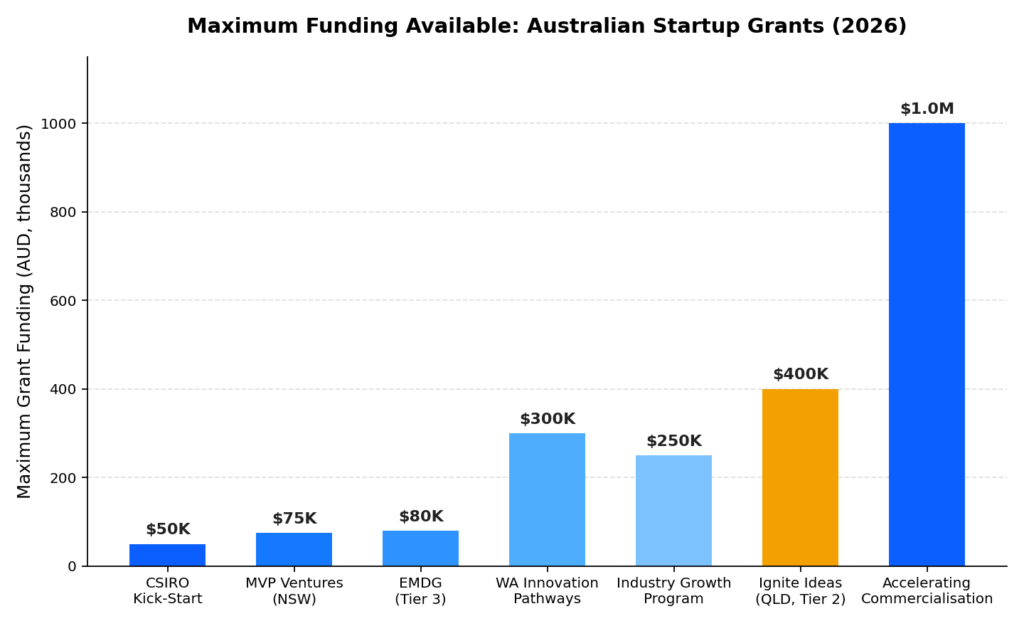
Note: The Future Made in Australia Innovation Fund and R&D Tax Incentive are excluded from this chart because they operate as multi-billion-dollar sector pools and percentage-based tax offsets respectively, rather than fixed per-application grant caps.
Eligibility Snapshot: Federal vs State Programs
| Factor | Federal Programs (RDTI, Accelerating Commercialisation, EMDG, etc.) | State Programs (MVP Ventures, Ignite Ideas, LaunchVic, WA Innovation Pathways) |
|---|---|---|
| Location requirement | Registered Australian business (ABN required) | Must typically be headquartered in that specific state |
| Competition level | Ranges from entitlement-based (RDTI, EMDG) to highly competitive | Mostly competitive, merit-assessed rounds |
| Typical co-contribution | 0–50% depending on program | 25–50% depending on stream |
| Application frequency | Ongoing or annual | Multiple rounds per financial year |
| Reporting obligations | Moderate to high (especially RDTI) | Moderate, milestone-based payments common |
How Founders Should Approach These Grants in 2026
Grant strategy works best as a layered approach rather than a single application. A typical sequencing looks like this: use CSIRO Kick-Start or a state MVP-style grant to validate the technical or commercial concept cheaply, register eligible spend for the R&D Tax Incentive along the way to recover cash regardless of outcome, then apply for a mid-tier program like the Industry Growth Program once a prototype exists, and finally pursue Accelerating Commercialisation or a state-tier grant such as Ignite Ideas once there’s a genuine path to market. Investors increasingly view a track record of grant success as a proxy for credibility — it signals that independent assessors have already scrutinised the technology, the team, and the commercial plan.
For founders and investors tracking the Australian innovation policy landscape, 2026 is shaping up as a year of consolidation: the underlying R&D Tax Incentive settings remain stable until 2028, EMDG has settled into its reformed entitlement structure, and states are competing harder than ever to attract high-growth startups through bigger, better-targeted funding pools. Staying close to program opening dates — and applying early, since several of these rounds close once funding is allocated rather than on a fixed date — remains the single most effective habit a founder can build.
Frequently Asked Questions
Are Australian government startup grants equity-free? Yes, in almost all cases. Federal and state grants covered here are non-dilutive, meaning founders don’t give up ownership. The trade-off is usually a co-contribution requirement and reporting obligations rather than equity.
Can a pre-revenue startup qualify for these programs? Many can. The R&D Tax Incentive, CSIRO Kick-Start, and several state MVP-stage grants are specifically designed for pre-revenue or pre-profit companies, since the refundable R&D offset pays cash regardless of profitability.
How competitive are these grants in 2026? It varies widely. Entitlement-based programs like the R&D Tax Incentive and EMDG guarantee funding if criteria are met, while merit-based programs such as MVP Ventures, Ignite Ideas, and Accelerating Commercialisation are genuinely competitive and require strong supporting evidence.