
Choosing where to work is one of the first big decisions a UK Startup makes. Traditional leases often mean five-year commitments, personal guarantees and fit-out costs that a young company cannot absorb. Coworking offers desks, meeting rooms and community on rolling terms. In 2026, with hybrid work standard and investors scrutinising burn rate closely, the right space can stretch your runway and put you in front of the people who matter.
This guide compares the best coworking options across the country, explains what they typically cost, and shows how to choose one that suits your stage. Whether you are a first-time founder or lead a seed-funded UK Startup preparing for a Series A, the shortlist below is a practical place to begin. Prices are indicative ranges, so confirm current rates directly with each operator.
Why Coworking Matters for a UK Startup in 2026
The UK remains Europe’s largest venture market, and a thriving UK Startup ecosystem now stretches well beyond the M25. For a UK Startup, the benefits go well past cheap desks:
- Flexibility: monthly rolling contracts let you scale up or down as headcount changes.
- Network effects: your neighbours are often founders, developers, lawyers and angel investors.
- Credibility: a recognised address reassures investors and enterprise customers.
- Predictable costs: one invoice usually covers internet, utilities, cleaning and meeting rooms.
- Programmes: many operators run demo days, mentoring sessions and investor evenings.
Founders researching a UK Startup workspace often underestimate the last two points. A single introduction at a community event can be worth more than a year of rent savings.
Quick Comparison of the Best Coworking Spaces
Here is how the leading options compare for a UK Startup at different stages.
| Space | Best for | Main location | Standout feature |
|---|---|---|---|
| Level39 | Fintech and cybersecurity | London (Canary Wharf) | Corporate and investor access |
| Runway East | Early-stage tech teams | London and regional cities | Strong community managers |
| Huckletree | Growth-stage companies | London and select cities | Founder and investor events |
| Techspace | Tech and creative teams | London and beyond | Flexible private team rooms |
| WeWork | Multi-city flexibility | Many UK cities | Wide availability |
| Bruntwood SciTech | Science, health and deep tech | Manchester, Birmingham, Leeds | University links |
| CodeBase | Software and data companies | Edinburgh | Incubator support |
| Engine Shed | Engineering and innovation | Bristol | Local ecosystem access |
Treat this table as a starting point. Locations and offers change, so check each operator’s website before you decide.
London: The Hub of the UK Startup Scene
London still attracts the largest share of venture capital, so a London base can help a UK Startup raise its first round faster.
Level39 in Canary Wharf is one of Europe’s best-known technology accelerator spaces, with a focus on fintech, cybersecurity and smart-city companies. Membership is application-based, which keeps the community focused. For a UK Startup building financial technology, proximity to banks, regulators and corporate partners is the main draw.
Runway East designs its spaces for early-stage tech teams, with hot desks, private offices and event areas. Its community managers are known for making introductions, which suits a UK Startup still searching for its first customers or advisers.
Huckletree targets growth-stage companies and hosts regular founder and investor events. It tends to suit teams of ten to fifty people who need meeting rooms and a polished setting for client visits.
Techspace serves tech and creative companies with flexible private offices and a developer-friendly culture. It is a strong option when your UK Startup needs a team room rather than a single desk.
WeWork remains the most widely available option, with locations across many UK cities. Its strength is flexibility, since you can access desks in several cities under one membership. The trade-off is that the community can feel less specialised than at niche operators.
Best Regional Coworking Spaces for a UK Startup
The cost gap between London and the regions has pushed many founders north and into the Midlands. Bruntwood SciTech runs innovation-focused buildings in Manchester, Birmingham and Leeds, combining workspace with links to universities and local business networks. A UK Startup with a deep-tech or health-tech focus will find the science-oriented tenants especially valuable. Hiring graduates from nearby universities is often easier, giving a regional UK Startup a talent advantage.
In Scotland, CodeBase in Edinburgh is a tech-focused incubator supporting software and data companies, and it is among the largest of its kind in the UK. In Bristol, Engine Shed sits beside Temple Meads station and connects founders with the city’s university and engineering strengths. An established ecosystem can help a UK Startup access mentors and grant guidance faster than working alone.
How Much Does Coworking Cost?
The chart below shows indicative monthly hot-desk prices by city. These are mid-point planning estimates, not quotes.
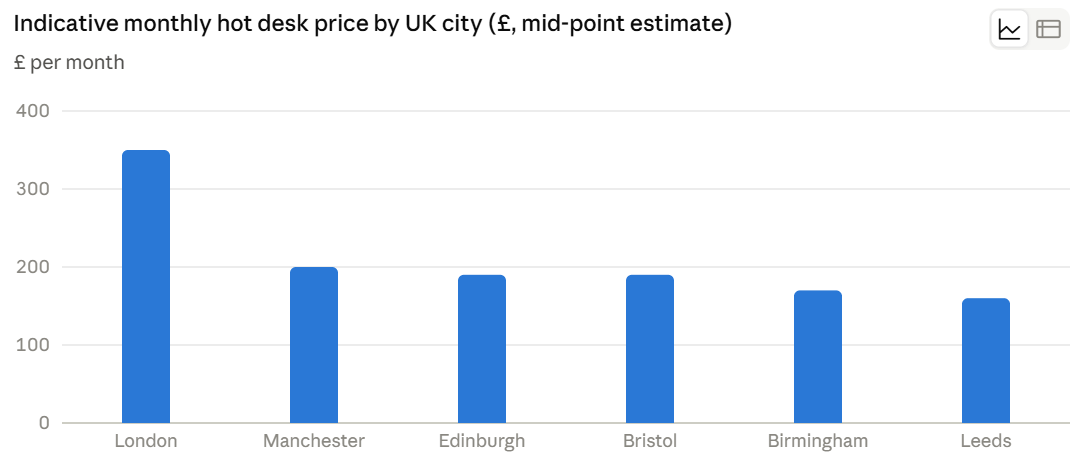
Even allowing for variation between spaces, a UK Startup based outside London can often save a third or more on desk costs, which matters when every pound of runway counts.
| Option | Typical monthly cost (indicative) | Best for |
|---|---|---|
| Virtual office | £20 to £80 | Pre-seed founders needing an address |
| Hot desk | £120 to £450 | Solo founders and remote-first teams |
| Dedicated desk | £200 to £550 | Small teams wanting a fixed spot |
| Private office (4 people) | £1,200 to £3,500 | Funded teams needing privacy |
How to Choose the Right Space for Your UK Startup
Run through these six checks before signing anything:
- Contract flexibility: look for rolling monthly or three-month terms, with no long lock-ins.
- Community fit: ask who the current members are. A fintech UK Startup benefits from different neighbours than a consumer app team.
- Investor access: look for demo days, angel evenings and partnerships with venture funds.
- Facilities: check meeting rooms, phone booths, internet speed and 24/7 access.
- Location: hybrid teams need an easy, central commute for staff.
- Total cost: read the small print on meeting-room credits, printing, deposits and notice periods.
Matching Your Space to Your Stage
| Stage | Team size | Best setup | Budget focus |
|---|---|---|---|
| Pre-seed | 1 to 3 | Hot desk or virtual office | Keep fixed costs minimal |
| Seed | 3 to 10 | Dedicated desks or small office | Community and hiring |
| Series A | 10 to 30 | Private office | Culture and meeting rooms |
| Series B and beyond | 30+ | Managed office or hybrid hub | Flexibility and brand |
Each UK Startup is different, but this framework helps you avoid paying for space you will not use.
Funding and Support Available to a UK Startup
Workspace is only one part of the picture. A UK Startup can also tap government-backed schemes such as the Seed Enterprise Investment Scheme (SEIS) and the Enterprise Investment Scheme (EIS), which offer investors tax relief, plus R&D tax relief for qualifying innovation work. Innovate UK grants and Start Up Loans are also worth exploring. Many coworking communities include accountants and advisers who can explain eligibility, but rules change, so check GOV.UK for current terms.
Tips to Get More From Your Membership
- Attend events in your first two weeks. Early visibility builds relationships.
- Offer help before asking for it. Founders remember generosity.
- Use your address on your website, pitch deck and filings, if the terms allow.
- Share your wins on social media. Coworking communities love amplifying member news, and it helps your UK Startup build an audience on Instagram and YouTube.
- Treat the community as your first customer base. A UK Startup that listens early finds product-market fit faster.
- Review your plan every quarter, and upgrade or downgrade based on actual use.
Frequently Asked Questions
What is the cheapest way for a UK Startup to get professional workspace?
A virtual office or hot desk. Virtual offices often cost under £100 a month, while hot desks outside London start from roughly £120.
Do investors care where a UK Startup works?
Not directly, but a credible address and an active community signal momentum, and many investors scout inside coworking hubs.
Is London necessary for a UK Startup to raise funding?
No. Manchester, Bristol and Edinburgh have active angel networks, and remote pitching is now common.
How long should my contract be?
Start with a rolling monthly or three-month term until your headcount is stable.
Final Thoughts
The best coworking space is the one that matches your stage, budget and goals. For a UK Startup chasing investors, London offers unmatched density, while regional hubs deliver lower costs and strong local support. Shortlist two or three spaces, book a trial day at each, and talk to current members before committing.
Done well, coworking becomes more than a desk: it becomes a growth channel. If you are building a UK Startup in 2026, choose a space that helps you meet customers, hires and investors, not just one that keeps the lights on.