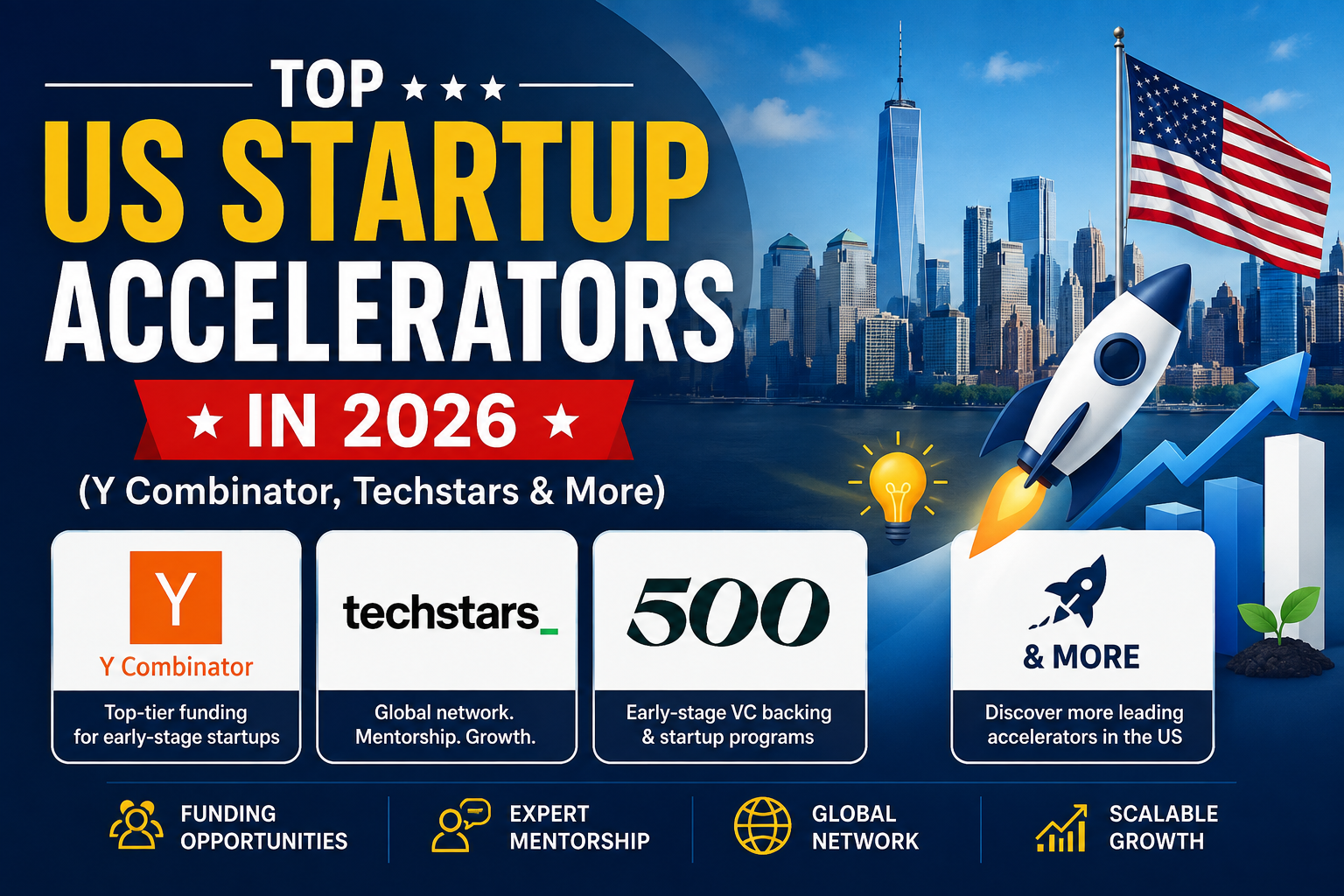
If you’re a founder trying to figure out where to spend the next three to six months of your life, or an investor scouting the next wave of seed-stage deal flow, the accelerator landscape has changed more in the last two years than in the previous decade combined. Venture firms now run their own accelerators. AI-native cohorts have become the norm rather than the exception. And deal terms that used to be negotiable are converging around a fairly predictable band.
This guide breaks down the best US startup accelerators in 2026 — what they invest, what they take, who they’re built for, and how to think about choosing between them. Whether you’re applying with a pre-seed idea or trying to understand which programs are worth watching as an investor, this is the current picture of the US accelerator market.
What a Startup Accelerator Actually Offers in 2026
Before ranking programs, it helps to know what you’re actually buying into. A modern accelerator typically bundles four things: a cash investment (usually structured as a SAFE), a fixed-term cohort with mentorship and structured programming, access to a demo day in front of investors, and — often the most underrated part — a lasting alumni network you can tap for years after the program ends.
The terms vary enormously. Some programs write six- and seven-figure checks for meaningful equity; others take no equity at all and instead monetize through corporate partnerships or economic development funding. Duration also varies, from intensive twelve-week sprints to multi-month or open-ended residencies. The right program depends heavily on your stage, sector, and what you actually need — capital, credibility, customers, or all three.
With that framework in place, here’s how the major US players stack up this year.
Y Combinator
Y Combinator remains the most recognized name in the industry, and it’s not close. Founded in 2005, YC pioneered the modern accelerator model and has since backed companies including Airbnb, Stripe, DoorDash, and Coinbase. Its alumni network has grown past 4,500 companies and more than 10,000 founders.
The standard YC deal is $500,000, split across two instruments: $125,000 through a post-money SAFE in exchange for 7% equity, plus an additional $375,000 through an uncapped SAFE with a most-favored-nation clause. YC now runs four batches a year instead of two, a shift designed to give more founders access without diluting the intensity of the program. Acceptance remains brutally competitive — historically hovering around 1% of applicants — and the program has leaned further into AI-focused startups, which now make up a majority of recent cohorts.
YC’s batches run roughly three months and culminate in a demo day in front of an enormous investor audience. The real value, though, tends to show up after the batch ends: warm introductions, the alumni network, and a brand signal that makes future fundraising conversations easier.
Techstars
Techstars is the closest thing YC has to a true peer in scale and brand recognition, with a presence across more than 50 US cities and a portfolio that includes early backers of Uber, Twilio, and DigitalOcean. Techstars has increased its standard investment to $220,000 per company, combining a $20,000 upfront payment with a $200,000 uncapped MFN SAFE, in exchange for roughly 5% common stock.
What sets Techstars apart from YC is its city-and-vertical model. Instead of one flagship program, Techstars runs dozens of concentrated cohorts — some general, some built around specific industries like fintech, health, or defense, and some run in partnership with corporations such as Barclays. This year the firm also expanded Techstars AI, a dedicated track for founders building AI-native products, launched in 2025 and scaled into additional US cities in 2026. For founders who want a strong network without necessarily relocating to San Francisco, Techstars is often the more practical choice.
a16z Speedrun
Andreessen Horowitz’s Speedrun program has become one of the most talked-about accelerators in the country, largely because of how aggressively it writes checks. Speedrun invests up to $1 million per company plus roughly $5 million in credits for cloud, AI tooling, and other services, structured around a $500,000 upfront investment for approximately 10% equity plus additional funding tied to milestones.
Speedrun runs two cohorts a year in San Francisco, each lasting about twelve weeks and admitting somewhere between 60 and 70 companies out of applicant pools that have exceeded 19,000. That puts its acceptance rate below 0.4%, making it arguably more selective than YC itself. Originally focused on gaming and interactive media, the program has broadened into a horizontal accelerator open to consumer and AI startups of nearly any category, giving admitted founders direct access to a16z general partners and a fast track toward a Series A conversation with the firm.
500 Global
500 Global has backed more than 3,100 companies and operates one of the broadest international networks of any US-founded accelerator, with programs and portfolio companies spanning more than 80 countries. Its typical deal sits around $150,000 for roughly 6% equity, positioning it as a more accessible entry point than YC or Speedrun for founders who may not fit the profile those programs are optimized for.
500 Global’s real strength is geographic and sector diversity. Because it isn’t anchored exclusively to Silicon Valley the way some peers are, it tends to be a strong fit for founders building for markets outside the traditional US tech hubs, or for companies whose customer base is genuinely global from day one.
MassChallenge
MassChallenge is the standout option for founders who want to avoid giving up equity altogether. It runs as a zero-equity accelerator, funded instead through corporate sponsorships and economic development partnerships, and has supported more than 3,200 startups since its founding. Its programs run in multiple US cities, with Boston as its home base, and are structured around industry tracks including health tech, climate, and fintech.
Because it takes no equity, MassChallenge is particularly attractive to founders who are earlier-stage, capital-light, or simply cautious about diluting ownership before they’ve proven out their model. The tradeoff is that the cash component is typically smaller or nonexistent compared to equity-based programs — the value here is mentorship, credibility, and access rather than a large check.
Plug and Play
Plug and Play built its reputation on corporate partnerships rather than a single flagship fund. With more than 550 corporate partners across sectors like fintech, mobility, retail, and sustainability, the program connects startups directly to enterprise customers and strategic investors, often without taking equity at all. For B2B founders whose biggest bottleneck is landing a first enterprise pilot rather than raising capital, Plug and Play’s corporate rolodex can be more valuable than a check.
Alchemist Accelerator
Alchemist is one of the few programs built specifically for enterprise and B2B startups, based in San Francisco. Its structure combines a modest SAFE investment with a program fee, which nets out to roughly $30,000 in actual proceeds for most founders — a detail that surprises people expecting a larger headline number. What Alchemist trades in check size, it makes up for in specialization: mentors, curriculum, and investor introductions are all tuned specifically toward enterprise sales cycles, which makes it a strong fit for technical founders selling into large organizations rather than consumers.
AngelPad
AngelPad runs smaller, tightly curated cohorts out of New York and San Francisco and has built a reputation for founder-level mentorship rather than scale. It’s a good example of the mid-tier accelerator category: not as globally recognized as YC or Techstars, but respected among investors who know the space, with alumni that have gone on to raise strong follow-on rounds.
South Park Commons
South Park Commons has emerged as one of the more distinctive programs in 2026 with its Founder Fellowship, offering $1 million per founder structured as $400,000 for 7% equity plus $600,000 in guaranteed follow-on funding. Rather than running a traditional cohort model, South Park Commons functions more like a community-first fellowship, built around helping technical founders find co-founders, refine ideas, and move from exploration to a fundable company. It’s a strong option for experienced builders who don’t yet have a fully formed startup but want structure and capital while they figure it out.
How to Choose Between Them
With dozens of credible options, the decision usually comes down to three questions. First, what stage are you at — pure idea, early traction, or post-revenue? Programs like South Park Commons and MassChallenge are more forgiving of an unfinished idea, while Speedrun and late-stage YC batches expect founders who can move fast on day one. Second, how much equity are you willing to give up for how much capital? The spread runs from zero-equity programs like MassChallenge and Plug and Play up to double-digit equity stakes at the highest-check programs. Third, what do you actually need most — capital, enterprise customers, technical mentorship, or investor signal? Matching the program’s strength to your actual bottleneck matters more than chasing brand name alone.
The Rise of AI-Focused Cohorts
One of the clearest shifts in 2026 is how thoroughly artificial intelligence has reshaped accelerator programming. It’s no longer a track within a general program — it’s often the organizing principle. Techstars AI now runs dedicated cohorts across multiple cities specifically for founders building AI-native products, pairing standard Techstars mentorship with specialists in areas like model fine-tuning and AI infrastructure. YC has reported that a majority of its recent batches are AI-focused companies, a marked change from the more evenly distributed sector mix of a few years ago.
This shift matters for how founders should think about positioning. A generalist accelerator with a strong AI cohort can still offer excellent mentorship, but a founder building a genuinely technical AI product may get more targeted value from a program whose partners and corporate connections are built specifically around that technology stack. It’s worth reading the fine print on any given cohort before applying — the same brand name can mean a very different experience depending on which track or vertical you land in.
Equity-Free vs. Equity-Based Programs
A recurring question for first-time founders is whether to prioritize a larger check with meaningful dilution, or a smaller (or nonexistent) equity stake with less capital attached. There isn’t a universally correct answer, but a few patterns hold up across the market. Founders who are pre-revenue and need runway to build tend to benefit most from equity-based programs like YC or Techstars, where the capital itself buys time. Founders who already have a working product and mainly need customer introductions or credibility often get more value from equity-free programs like MassChallenge or Plug and Play, where the corporate network matters more than the check size. And founders explicitly optimizing for a fast follow-on raise tend to gravitate toward the venture-backed accelerators — YC, Techstars, and a16z Speedrun — because those programs are structurally built to funnel graduates directly into a subsequent priced round.
Frequently Asked Questions
What is the best startup accelerator in the US for 2026? There’s no single “best” program — it depends on stage and sector. Y Combinator remains the top choice for brand signal and network size, Techstars is the strongest option for founders who want a city- or industry-specific cohort, and a16z Speedrun offers the largest check for founders who can move fast on a compressed timeline.
Do all accelerators take equity? No. Programs like MassChallenge, Plug and Play, and Google for Startups Accelerator run on a zero-equity model, funded instead through corporate sponsorships or economic development partnerships rather than ownership stakes.
How competitive are top accelerators? Extremely. YC has historically accepted roughly 1% of applicants, while a16z Speedrun’s acceptance rate has fallen below 0.4% in recent cohorts, making it one of the most selective programs in the country.
Can pre-idea founders apply to an accelerator? Some can. Programs like South Park Commons and, to a lesser extent, Y Combinator itself are built to accommodate founders who don’t yet have a fully formed company, focusing instead on team strength and problem-solving ability.
The Bottom Line
The 2026 US accelerator market has bifurcated into two tiers. At the top, YC, Techstars, and a16z Speedrun offer the largest checks, the strongest brand signal, and the most competitive acceptance rates. Below that sits a wide field of specialized, regional, and zero-equity programs — MassChallenge, Plug and Play, Alchemist, AngelPad, 500 Global, and South Park Commons among them — each optimized for a specific type of founder rather than trying to be everything to everyone. For founders, the smartest move is rarely applying to the most famous name on the list; it’s applying to the program whose network, check size, and focus actually match where your company is right now. For investors, this expanding and increasingly specialized pipeline is exactly why accelerator demo days remain one of the highest-density sources of early-stage deal flow in the country.