Every year, thousands of ambitious entrepreneurs set their sights on the United States, drawn by its deep capital markets, world-class universities, and the world’s largest consumer economy. Yet one persistent myth trips up even the sharpest founders: the belief that a single “startup visa” exists. It doesn’t. Instead, the U.S. immigration system offers a patchwork of visa categories, each designed for a different kind of applicant — the trader, the investor, the extraordinary talent, the multinational executive. Understanding these US startup visa options is often the single most important piece of homework a foreign founder can do before booking a flight.
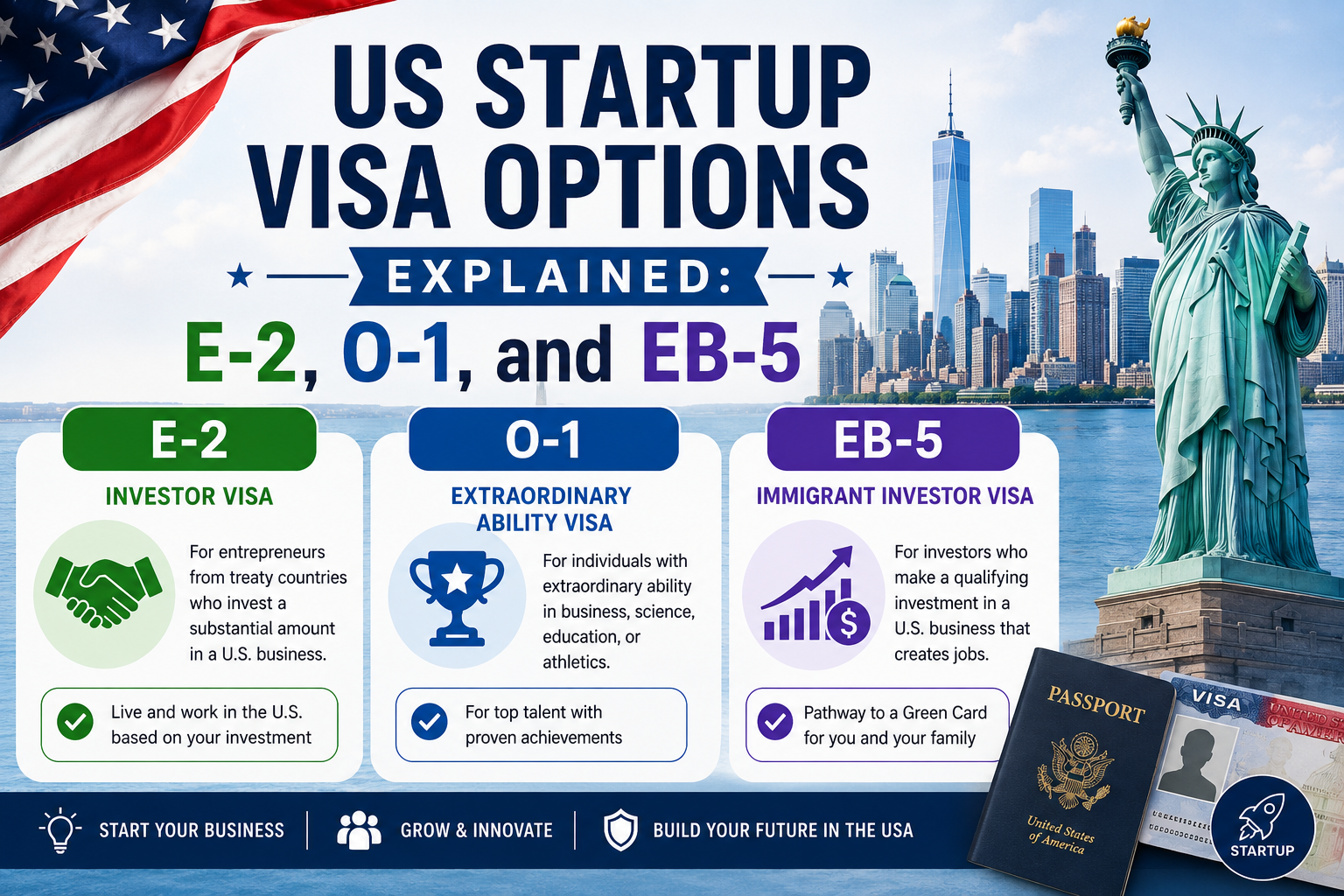
This guide breaks down three of the most relevant pathways for founders and investors — the E-2, the O-1, and the EB-5 — along with a look at a few adjacent routes worth knowing about. Whether you’re bootstrapping a small business, running a fast-growing tech startup, or writing a large check into a U.S. venture, one of these categories is likely to be your starting point.
Why There’s No Single “Startup Visa”
Congress has never created a visa category specifically labeled for startup founders. This surprises many international entrepreneurs who assume that a country as business-friendly as the U.S. would have a dedicated lane for them. Instead, founders must fit themselves into visa categories originally designed for traders, investors, or individuals with extraordinary talent. The upside is that there are multiple doors to try; the downside is that each door has its own lock, and picking the wrong one can waste months of preparation.
The three most commonly discussed options — E-2, O-1, and EB-5 — sit at very different points on the spectrum of investment size, qualification criteria, and long-term immigration outcome. Some are temporary and renewable, others lead directly to a green card. Choosing between them depends heavily on your business stage, your capital, your nationality, and your personal track record.
The E-2 Treaty Investor Visa
The E-2 is often the first stop for founders who want to actively run a business in the U.S. rather than passively invest in one. It’s a nonimmigrant (temporary) visa available only to nationals of countries that hold a qualifying treaty of commerce with the United States — a list that includes many European nations, several Latin American countries, and parts of Asia, but notably excludes some major economies such as India and China.
To qualify, an applicant generally needs to show:
- Nationality from a treaty country — the applicant must hold citizenship in a country on the E-2 treaty list.
- A substantial investment — there’s no fixed statutory minimum dollar amount, but the investment needs to be substantial relative to the total cost of the business and sufficient to ensure its success.
- A real, operating business — the enterprise must be a genuine, active commercial venture, not a passive real estate holding or a shell company.
- Majority ownership or operational control — the applicant typically needs to own at least 50% of the business or otherwise demonstrate operational control.
- Intent to develop and direct the enterprise — the applicant must be coming to the U.S. specifically to grow and manage the business, not simply to hold a stake in it.
One of the E-2’s most attractive features is flexibility around funding amount. Unlike the EB-5 category, there’s no hard investment floor written into the law — a well-documented $100,000 investment in a service business might satisfy a consular officer just as well as a much larger sum in a capital-intensive venture, as long as it’s proportionate to the type of business. The visa is typically issued for an initial period and can be renewed indefinitely as long as the business remains active and the founder continues to meet the requirements.
The trade-off is that the E-2 does not by itself lead to a green card. It’s a “dual intent” gray area — technically a nonimmigrant visa tied to maintaining the business — so founders who want permanent residency eventually need to transition to another category, such as the EB-5 or one of the employment-based green card routes discussed below. Many founders treat the E-2 as a practical bridge: it gets them operating on U.S. soil quickly while they build the track record needed for a longer-term green card strategy.
The O-1 Visa for Extraordinary Ability
The O-1 visa takes a completely different approach. Instead of asking how much money you’re putting into a business, it asks who you are and what you’ve already accomplished. Designed originally for artists, scientists, and athletes with extraordinary ability, the O-1A category has become a popular route for startup founders — particularly those who have built a strong public profile through funding rounds, media coverage, patents, speaking engagements, or leadership roles in previous ventures.
To qualify for an O-1A, an applicant must demonstrate extraordinary ability in business, science, education, or athletics, typically by satisfying at least three of several evidentiary criteria set out by U.S. Citizenship and Immigration Services. These can include things like receiving nationally or internationally recognized awards, holding a leading or critical role in distinguished organizations, commanding a high salary relative to peers, or being the subject of significant media coverage.
For startup founders, this often translates into evidence such as:
- Venture capital funding raised for a current or past company
- Press coverage in recognized business or tech publications
- Patents or other intellectual property
- Advisory roles, board seats, or judging positions in the startup ecosystem
- Awards or recognitions from credible industry bodies
Unlike the EB-5, the O-1 doesn’t require any specific dollar investment. Unlike the E-2, it isn’t restricted to nationals of treaty countries — founders from virtually any country can apply, which makes it especially valuable for entrepreneurs from nations like India and China that fall outside the E-2 treaty list. The visa typically requires a U.S. petitioner or agent, which for many founders means their own company can act as the sponsoring entity, provided the structure is set up correctly.
The O-1 is usually granted in increments and can be extended in additional periods as long as the underlying work continues, with no fixed lifetime cap on renewals. It’s also a strong feeder into an eventual green card, because much of the same evidence used for an O-1 petition overlaps with what’s needed for the EB-1A “extraordinary ability” green card category or the National Interest Waiver under EB-2. Founders who build a compelling record for their O-1 often find the transition to permanent residency more straightforward than those coming from a purely investment-based background.
The EB-5 Immigrant Investor Program
While the E-2 and O-1 are nonimmigrant visas, the EB-5 sits in a different category entirely: it’s an immigrant visa, meaning it leads directly to a green card and, eventually, potential U.S. citizenship. This makes it fundamentally different in purpose from the E-2 and O-1 — it’s less about running a startup day-to-day and more about making a qualifying capital investment that creates American jobs.
Following reforms enacted through the EB-5 Reform and Integrity Act, the current investment thresholds sit at roughly $800,000 for a project located in a Targeted Employment Area (TEA) — generally a rural area or a region with high unemployment — or approximately $1,050,000 for investments outside a TEA. In either case, the investment must go into a new commercial enterprise and must create or preserve at least ten full-time jobs for U.S. workers within a defined period.
Investors have two broad paths for deploying EB-5 capital:
- Direct investment, where the investor personally starts or invests in a business and is directly responsible for job creation.
- Regional Center investment, where capital is pooled into a USCIS-designated regional center that manages a larger project, often real estate or infrastructure development, and job creation is calculated using indirect and induced job methodologies rather than requiring the investor to run the business.
The EB-5 is popular with high-net-worth individuals and families who want a green card for themselves and often their spouse and unmarried children under 21, without needing to demonstrate extraordinary ability or run a business personally. It’s a comparatively passive route to permanent residency, provided the investor is comfortable with the capital commitment and the multi-year processing timelines that can accompany the category, particularly for applicants from countries with high EB-5 demand.
It’s worth noting that EB-5 policy has been a subject of ongoing political discussion, including proposals to significantly raise investment thresholds under a differently branded investor program. As of this writing, the traditional EB-5 framework remains active, but founders and investors considering this route should check current program rules and consult an immigration attorney before committing capital, since thresholds and processing rules can shift.
Other Pathways Worth Knowing
Beyond the three core categories, a few additional options frequently come up in founder conversations:
- L-1A Intracompany Transfer — for founders who already run a qualifying business abroad and want to open or expand operations in the U.S. as a manager or executive. It can later feed into the EB-1C green card category for multinational executives.
- International Entrepreneur Rule (IER) — a parole program, not technically a visa, allowing founders who own a meaningful stake in a young, well-funded U.S. startup to remain temporarily to grow the company. It offers no direct path to a green card and has faced inconsistent use over the years.
- EB-1A and EB-2 NIW — green card categories for individuals of extraordinary ability or those whose work serves the national interest, both of which allow self-sponsorship without an employer or a large capital investment.
Choosing the Right Path
There’s no universal answer to which visa is “best” — the right choice depends on nationality, available capital, business stage, and personal accomplishments. A founder from a treaty country with a modest amount of capital and a hands-on business plan may lean toward the E-2. A founder with a strong track record of funding, press, and industry recognition — especially one from a non-treaty country — may find the O-1 a better fit. An investor prioritizing a direct and predictable path to permanent residency, and willing to commit six or seven figures of capital, may look to the EB-5.
Many founders end up combining strategies over time: starting on an E-2 or O-1 to establish U.S. operations, then transitioning to a green card category once the business or personal track record matures. Because immigration law changes frequently and eligibility hinges on specific facts, anyone seriously considering these options should work with a qualified immigration attorney to map out a realistic timeline before making major business or financial commitments.