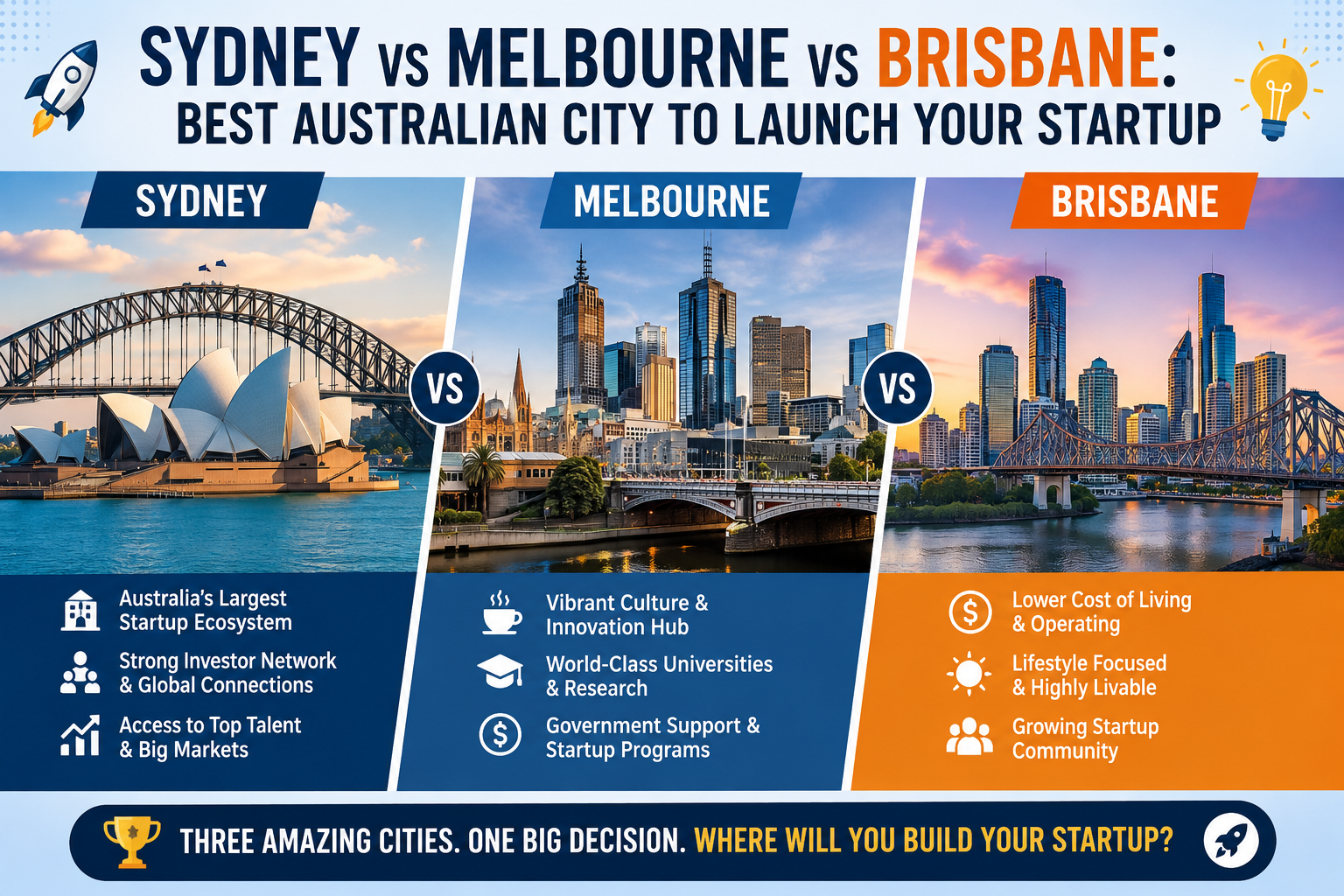
Choosing where to base a new venture is one of the most consequential decisions a founder makes, and nowhere is that choice more interesting than in Australia. If you’re weighing the best city to start a business Australia has to offer, three names dominate the conversation: Sydney, Melbourne, and Brisbane. Each city has built a distinct identity within the broader Australia startup landscape, and each pulls founders and investors in for different reasons — capital access, cost of living, talent density, or lifestyle.
This guide breaks down all three cities across the metrics that actually matter to early-stage founders and the investors who back them: funding availability, operating costs, talent pools, industry specialization, and long-term growth potential. Whether you’re bootstrapping a SaaS product or preparing a seed round, understanding these differences will shape how far your runway stretches and how fast you can grow.
Why City Choice Matters for an Australia Startup
Unlike larger nations where dozens of metro areas host meaningful venture activity, Australia’s startup ecosystem is concentrated in a handful of hubs. That concentration means location decisions carry outsized weight. Office rent, salary benchmarks, proximity to venture capital firms, and even the density of relevant meetups can differ enormously between cities that are only a few hours apart by plane.
For any founder building an Australia startup today, the calculation usually comes down to three questions: Where is the capital? Where is the talent? And where can I actually afford to operate long enough to reach product-market fit? Sydney, Melbourne, and Brisbane each answer these questions differently.
Sydney: The Financial and Venture Capital Hub
Sydney is Australia’s largest city and its undisputed financial center, and that status carries directly into the startup world. The city hosts the heaviest concentration of venture capital firms in the country, along with a dense network of angel investors, corporate accelerators, and banking-adjacent fintech infrastructure. For founders in fintech, enterprise SaaS, or anything requiring proximity to institutional capital, Sydney remains the default choice for an Australia startup seeking its first major raise.
The trade-off is cost. Commercial rents, residential housing, and salary expectations in Sydney sit well above the national average, which means runway burns faster here than almost anywhere else in the country. Talent is abundant but competitive — engineers and product managers routinely field multiple offers, pushing compensation packages upward.
Sydney also benefits from strong international connectivity. Its airport offers more direct long-haul routes than Melbourne or Brisbane, which matters for founders who need to court overseas investors or expand into Southeast Asian and North American markets. This global access is a major reason multinational tech companies choose to anchor their regional headquarters in Sydney, creating a secondary ecosystem of experienced operators who eventually spin out their own ventures.
Melbourne: The Creative and Diversified Economy
Melbourne offers a different value proposition. Often described as Australia’s cultural and creative capital, the city has cultivated strength in biotech, health-tech, edtech, and consumer products alongside a healthy fintech scene of its own. Melbourne’s startup community has a reputation for being tightly knit and collaborative, with active co-working spaces, university-linked incubators, and a strong founder mentorship culture.
Cost-wise, Melbourne sits in the middle of the pack — cheaper than Sydney but not dramatically so, particularly in inner-city commercial districts. What Melbourne offers instead is depth of talent in specific verticals. The city’s world-class universities produce a steady pipeline of researchers and engineers, which has made it a magnet for biotech and medtech ventures that need access to lab facilities and scientific talent.
Government support also plays a role here. Victoria’s state government has historically funded startup grant programs and innovation precincts, giving early-stage Australia startup founders access to non-dilutive capital that can extend runway before a first institutional round. Melbourne’s investor base, while smaller than Sydney’s, is highly active in specific sectors, meaning a well-targeted pitch in biotech or health-tech can find faster traction here than in a more generalist market.
Brisbane: The Rising Contender
Brisbane has spent the last several years transforming from an overlooked regional capital into a genuine contender for founders evaluating the best city to start a business Australia offers. Several forces are driving this shift. Queensland’s lower cost of living and cheaper commercial real estate mean founders can stretch a seed round significantly further than in Sydney or Melbourne. Office space, warehouse capacity for hardware startups, and residential housing all come in noticeably cheaper.
Brisbane’s population growth has also accelerated, driven by interstate migration as workers and founders seek a lower cost of living without sacrificing quality of life. The city’s climate, lifestyle, and growing café and coworking culture have made it increasingly attractive to remote-first teams and founders who no longer need to be physically anchored to Sydney or Melbourne to access capital, thanks to the normalization of video-call investor meetings.
The upcoming 2032 Olympic Games has become a genuine tailwind for the city’s startup scene, spurring infrastructure investment, government-backed innovation funding, and a broader narrative push to position Queensland as a serious technology hub. Local government has responded with grant programs and startup precincts aimed at attracting founders who might otherwise default to the two larger cities. While Brisbane’s venture capital density still lags behind Sydney and Melbourne, the gap is narrowing every year, and an increasing number of interstate and international investors now travel to Brisbane specifically to source deals.
Side-by-Side Comparison
| Factor | Sydney | Melbourne | Brisbane |
|---|---|---|---|
| Venture capital density | Highest | High | Growing |
| Average commercial rent | Highest | Mid-high | Lowest |
| Talent pool size | Largest | Large, specialized | Growing rapidly |
| Cost of living | Highest | Mid-high | Lowest |
| Strongest sectors | Fintech, SaaS, enterprise | Biotech, edtech, consumer | Proptech, agtech, hardware |
| International flight access | Excellent | Good | Improving |
| Government startup grants | Moderate | Strong | Strong and expanding |
| Founder community density | Large, competitive | Tight-knit, collaborative | Emerging, tight-knit |
This table makes clear that no single city wins on every dimension. A founder chasing a large Series A in fintech will likely find Sydney’s investor density hard to beat, while a Brisbane-based Australia startup building hardware or agtech products can operate on a fraction of the burn rate while tapping into a growing pool of government-backed funding.
Estimated Startup Cost Comparison (Illustrative)
The chart below illustrates the relative difference in typical early-stage operating costs across the three cities, indexed against Sydney as the baseline (100).
Sydney     |████████████████████████████████████████| 100
Melbourne  |███████████████████████████████████      | 85
Brisbane   |██████████████████████████               | 65
Index reflects a composite of commercial rent, average tech salaries, and general operating expenses. Lower numbers indicate a more affordable environment for an early-stage Australia startup to conserve runway.
Funding Access by City (Illustrative Distribution)
Sydney      ████████████████████████████ 52%
Melbourne   ███████████████████ 33%
Brisbane    ████████ 15%
Approximate share of national early-stage deal flow historically concentrated in each city. Brisbane’s share has been trending upward year over year as more funds open regional offices or actively source deals outside the two largest hubs.
Which City Fits Which Founder?
Choose Sydney if: you’re building in fintech, enterprise software, or any category where proximity to institutional capital and international investors is critical, and you have enough capital to absorb higher operating costs from day one. Sydney remains the strongest launchpad for an Australia startup targeting a fast institutional raise.
Choose Melbourne if: your venture sits in biotech, health-tech, edtech, or another research-intensive category where university partnerships and specialized talent matter more than raw investor density. Melbourne also suits founders who value a collaborative, community-driven startup culture over a highly competitive one.
Choose Brisbane if: capital efficiency is your primary constraint, you’re building in proptech, agtech, or hardware, or you simply want to extend your runway as far as possible while government grant programs and a growing investor base catch up to the city’s momentum. Many bootstrapped founders now describe Brisbane as the most pragmatic base for an early-stage Australia startup that hasn’t yet raised outside capital.
The Bigger Picture: Australia’s Startup Ecosystem Is Not Zero-Sum
It’s worth noting that these three cities increasingly function less as rivals and more as complementary nodes within one national ecosystem. Many Australia startup founders now run distributed teams, headquartering legally in one city while hiring engineers in another and courting investors in a third. Remote work normalization has weakened the historical requirement to be physically present in Sydney to raise capital, which is part of what has allowed Brisbane’s ecosystem to grow so quickly.
For founders and investors researching the best city to start a business Australia currently offers, the honest answer is that there is no universal winner. Sydney offers unmatched access to capital and global connectivity. Melbourne offers depth in specialized sectors and a strong collaborative culture. Brisbane offers affordability and momentum. The right choice depends entirely on your sector, your funding stage, and how much runway you need to reach your next milestone.
Frequently Asked Questions
Is Sydney really the best city to start a business in Australia? For capital-hungry ventures chasing institutional rounds, Sydney’s investor density is hard to match, making it a natural home base for an Australia startup that needs to raise quickly. But “best” depends heavily on sector — a bootstrapped hardware team may find Sydney’s costs prohibitive compared with Brisbane.
Does an Australia startup need to be based in one of these three cities? No. Adelaide, Perth, and Canberra all host smaller but active startup communities, and remote-first teams increasingly split operations across multiple cities. Still, Sydney, Melbourne, and Brisbane account for the overwhelming majority of national deal flow, which is why most founders default to one of the three.
Which city is cheapest for an early-stage Australia startup? Brisbane consistently ranks as the most affordable of the three, both in commercial rent and average salaries, which is a major reason its founder community has grown so quickly in recent years.
Can investors based in Sydney fund a Brisbane or Melbourne startup? Absolutely. Video-based due diligence and quarterly in-person visits have become standard practice, and many Sydney-based funds now actively source deals from Melbourne and Brisbane rather than waiting for founders to relocate.
Final Thoughts
Australia’s startup landscape has matured well beyond a two-city race. Sydney remains the financial gravity well, Melbourne continues to punch above its weight in specialized innovation, and Brisbane is emerging as the ecosystem’s most interesting growth story. Any founder evaluating where to build their next Australia startup should weigh sector fit and cost structure just as heavily as brand-name investor proximity — because in 2026, capital increasingly follows good ideas wherever they’re based, rather than the other way around.
Ultimately, the debate over the best city to start a business Australia offers isn’t really about picking a winner — it’s about matching your specific Australia startup to the ecosystem that fits its stage, sector, and budget. Get that match right, and the city you choose becomes a genuine accelerant rather than just an address on your incorporation documents.