Choosing where to build a company shapes almost everything that follows — how much money you can raise, how fast you’re expected to grow, and even how failure is perceived by the people around you. The us vs uk startup culture debate comes up constantly among early-stage founders, and for good reason: these two English-speaking markets look similar on the surface but operate on very different assumptions.
This guide breaks down the real, practical differences in the us vs uk startup conversation — from funding size and investor mindset to hiring, taxes, and exit strategy — so you can decide which environment fits your company, or how to navigate both if you’re expanding across the Atlantic.
Why the US vs UK Startup Culture Debate Matters
Every year, thousands of founders and investors research the us vs uk startup culture question before deciding where to incorporate, raise capital, or relocate a team. The stakes are high: valuation multiples, tax treatment, and access to talent all shift depending on which side of the Atlantic you build in.
At a glance, the us vs uk startup landscape splits along a few key lines:
- Capital availability — the US has dramatically more venture capital in absolute terms
- Risk appetite — American investors and founders tolerate failure differently than British ones
- Market size — a US startup can scale to 330 million people without crossing a border
- Talent pools — both countries have deep tech talent, but visa rules differ sharply
- Exit expectations — IPOs and mega-acquisitions are far more common in the US
Funding and Investment: The Core of US vs UK Startup Culture
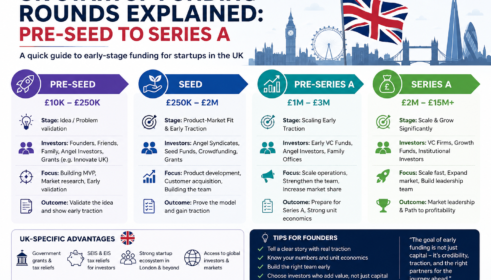
Nowhere is the us vs uk startup gap wider than in venture funding. US venture capital firms deployed roughly ten times the capital of UK firms in recent years, even though the UK remains Europe’s largest startup hub by a wide margin.
| Metric | United States | United Kingdom |
|---|---|---|
| Annual VC investment (approx.) | $170–200B+ | $15–20B |
| Median Seed round | $2.5M–$3M | £500K–£1M |
| Median Series A | $10M–$15M | £3M–£6M |
| Unicorns (cumulative) | 700+ | 50–60 |
| Typical investor check size | Larger, faster | Smaller, more cautious |
A simple way to visualize the funding gap in the us vs uk startup culture discussion:
US VC Capital   ████████████████████████████████████████  $190B
UK VC Capital   ████                                        $18B
American VCs, particularly in Silicon Valley, are known for writing larger checks earlier and moving faster through due diligence. British investors tend to be more conservative, asking for more traction and profitability signals before committing. This single dynamic is often the deciding factor when founders compare us vs uk startup ecosystems — access to capital shapes almost every other decision a founder makes.
Risk Tolerance and Attitudes Toward Failure
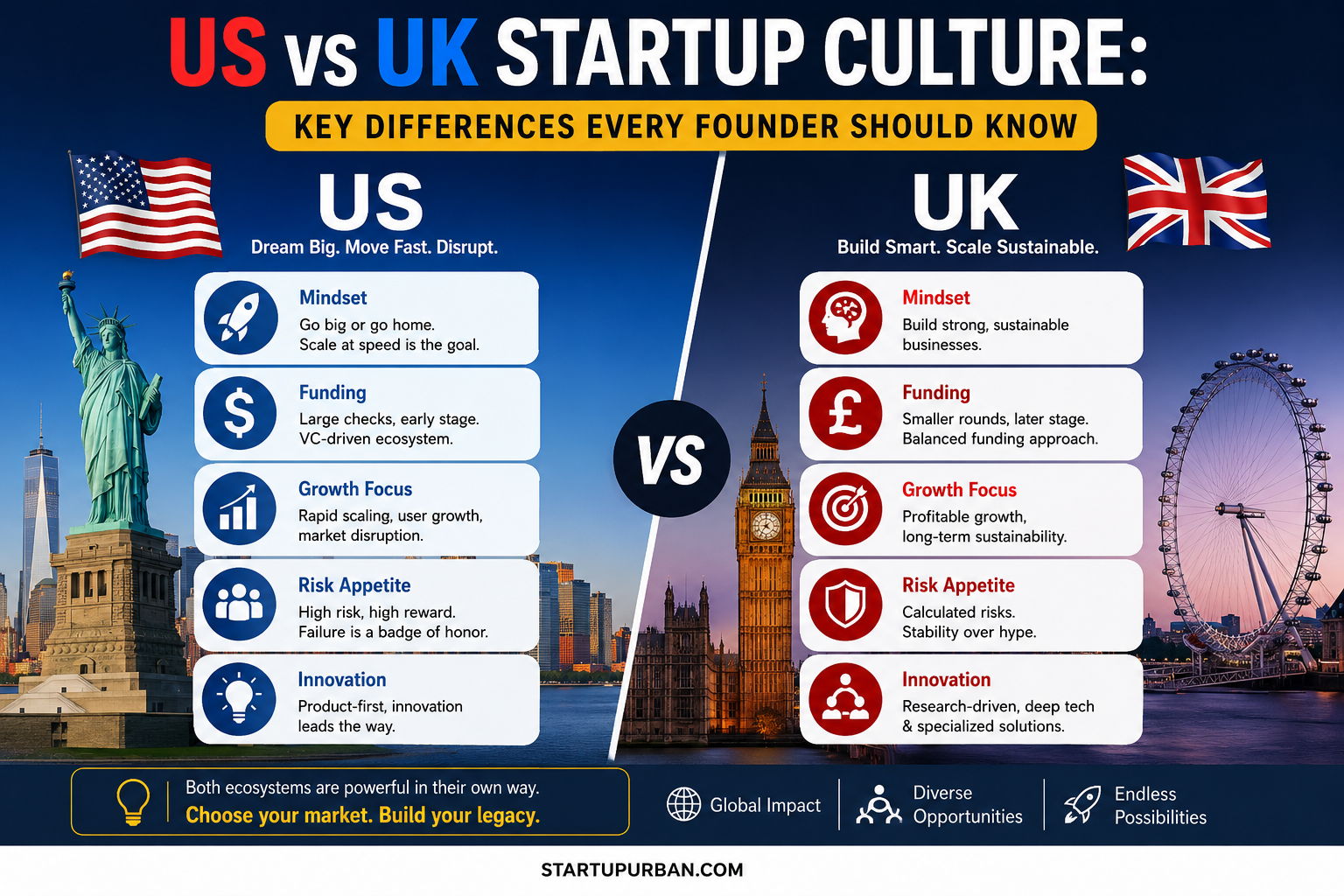
One of the most cited differences in us vs uk startup culture conversations is how each country treats failure. In the US, a failed startup is often viewed as a valuable data point on a founder’s resume — Silicon Valley folklore is full of entrepreneurs who failed twice before their breakout success.
In the UK, failure still carries more social and professional stigma, though this is changing as the ecosystem matures. British founders in the us vs uk startup comparison often report feeling more pressure to appear cautious and “sensible” to investors, while US founders are rewarded for bold, even reckless, ambition.
This cultural gap shows up in how founders pitch:
| Trait | US Founders | UK Founders |
|---|---|---|
| Pitch tone | Bold, big-vision | Measured, evidence-based |
| Preferred growth pace | “Blitzscale” fast | Sustainable, steady |
| Attitude to failure | Badge of experience | Reputational risk |
| Fundraising narrative | Market domination | Path to profitability |
Talent, Hiring, and Equity Practices
Talent dynamics are another major thread in the us vs uk startup story. The US benefits from a dense concentration of engineering talent in hubs like the Bay Area, New York, and Austin, alongside a culture where employees expect meaningful equity stakes and stock option packages as standard compensation.
UK startups, based mostly around London, Manchester, and Cambridge, also offer equity — often through the UK’s EMI (Enterprise Management Incentive) scheme, which has favorable tax treatment — but overall equity grants tend to be smaller relative to salary than in the US.
Visa and immigration policy is a real practical difference too. US immigration for skilled tech workers (H-1B visas) is famously competitive and slow, which pushes some founders to consider Canada or the UK instead. The UK’s Global Talent visa and Innovator Founder visa are comparatively more founder-friendly, making the us vs uk startup hiring conversation more nuanced than “bigger market wins.”
| Factor | United States | United Kingdom |
|---|---|---|
| Engineering talent density | Very high (SF, NYC, Seattle) | High (London, Cambridge) |
| Typical equity for early hires | 0.5%–2%+ | 0.25%–1% |
| Skilled worker visa | H-1B (lottery, competitive) | Global Talent / Innovator Founder |
| Remote hiring norms | Common, especially post-2020 | Common, EU talent pool nearby |
Regulatory Environment and Taxes
Regulation is a quieter but important part of the us vs uk startup culture picture. The US has no single national company registration system — founders typically incorporate in Delaware regardless of where they physically operate, thanks to its predictable corporate law. The UK has a single, simpler system through Companies House, which many founders find faster and cheaper to navigate.
On taxes, the UK’s Seed Enterprise Investment Scheme (SEIS) and Enterprise Investment Scheme (EIS) give angel investors substantial income tax relief for investing in early-stage companies — a strong incentive that doesn’t have a direct US equivalent at the federal level. This is one area where the us vs uk startup comparison actually favors British early-stage investors, even though overall capital volume favors the US.
Employment law also differs meaningfully. US employment is largely “at-will,” giving startups flexibility to hire and let go of staff quickly. UK employment law offers workers more built-in protections, including statutory notice periods and redundancy pay, which changes how UK startups plan headcount growth.
Startup Hubs and Ecosystem Density
Geography still matters enormously in the us vs uk startup equation. Silicon Valley remains the world’s densest concentration of venture capital, technical talent, and successful founders willing to mentor or angel-invest in the next generation. New York, Austin, and Miami have grown into legitimate secondary hubs.
London dominates the UK ecosystem, home to the vast majority of British venture capital and unicorns, with fintech being a particular strength thanks to proximity to European financial markets. Cambridge contributes deep-tech and biotech strength through its university research pipeline.
A founder weighing us vs uk startup culture for a physical base should consider: the US offers a bigger domestic market and more capital, but the UK offers easier access to the broader European market, a strong fintech reputation, and a lower cost of living in most cities outside London.
Exit Strategies: IPOs vs Acquisitions
Exit expectations differ sharply too. US startups are far more likely to pursue a public listing on Nasdaq or NYSE, and even when they don’t IPO, the sheer number of well-capitalized US acquirers (Google, Microsoft, Salesforce, Meta) creates more paths to a large exit.
UK startups exit predominantly through acquisition rather than IPO — London’s public markets have struggled to attract high-growth tech listings, with several notable UK unicorns choosing to list in New York instead. This is a genuine sore point in UK policy circles and a recurring theme in us vs uk startup analysis from industry commentators.
| Exit Path | United States | United Kingdom |
|---|---|---|
| IPO frequency | Higher, deeper public markets | Lower, many list in the US instead |
| Typical acquirer type | Big Tech, PE firms | Corporates, PE firms |
| Average exit size | Larger | Smaller |
| Time to exit | Often longer, bigger swings | Often faster, smaller outcomes |
Work Culture and Day-to-Day Operations
Day-to-day, the us vs uk startup cultural gap shows up in pace and hours. US startup culture, especially in Silicon Valley, often glorifies long hours, rapid iteration, and an “always-on” mentality. UK startups tend to have a somewhat more balanced approach to work-life boundaries, influenced by broader European norms around holiday time and working hours, though this gap has narrowed as UK startups compete globally for talent.
Communication style differs as well — American startup culture tends to be more direct, sales-driven, and comfortable with self-promotion, while British startup culture leans toward understatement, which can sometimes work against UK founders when pitching to US investors who expect bolder claims.
Which Ecosystem Is Better for Founders?
There’s no universal winner in the us vs uk startup culture debate — it depends entirely on your business model, target market, and personal risk tolerance.
Consider the US if you want access to the deepest capital markets in the world, plan to scale aggressively, and can tolerate a more competitive, higher-pressure environment. Consider the UK if you value a supportive early-stage tax environment for investors, want easier access to the wider European market, and prefer a slightly more measured approach to growth.
Many successful companies now deliberately straddle both markets: incorporating and raising later-stage capital in the US while keeping engineering or operations teams in the UK to balance cost and talent access. This hybrid approach is becoming one of the most talked-about strategies in modern us vs uk startup planning.
Final Thoughts
The us vs uk startup culture difference isn’t just academic — it directly affects how much money you can raise, how your team is compensated, how failure is treated, and where your company can realistically exit. Founders and investors who understand these us vs uk startup nuances before committing to a market make better decisions about incorporation, hiring, and long-term strategy.
Whichever side of the Atlantic you choose, the fundamentals of building a great company — solving a real problem, building a strong team, and managing capital wisely — remain the same. The us vs uk startup environment you pick simply changes the rules of the game you’re playing.
Frequently Asked Questions on US vs UK Startup Culture
Is it easier to raise money in the US or UK? In almost every stage comparison, the US offers larger checks and faster deal cycles, which is why so many founders researching us vs uk startup funding ultimately raise a US round even while operating a UK-based team.
Does the us vs uk startup culture gap affect valuations? Yes. US startups are typically valued at higher multiples than comparable UK companies at the same revenue stage, partly because of deeper capital pools and partly because of investor appetite for aggressive growth stories.
Can a UK startup incorporate in the US to access us vs uk startup advantages on both sides? Many do. It’s common for UK-founded companies to flip to a US Delaware structure once they raise a US-led round, while keeping their original UK entity and engineering team intact — a practical way to benefit from both ecosystems in the broader us vs uk startup landscape.