Every founder building one of the many australia startups launching each year eventually asks the same question: what must I register before I can trade legally? The short answer is an Australian Business Number (ABN) and, if you incorporate, an Australian Company Number (ACN). Getting both right matters to investors too, because clean registration is the first thing due diligence teams check when they assess australia startups. This guide explains what each number does, walks through registration step by step, compares costs and flags the mistakes that slow founders down. Whether you are launching one of the australia startups focused on fintech, agritech or SaaS, the process is simple once you know the order of operations.
ABN vs ACN: What Is the Difference?
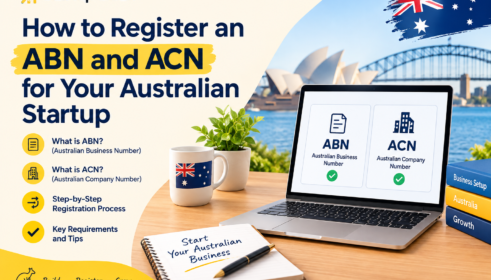
An ABN is an 11-digit number that identifies your business to the tax office, suppliers and customers. An ACN is a 9-digit number issued by the Australian Securities and Investments Commission (ASIC) to every registered company. Sole traders and partnerships need only an ABN, while a company receives an ACN when it is registered and then holds an ABN as well. Because most venture-backed australia startups use a proprietary limited company (Pty Ltd), they usually need both.
| Feature | ABN | ACN |
|---|---|---|
| Length | 11 digits | 9 digits |
| Issued by | Australian Business Register (run by the ATO) | ASIC |
| Who needs it | Any business: sole traders, partnerships, trusts, companies | Registered companies only |
| Cost | Free | Included in the company registration fee |
| Main purpose | Tax, GST, invoicing, grants | Legal identity of the company |
| Where it appears | Invoices, website, contracts | Company documents and ASIC filings |
Why Company Structure Matters for Australia Startups
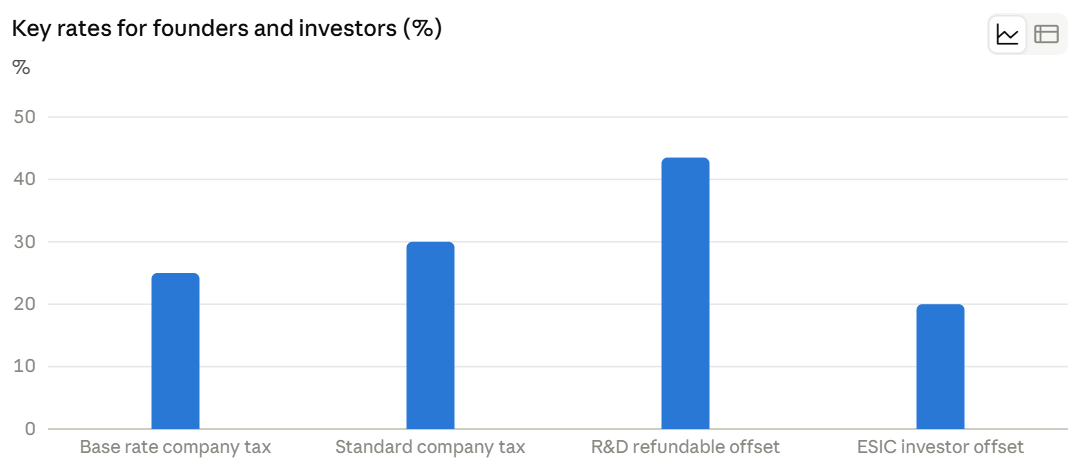
Registration starts with structure, because structure decides which numbers you need. Investors backing australia startups strongly favour companies, since shares and options can be issued, liability is limited and ownership is easy to document. A sole trader or partnership can work for a side project, but it is hard to raise venture capital from either. The structure also affects tax: companies pay a 25% rate if they are a base rate entity (aggregated turnover under A$50 million, mostly active business income) and 30% otherwise.
| Structure | ABN | ACN | Investor-ready? | Typical tax treatment |
|---|---|---|---|---|
| Sole trader | Yes | No | Rarely | Personal marginal rates |
| Partnership | Yes | No | Rarely | Taxed in partners’ hands |
| Trust | Yes | Only with a corporate trustee | Sometimes | Varies by trust type |
| Pty Ltd company | Yes | Yes | Yes | 25% or 30% company rate |
What You Need Before You Apply
Gathering the following first will save hours:
- Director ID: every director needs a Director Identification Number, issued free through the Australian Business Registry Services (ABRS) after identity verification with myID.
- Company name: check it against ASIC’s company and business name registers, and against trademarks and domain names.
- Registered office address in Australia, plus your principal place of business.
- At least one director who ordinarily lives in Australia.
- At least one shareholder (this can be the director) and a planned share structure.
- Constitution decision: adopt the standard “replaceable rules” or write a custom constitution.
Founders behind australia startups with overseas co-founders should plan for the resident director requirement early, because it can delay incorporation if left to the last minute.
Step-by-Step: Registering Your Company and Getting an ACN
- Apply for your Director ID. Verify your identity with myID and complete the application. It is usually issued the same day.
- Choose and check your name. Search ASIC’s register to confirm the name is available.
- Log in to the ABRS online registration service. Select the option to register a proprietary company.
- Enter company details. Provide the company type, name, addresses, director details, shareholders and share capital.
- Confirm your governance rules. Choose replaceable rules or upload a constitution.
- Pay the ASIC fee and submit. The fee was about A$611 for a Pty Ltd in 2025-26, and it is indexed each 1 July.
- Receive your certificate. Your ACN appears on the Certificate of Registration, often within hours.
Australia startups should store the certificate, constitution and share register in a secure data room from day one, since every future investor will ask for them.
Step-by-Step: Getting Your ABN
When you register a company through the ABRS service, you can apply for an ABN, tax file number (TFN) and GST registration at the same time. If you skipped that step, or you are a sole trader, apply directly through the Australian Business Register at abr.gov.au.
- Confirm eligibility. You need to be carrying on an enterprise in Australia.
- Prepare your details. Have your ACN, TFN, business address, director details and a description of your main business activity ready.
- Apply online. The application is free.
- Answer the questions. Include expected turnover and whether you intend to register for GST.
- Receive your ABN. Many applications are approved instantly, though some go to manual review and can take up to 28 days.
Many australia startups pay third-party agents for something that costs nothing. Apply directly and avoid the fee.
Costs and Timelines
The good news is that the true cost of registration for australia startups is low. The bigger expenses come from the legal and accounting work around it.
| Item | Typical cost (A$) | Timeframe |
|---|---|---|
| Director ID | 0 | Same day |
| ABN | 0 | Instant to 28 days |
| ASIC Pty Ltd registration | About 611 | Hours to 2 days |
| ASIC annual review fee | About 300-350 | Yearly |
| Accountant setup (optional) | 500-1,500 | 1-3 days |
| Lawyer for constitution and shareholders agreement | 1,500-5,000 | 1-2 weeks |
Fees change, so always confirm current amounts on ASIC’s website.
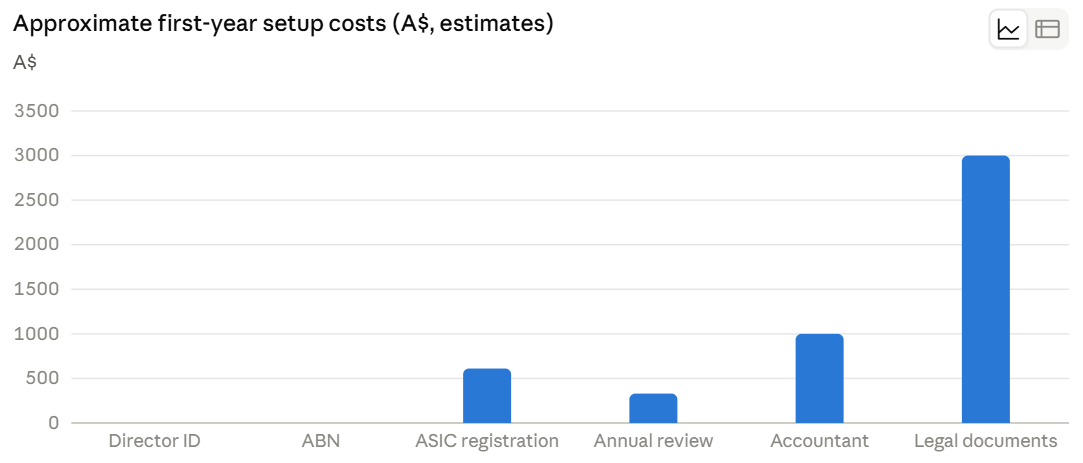
The chart uses midpoints for the accountant and legal ranges, so treat it as a planning guide. Legal documents dominate the budget for most australia startups, and registration itself is almost trivial by comparison.
Register for GST, PAYG and Other Taxes
Your ABN unlocks the wider tax system. GST registration is compulsory once your annual turnover reaches A$75,000, and it is optional below that. Registering voluntarily early lets australia startups claim GST credits on software subscriptions, contractors and equipment, which improves cash flow while revenue is still small. If you plan to hire, you will also need PAYG withholding and superannuation arrangements, and possibly state payroll tax once wages pass your state’s threshold.
| Registration | Trigger | Where to register |
|---|---|---|
| GST | Turnover of A$75,000+ (or voluntary) | Australian Business Register / ATO |
| PAYG withholding | Employing staff or paying certain contractors | ATO |
| Superannuation | Having employees | ATO and your chosen fund |
| Payroll tax | Wages above the state threshold | State revenue office |
| Business name | Trading under a name different from your company name | ASIC |
Tax Incentives for Australia Startups
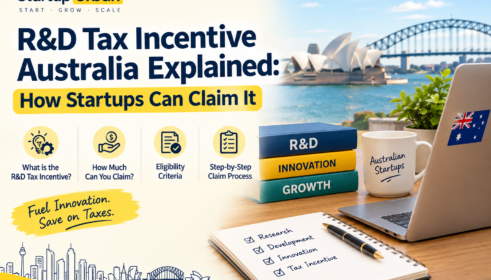
Correct registration is not just paperwork. It determines which government incentives you can access. The Research and Development Tax Incentive offers a refundable tax offset of 43.5% for eligible companies with aggregated turnover under A$20 million, provided you register your R&D activities with AusIndustry within ten months of the end of the income year. The Early Stage Innovation Company (ESIC) regime gives eligible investors a 20% non-refundable tax offset, capped at A$200,000 per investor per year, plus capital gains tax concessions.
Investors who back these australia startups often factor the offsets into their return calculations, so being eligible makes your round easier to close. Only companies can access these schemes, which is one more reason australia startups incorporate early.
Common Mistakes to Avoid
Here are the errors we see most often among australia startups:
- Trading before registering. Contracts signed before incorporation can leave founders personally liable.
- Paying ABN agents. The ABN is free when you apply directly.
- Mismatched details. Company names, addresses and directors should be identical across ASIC and ABR records.
- Forgetting Director ID. Without it, you cannot complete registration.
- Skipping the shareholders agreement. Co-founder disputes over equity are a leading cause of startup failure.
- Leaving IP outside the company. Investors in australia startups expect all intellectual property to be assigned to the company.
- Ignoring annual obligations. Missing the ASIC annual review can lead to late fees and, eventually, deregistration.
What Investors Look for in Australia Startups
If you plan to raise capital, treat registration as part of your pitch. When evaluating australia startups, investors typically check that the company is properly incorporated, the share register matches the cap table, directors have valid Director IDs, and tax registrations such as GST and PAYG are current. They also confirm that the entity holding the IP, contracts and bank account is the same registered company.
Well-organised australia startups close rounds faster because due diligence has nothing to catch. A tidy data room containing your certificate of registration, ABN details, constitution, shareholders agreement and ESIC or R&D eligibility notes signals maturity. In a competitive funding market, strong governance is a genuine edge for australia startups.
FAQ: ABN and ACN for Australia Startups
Do all australia startups need an ACN?
No. Sole traders and partnerships need only an ABN. But if you want to raise venture funding, issue equity or limit personal liability, you will need a company and therefore an ACN.
Can foreign founders register a company?
Yes, but at least one director must ordinarily reside in Australia. This matters for australia startups run by non-resident founders, who often appoint a local director or advisor.
How much does it cost?
The ABN is free and ASIC’s Pty Ltd fee is roughly A$611. Including optional legal and accounting support, most australia startups spend between A$1,000 and A$6,000 to get properly set up.
Which comes first, the ABN or the ACN?
For a company, the ACN is issued at registration and the ABN is usually applied for in the same online process, or shortly afterwards.
Final Thoughts
Registering an ABN and ACN is the foundation for australia startups: it gives your business a legal identity, unlocks tax registrations and makes you visible to investors. The process is quick, largely online and inexpensive, provided you complete the steps in order: Director ID, company registration, ABN, then GST and PAYG as needed.
The most successful australia startups treat compliance as a growth tool rather than an admin chore. Clean records speed up fundraising, protect founders and qualify the business for incentives that extend your runway. With a growing ecosystem of australia startups competing for the same investor attention, the founders who get the basics right early stand out.
If you are building one of the australia startups shaping the next wave of Australian innovation, follow the steps above, keep your documents organised and revisit your structure as you scale. Do that, and your australia startups journey will start on solid legal and financial footing.