Not long ago, launching a company meant hiring a developer, a designer, a marketer, and a bookkeeper before the first sale. In 2026, a solo founder in Austin or Denver can launch with a fraction of that payroll. The reason is simple: ai tools for startups now handle coding, support, accounting, and outreach for a small share of the old cost.
This guide looks at how American founders use ai tools for startups to stretch their runway, which categories save the most money, and what investors want to see. If you are researching ai tools for startups 2026 before a build or a fundraise, the numbers and frameworks below give you a practical starting point.
Why AI Tools for Startups Matter More in 2026
Funding has become more disciplined. Seed investors now ask how far a round will stretch, not just how fast a company can grow. Founders who adopt ai tools for startups can reach early milestones with smaller teams, which means less dilution and a longer runway. A product that once needed six people can often be built and supported by two or three, and investors notice that difference.
The spread of ai tools for startups also helps founders outside Silicon Valley, who may lack access to large networks of affordable talent.
Where Founders Save the Most Money
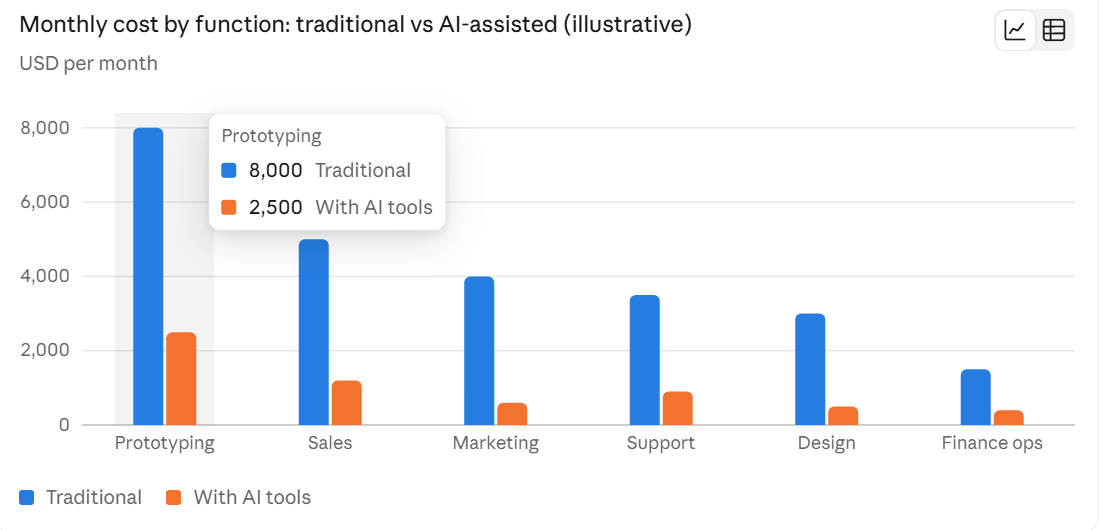
The savings are not spread evenly. The table below shows typical monthly spending for a small early-stage team before and after adopting ai tools for startups. The figures are illustrative estimates based on common founder-reported ranges, so treat them as a planning baseline, not a guarantee.
| Business function | Traditional monthly cost | Cost with AI tools | Typical saving |
|---|---|---|---|
| Software prototyping | $8,000 | $2,500 | 69% |
| Sales outreach | $5,000 | $1,200 | 76% |
| Marketing content | $4,000 | $600 | 85% |
| Customer support | $3,500 | $900 | 74% |
| Design | $3,000 | $500 | 83% |
| Bookkeeping and finance ops | $1,500 | $400 | 73% |
| Total | $25,000 | $6,100 | 76% |
TraditionalWith AI toolsUse the arrow keys to move between data points
Across these six functions, total monthly spend falls from roughly $25,000 to $6,100, a reduction of about 76 percent. The biggest absolute savings come from product development, while marketing and design show the highest percentage cuts. Founders who use ai tools for startups strategically tend to begin with work that is repetitive and easy to review.
1. Building Products Faster with AI Coding Assistants
Engineering is usually the largest line item, so it is the first place founders look. AI coding assistants write boilerplate, generate tests, explain unfamiliar code, and catch bugs before they reach customers. Among the most useful ai tools for startups, these assistants let one technical founder do work that once needed a small team. Many founders also use no-code and low-code builders for internal dashboards and landing pages, saving engineers for the core product. The savings come mainly from shorter build cycles: a prototype that took three months can often reach early users in a few weeks.
2. Marketing and Content at a Fraction of the Cost
Content creation is where ai tools for startups show the quickest return. Founders use AI to draft blog outlines, social posts, email sequences, and ad variations, then edit them for voice and accuracy. The winning pattern is human-led and AI-assisted: AI produces a first draft, and a founder or editor adds original insight, real customer stories, and fact-checking. Search engines reward helpful, original content, so publishing unedited AI text is a poor shortcut. Design tools with built-in AI also let non-designers produce polished graphics, which removes the need for a retained agency in the early months.
3. Customer Support That Scales Without Hiring
Support tickets grow with every new customer, and hiring agents is expensive. AI chat assistants trained on a company’s help documents can resolve common questions around the clock and pass harder cases to a person. For many American SaaS and e-commerce founders, this is one of the most practical ai tools for startups because the benefit shows up immediately in response times and headcount. The key is keeping a clear path to a human, since customers quickly lose patience with a bot that cannot escalate.
4. Smarter Sales Outreach
Sales automation tools now research prospects, personalize emails, schedule follow-ups, and summarize calls. Founders report that this lets them run outbound campaigns without a full-time sales development rep. Used well, ai tools for startups shorten the time from list building to first meeting. Used badly, they produce generic spam that damages a sender’s reputation, so personalization and list quality still matter more than volume.
5. Finance, Legal, and Operations
Bookkeeping software with AI categorizes transactions, flags unusual spending, and prepares monthly reports. Contract review assistants highlight risky clauses before a lawyer reviews the final draft, which can reduce billable hours. Workflow automation connects forms, spreadsheets, and messaging apps so routine tasks run on their own. These back-office ai tools for startups rarely make headlines, yet they quietly remove hours of administrative work every week. Founders should still consult a qualified accountant and attorney for tax and legal decisions.
Popular AI Tool Categories and Typical Costs
The table below summarizes the main categories American founders consider when comparing ai tools for startups. Prices are typical ranges for small teams and change often, so confirm current pricing on each vendor’s website.
| Category | Main use | Example tools | Typical monthly cost |
|---|---|---|---|
| Coding assistants | Faster development | GitHub Copilot, Cursor | $10–$40 per user |
| General AI assistants | Research, drafting, analysis | ChatGPT, Claude | $20–$30 per user |
| Support automation | Chat and ticket handling | Intercom, Zendesk | $30–$100+ per seat |
| Design and content | Graphics, copy, notes | Canva, Notion AI | $10–$30 per user |
| Workflow automation | Connecting apps and tasks | Zapier, Make | $20–$70 per plan |
| Finance tools | Bookkeeping and reports | QuickBooks, Xero | $30–$90 per company |
How AI Is Changing Startup Burn Rate
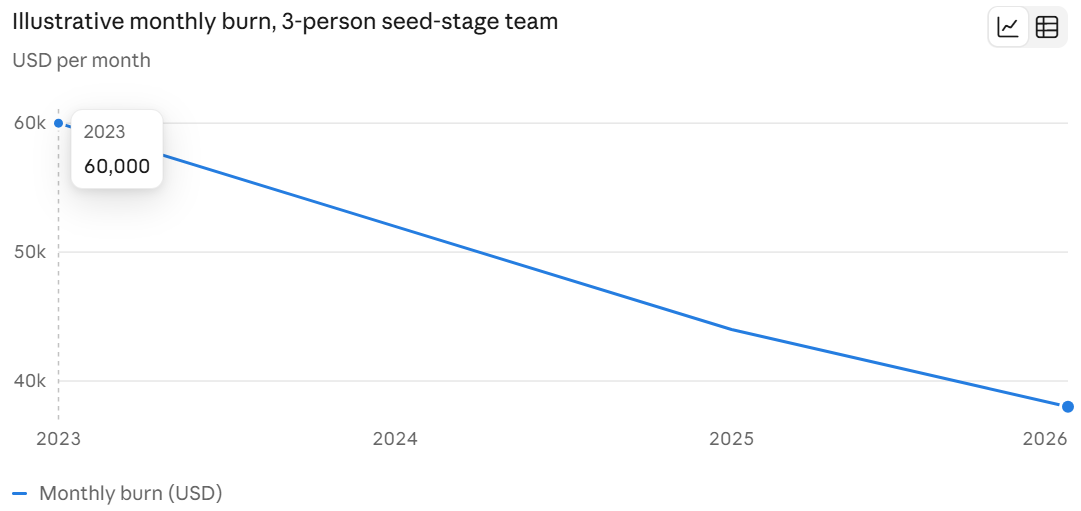
Burn rate is the clearest proof that ai tools for startups change the economics of a young company. The chart below shows an illustrative monthly burn for a three-person seed-stage team as AI adoption has grown.
Monthly burn (USD)Use the arrow keys to move between data points
Even a modest drop in burn adds months to a company’s runway. If a startup holds $500,000 in the bank, cutting burn from $60,000 to $38,000 extends runway from about 8 months to about 13. That extra time is often what lets a team using ai tools for startups reach product-market fit before the next raise.
Three Composite Examples
These scenarios are composites based on common founder patterns, not individual companies.
A solo SaaS founder uses a coding assistant and a support chatbot to launch with no employees, keeping monthly costs under $3,000. An e-commerce brand uses AI for product descriptions, ad testing, and inventory forecasting, trimming agency fees by more than half. A two-person fintech team uses AI to summarize regulatory documents and draft customer communications, then has counsel review everything before it goes out. That keeps legal spend predictable while the team still moves quickly.
What Investors Think About AI-Powered Cost Savings
Investors are not impressed by tools alone. They want evidence that savings turn into progress. Strong signals in a pitch include:
- Revenue per employee that outpaces peers
- Clear before-and-after cost data
- A plan for quality control and human oversight
- Defensible advantages beyond using the same ai tools for startups as every competitor
Because access to ai tools for startups is open to everyone, they are rarely a moat on their own. The moat comes from proprietary data, customer relationships, and execution speed. Founders who explain how their use of ai tools for startups supports those advantages tell a more convincing story than those who simply list subscriptions.
Risks Founders Should Manage
Cost savings come with trade-offs. Data privacy is the first concern: customer information should not be pasted into tools without checking how the vendor stores and trains on data. Accuracy is the second, since AI can state wrong facts confidently. Vendor lock-in and rising subscription costs are the third, because a stack of many small tools can add up. Finally, regulation is evolving, and U.S. state laws on automated decision-making and data use continue to change. A sensible approach to ai tools for startups includes written usage rules, human review for anything public or legal, and a quarterly audit of subscriptions.
A 90-Day Plan to Adopt AI Tools for Startups
Founders who want results without chaos can follow a simple sequence.
| Phase | Focus | Goal |
|---|---|---|
| Days 1–30 | Audit costs and pick two repetitive workflows | Baseline spend and time |
| Days 31–60 | Pilot one tool per workflow | Measure hours and dollars saved |
| Days 61–90 | Keep, cut, or expand | Document results for investors |
Start small. The best ai tools for startups are the ones a team actually uses every week, not the ones with the longest feature list. Track hours saved and dollars saved for each tool, and cancel anything that does not pay for itself within two or three months.
Mistakes to Avoid
Many teams adopting ai tools for startups make the same errors:
- Buying too many overlapping tools
- Publishing AI output without editing it
- Ignoring security and privacy settings
- Measuring activity instead of outcomes
Avoiding these mistakes keeps ai tools for startups a genuine advantage instead of a growing expense.
Frequently Asked Questions
What are the best ai tools for startups in 2026?
There is no single best option. Most founders combine a general AI assistant, a coding assistant, a support chatbot, and an automation platform, then add specialized tools as needs grow.
Can ai tools for startups replace hiring entirely?
No. They reduce the need for early hires in repetitive roles, but strategy, relationships, and judgment still require people.
How much can a startup save?
Many founders estimate savings between 30 and 70 percent in specific functions, depending on the workflow and how much human review is needed.
Are ai tools for startups safe for confidential data?
It depends on the vendor and plan. Review privacy terms, use business-tier accounts where available, and avoid sharing sensitive information unnecessarily.
Final Thoughts on AI Tools for Startups in 2026
American founders are proving that a lean team can compete with much larger rivals. By choosing ai tools for startups carefully, measuring results, and keeping humans in charge of quality, they cut costs without cutting ambition. For investors, the takeaway is to look past the tool list and examine how a company converts savings into growth. For founders, the message is practical: begin with one workflow, prove the savings, and expand. The companies that treat ai tools for startups as a disciplined operating strategy, not a trend, will be best placed to last.