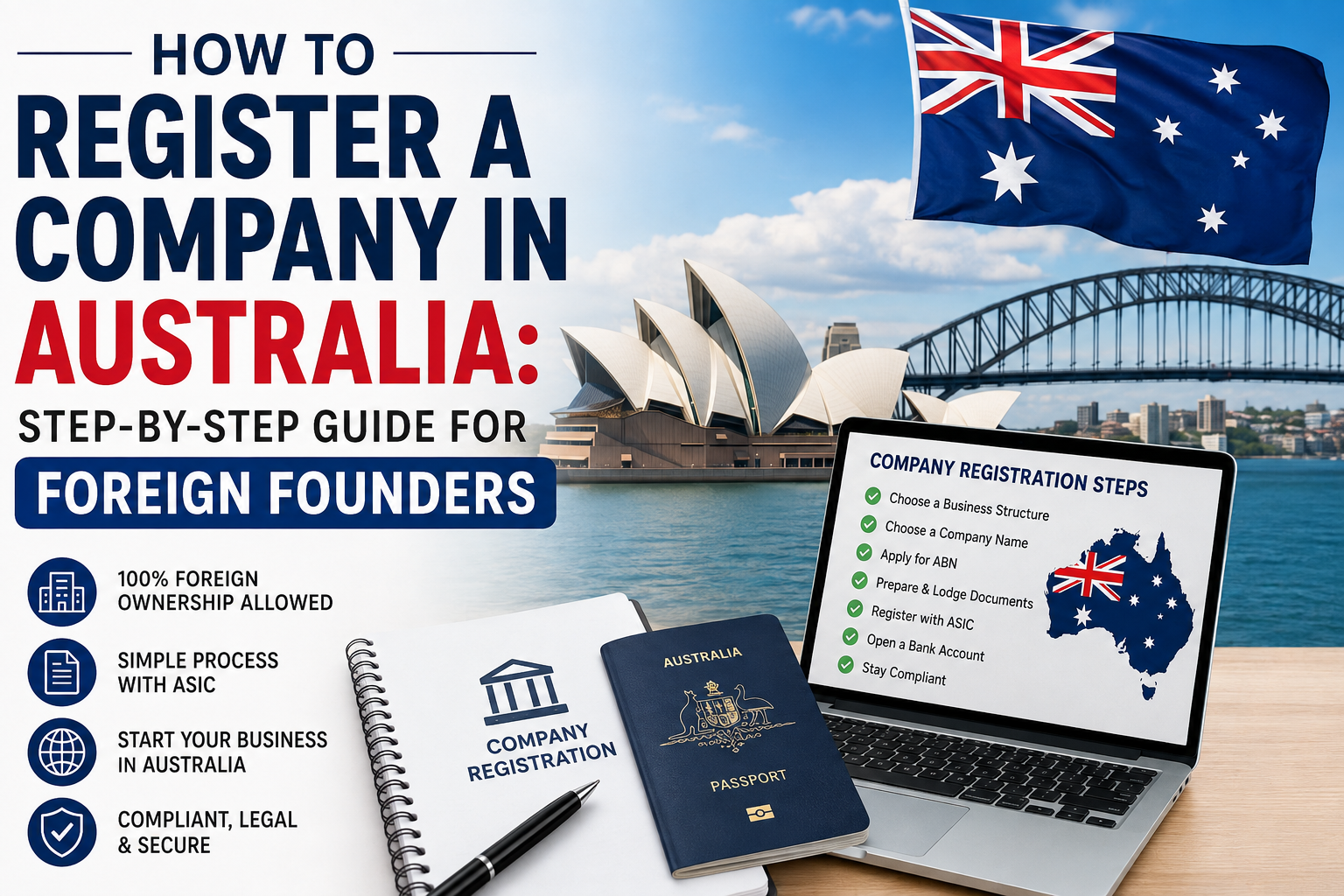
Australia has quietly become one of the most attractive jump-off points for founders building toward the Asia-Pacific region. Political stability, a transparent legal system, a skilled workforce, and a tax environment that rewards genuine business activity make it a natural landing spot for entrepreneurs who don’t want to gamble on unpredictable markets. For overseas founders and early-stage investors, though, the appeal is often tangled up with a fair amount of confusion: Which structure fits? Do you need to live there? What does ASIC actually require from someone sitting in another country?
This guide walks through the entire process of registering a company in Australia as a foreigner — the structures available, the paperwork, the realistic costs in 2026, and the compliance obligations that continue after the certificate lands in your inbox.
Why Foreign Founders Are Looking at Australia
Before getting into the mechanics, it’s worth understanding why this market keeps showing up on founder shortlists. Australia’s economy is diversified across mining, agriculture, technology, healthcare, and financial services, which cushions it against sector-specific shocks. The country also has a strong network of free trade agreements across the Asia-Pacific, giving an Australian-registered entity credibility and market access that a purely offshore company may lack.
For investors, an Australian company can also serve as a clean, well-regulated vehicle for holding assets or channeling capital into the region, with corporate governance standards that reduce due-diligence friction later on.
Step 1: Choose the Right Business Structure
The very first decision shapes everything that follows. Australia recognizes several structures, but not all of them are realistic options for someone based overseas.
- Sole trader — an individual trading under their own name with unlimited personal liability. This structure generally isn’t available to non-residents, since it assumes the operator is physically present and personally accountable in Australia.
- Partnership — two or more people or entities sharing profit and liability. Rarely used by foreign founders because it doesn’t shield personal assets.
- Proprietary Limited Company (Pty Ltd) — a separate legal entity registered with the Australian Securities and Investments Commission (ASIC), offering limited liability to shareholders. This is, by a wide margin, the structure most foreign founders and investors choose, and the one this guide focuses on.
- Trust — used for asset protection and estate planning, less common as a starting point for an operating business.
- Branch of a foreign company — instead of forming a new local entity, an existing overseas company can register as a foreign company operating in Australia through ASIC, typically via an ARBN registration. This still requires a local agent and a registered address, and the parent company remains liable for the branch’s obligations.
For most founders launching a genuinely new venture — rather than extending an existing overseas company — a Pty Ltd is the practical choice. It gives you a distinct Australian legal identity, limited liability, and a structure that Australian banks, clients, and investors instantly recognize.
Step 2: Understand the Resident Director Requirement
This is the single biggest surprise for many overseas founders. Australian corporate law requires every Pty Ltd company to have at least one director who ordinarily resides in Australia. A foreign national who is merely visiting or holds a temporary visa without residency status typically won’t satisfy this requirement.
If you don’t have an Australian-resident co-founder, partner, or trusted contact who can take on this role, there are two common workarounds:
- Appoint a nominee resident director through a corporate services or company formation provider. This is a paid, ongoing arrangement where a qualified local professional formally holds the director title while you retain full ownership and operational control through your shareholding and internal agreements.
- Relocate a director, if your business plan already involves someone on your team moving to Australia.
Whichever path you take, every director — resident or not — must first obtain a Director Identification Number (Director ID) from the Australian Business Registry Services before the company can be lodged. This is a unique, lifetime identifier tied to the individual, designed to prevent fraudulent or “phoenix” company activity, and it must be in place before registration, not after.
If the company ends up more than 50% foreign-owned, expect additional ongoing ASIC reporting obligations, including periodic lodgement of financial statements — a detail that surprises founders who assumed reporting requirements were identical to those for locally owned companies.
Step 3: Reserve a Company Name
Your company name needs to be distinct from existing registered names and trademarks in Australia. Before locking in branding, search the ASIC company register and the IP Australia trademark database to confirm the name is genuinely free — a step many founders skip and later regret when a rebrand becomes necessary.
If you plan to trade under a name different from your official registered company name, you’ll also need to register that business name separately, which currently costs roughly AUD $47 for one year or around AUD $108 for three years.
Step 4: Register the Company With ASIC
This is the core registration step, and it can be completed entirely remotely — no visit to Australia required. You’ll need to submit:
- The proposed company name and structure
- Full details of all directors and shareholders, including identification documents
- The registered office address (a physical Australian address — a P.O. box will not be accepted)
- The principal place of business
- Share structure and initial share capital (this can be as low as AUD $1)
As of 1 July 2026, ASIC’s standard company registration fee sits at around AUD $636, up from roughly AUD $611 previously. Processing is usually fast — often completed within one to three business days when the paperwork is in order.
Once approved, ASIC issues your company an Australian Company Number (ACN) — a unique nine-digit identifier that appears on every legal and financial document your company issues from that point forward. You’ll also receive a Certificate of Registration confirming the company legally exists.
Step 5: Set Up a Registered Office Address
Every Australian company must maintain a registered office — a real, physical address in Australia used for official correspondence from ASIC, the Australian Taxation Office (ATO), and other regulators. This cannot be a virtual mailbox alone in most cases and must be a genuine location where documents can be served.
Many foreign founders solve this through a registered agent or corporate services provider who offers a compliant registered address as part of a formation package, along with mail scanning and forwarding so nothing gets missed from overseas.
Step 6: Apply for an Australian Business Number (ABN)
With your ACN in hand, the next step is applying for an ABN through the Australian Business Register. The ABN is the identifier your company uses to interact with the ATO, issue tax invoices, and register for other obligations. Unlike company registration, ABN applications are free.
You’ll typically apply for the ABN alongside a Tax File Number (TFN) for the company, which is required for lodging tax returns.
Step 7: Register for GST (If Applicable)
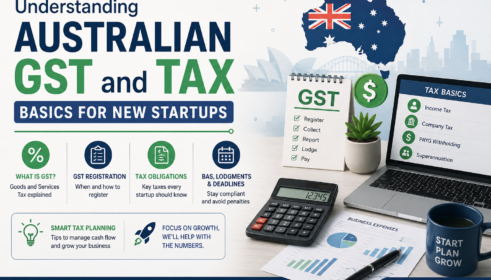
Goods and Services Tax (GST) registration becomes mandatory once your company’s annual turnover is expected to exceed AUD $75,000. Below that threshold, registration is optional but sometimes worthwhile, since it allows you to claim GST credits on business expenses. Founders anticipating rapid growth often register from day one to avoid a mid-year scramble.
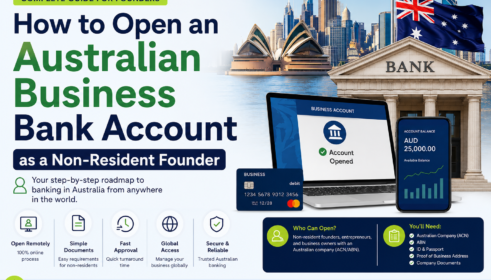
Step 8: Open an Australian Business Bank Account
Most Australian banks require at least one director or authorized signatory to appear in person to open a business account, which can be a genuine obstacle for founders who don’t plan to travel immediately. Some banks and fintech providers now offer remote onboarding for foreign-owned companies, particularly when a formation agent or accountant vouches for the business, so it’s worth comparing options rather than assuming an in-person visit is unavoidable.
Step 9: Understand Ongoing Compliance Obligations
Registration is the starting line, not the finish line. Once your Pty Ltd is active, expect these recurring obligations:
- Annual review fee to ASIC, generally in the range of AUD $300–$320, due on the anniversary of registration.
- Annual financial statements, especially if the company is majority foreign-owned, where ASIC reporting is stricter.
- Tax returns lodged with the ATO, along with any applicable GST Business Activity Statements.
- Maintaining the resident director requirement continuously — if your resident director resigns or moves overseas, you generally have a short window (commonly 30 days) to appoint a replacement.
- Keeping the registered office current, since missed correspondence from ASIC or the ATO doesn’t excuse non-compliance.
Falling behind on any of these can result in penalties or, in serious cases, deregistration of the company — a costly setback for a founder who has already built momentum with Australian clients or investors.
Realistic Costs and Timeline
Bringing all the pieces together, most foreign founders should budget somewhere between AUD $1,500 and $6,000 to get a compliant Pty Ltd fully operational, depending on whether they handle registration themselves or use a formation service, whether a nominee director is needed, and how quickly they need banking sorted. End to end — from Director ID application through ASIC registration, ABN, TFN, and GST — the process commonly takes one to three weeks when documents are prepared correctly the first time.
Common Mistakes Foreign Founders Make
A few missteps show up again and again:
- Delaying registration while “testing the market.” Once you’re signing contracts, working regularly with Australian clients, or hiring locally, you’re considered to be carrying on business in Australia, and ASIC registration is expected.
- Underestimating the resident director requirement, then scrambling for a nominee at the last minute.
- Using a P.O. box as a registered address, which ASIC will reject.
- Skipping a trademark search, only to discover the chosen name conflicts with an existing brand.
- Assuming banking will be instant, when in-person verification requirements can add unexpected delay.
Final Thoughts
Registering a company in Australia as a foreigner is entirely achievable — and increasingly common — but it rewards founders who plan the resident director, registered address, and banking logistics early rather than treating them as afterthoughts. With the structure right and the paperwork sequenced correctly, most overseas founders can have a fully compliant, investor-ready Australian company operating within a few weeks, positioned to tap into one of the most stable and strategically located economies in the Asia-Pacific region.
If you’re weighing Australia against other jurisdictions, it’s worth speaking with a local corporate services provider or accountant before you lodge anything — the fee for that conversation is small compared to the cost of unwinding a structure that doesn’t fit your long-term plans.