Choosing where to build is one of the highest-leverage decisions a founder makes, and the debate over the best US cities for startups 2026 has never been more data-rich. Capital, talent, and cost of living now diverge sharply across metros, and a founder’s choice of headquarters can shape everything from burn rate to hiring speed to the investors they end up meeting at demo day. This guide breaks down the four metros that dominate the conversation among founders and venture capitalists — San Francisco, Austin, New York City, and Miami — using the latest funding data, cost comparisons, and ecosystem trends for 2026.
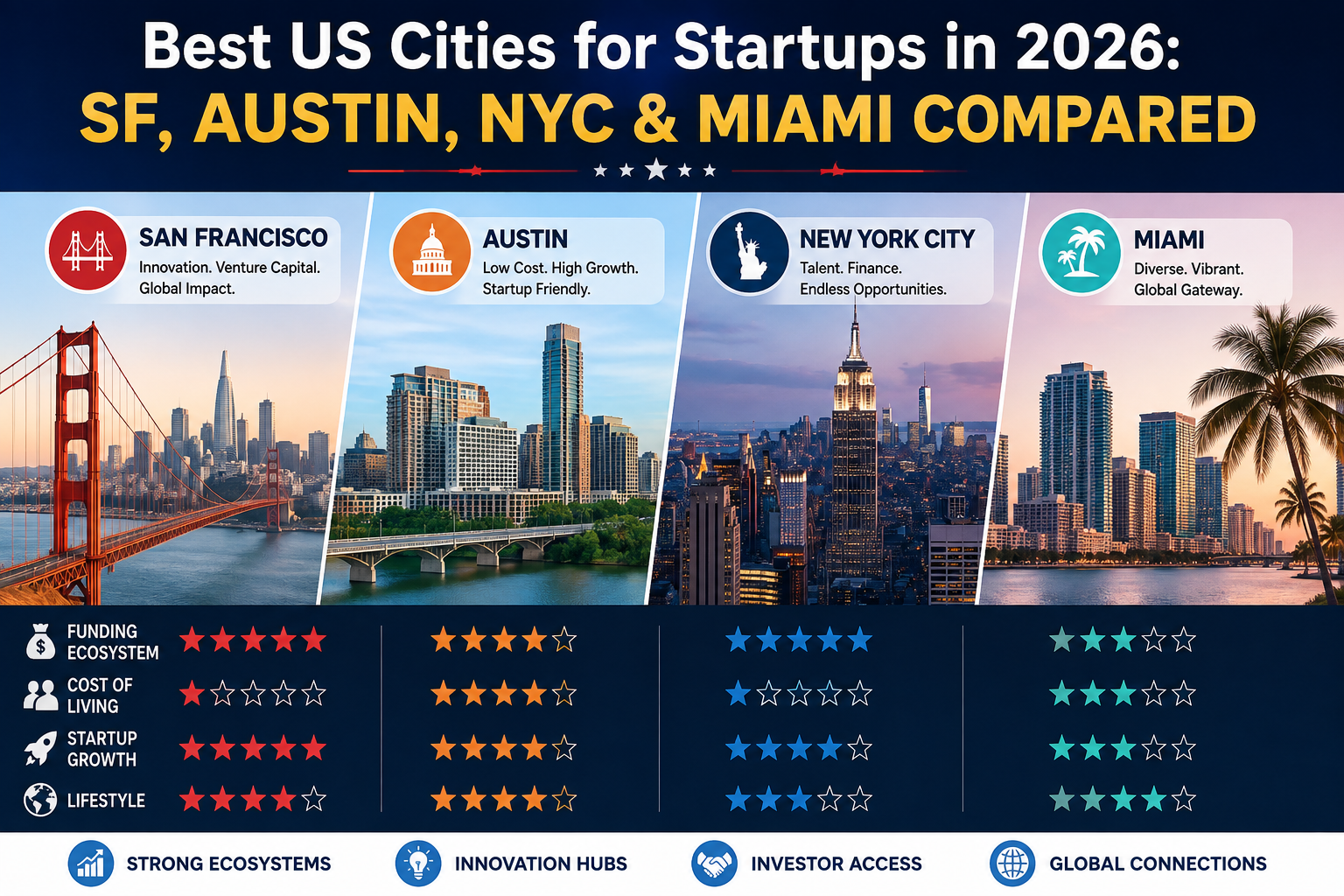
Each of these cities offers a genuinely different value proposition. San Francisco remains the undisputed center of frontier AI capital. Austin has become the default landing spot for founders priced out of the Bay Area who still want density and dealflow. New York blends financial capital with a deep enterprise and fintech bench. Miami has turned no state income tax and a Latin America bridge into a fast-growing, capital-hungry ecosystem. Ranking the best US cities for startups 2026 isn’t about picking a single winner — it’s about matching a founder’s stage, sector, and runway to the right environment.
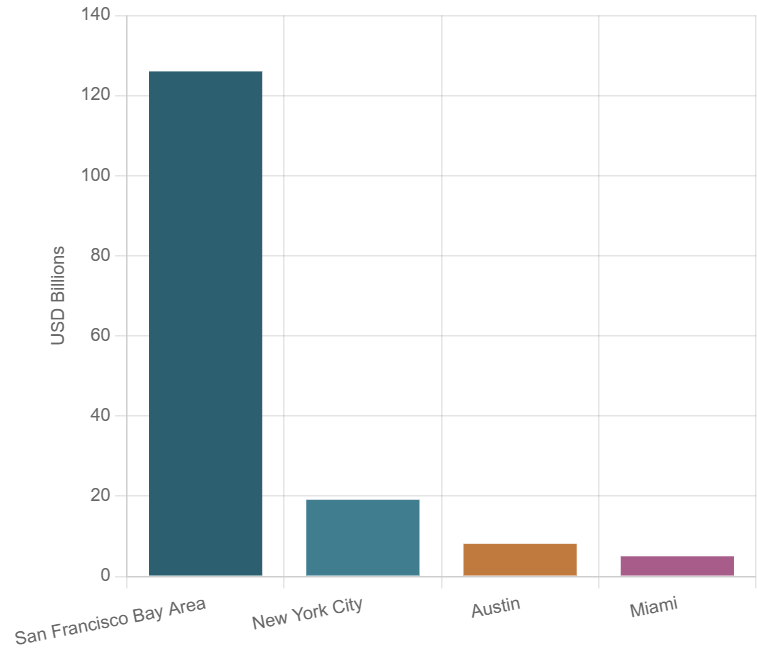
Estimated 2025 venture capital raised, by metro area (USD billions)
Quick Comparison: The Four Contenders
Before diving into each city individually, here is a side-by-side snapshot that founders and investors researching the best US cities for startups 2026 tend to ask for first.
| Metric | San Francisco | Austin | New York City | Miami |
|---|---|---|---|---|
| 2025 VC raised (approx.) | ~$126B (AI-heavy) | ~$8.1B | ~$19.1B | ~$4B–$6B (metro) |
| Dominant sectors | Foundation models, AI infra | AI, robotics, energy, defense | Fintech, enterprise, AI, media | Fintech, crypto, healthtech |
| State income tax | Yes (CA) | None (TX) | Yes (NY) | None (FL) |
| Median 1BR rent (approx.) | $3,000+ | $1,500–$1,800 | $3,200+ | $2,400–$2,800 |
| Standout advantage | Talent density, AI capital | Cost efficiency, momentum | Financial & enterprise access | LatAm bridge, tax-free |
| Best fit for | Deep tech, AI-native teams | Hardware, B2B SaaS, defense | Fintech, enterprise, media | Fintech, crypto, LatAm-facing |
Methodology: How We Compared These Cities
To evaluate the best US cities for startups 2026, we weighted five factors that founders and investors consistently cite as decisive: total venture capital raised, sector concentration, cost of living relative to salaries, tax environment, and the depth of the local investor and talent bench. Figures are drawn from Crunchbase, PitchBook, AlleyWatch, StartupBlink, and regional economic development reports published between late 2025 and mid-2026. Because funding totals shift quarter to quarter, treat the numbers below as directional rather than exact. This weighting is designed to reflect how real founders and investors actually shortlist the best US cities for startups 2026, rather than ranking cities on prestige alone.
San Francisco: Still the Center of Gravity
No conversation about the best US cities for startups 2026 can start anywhere but San Francisco. The Bay Area captured roughly $126 billion, or about 60% of global AI funding, in 2025 — a figure driven by mega-rounds at OpenAI, Anthropic, xAI, and a handful of other frontier labs. Even excluding those outliers, the region’s density of engineers, researchers, and repeat-founder talent is unmatched anywhere in the country.
The tradeoff is cost. Office space, salaries, and housing in San Francisco remain the highest of any market on this list, and California’s state income tax adds real friction for founders and early employees weighing offers. Neighborhoods like Hayes Valley and SoMa — now nicknamed “Cerebral Valley” — have become the physical center of the AI boom, and for founders building anything AI-native, in-person presence here has increasingly become close to non-negotiable.
Why founders still choose San Francisco
- Unmatched access to AI research talent and technical co-founders
- The deepest bench of tier-one venture firms in the world
- Fastest path to follow-on funding for AI and deep-tech startups
Austin: The Momentum Play
Austin has posted the fastest growth trajectory of any city on this list. Funding into Austin startups reached roughly $8.1 billion in 2025, up nearly tenfold over five years, with the first half of 2026 alone bringing in another $5 billion. Robotics, energy, defense tech, and advanced manufacturing — not just software — are driving the surge, helped by large late-stage deals and a wave of Bay Area transplants who brought both capital and operating experience with them.
Texas’s lack of a state income tax, combined with meaningfully lower housing and office costs than San Francisco or New York, makes Austin an easy sell for founders trying to extend runway. The University of Texas pipeline, a growing bench of local funds, and the presence of firms like Andreessen Horowitz and Sequoia give the city a level of institutional depth that used to be reserved for the coasts.
Why Austin keeps climbing the rankings
- Nearly 65% lower cost of living than San Francisco, with no state income tax
- Fast-growing hardware, robotics, and defense-tech clusters
- A maturing local VC ecosystem with capital available from pre-seed through growth
New York City: Capital, Fintech, and Enterprise Muscle
New York’s case among the best US cities for startups 2026 rests on scale and diversification. NYC startups raised close to $17.7 billion in the first half of 2026 alone, putting the city on pace to approach its 2025 total of roughly $19.1 billion — historically NYC’s second-best year ever, trailing only the 2021 peak. Fintech and AI together account for a majority of that capital, with healthtech and climate tech forming a strong secondary layer.
What sets New York apart is proximity to enterprise buyers, media distribution, and the financial institutions that fintech startups ultimately need as partners or acquirers. Research pipelines out of Columbia, NYU, and Cornell Tech are increasingly producing AI-native founders who no longer feel obligated to relocate to the Bay Area to raise a serious round. The tradeoff remains cost: rent, salaries, and New York State income tax keep the city firmly in the “expensive but worth it” category for founders who need enterprise or financial-sector proximity.
Miami: The Tax-Free Bridge to Latin America
Miami’s rise has been the most dramatic percentage gain among major US startup hubs. Depending on the data source, the greater Miami metro area pulled in somewhere between $4 billion and $6.2 billion in venture capital in 2025, and the city climbed several spots in global startup-ecosystem rankings for 2026 — one of the fastest ascents of any hub tracked. Fintech, crypto, and healthtech dominate the local sector mix, and Florida’s absence of a state income tax continues to pull high-earning founders and executives away from higher-tax states.
Miami’s most distinctive advantage is geographic: it functions as a dollar-denominated capital bridge for Latin American founders and investors, letting US funds back LatAm-facing companies without the operational complexity of investing across borders directly. That positioning, paired with a lower cost base than San Francisco or New York, has made Miami a serious contender rather than a lifestyle afterthought — and a fixture on any updated list of the best US cities for startups 2026.
Investor takeaway: Each of these cities now supports a full funding stack from pre-seed to growth, which means the old advice to “just move to San Francisco” no longer applies universally. Sector and stage matter more than city prestige alone when evaluating the best US cities for startups 2026.
Cost of Living & Tax Environment
Runway is often the deciding factor for early-stage founders, and it’s where the four cities diverge most sharply. The table below compares the core cost drivers founders weigh when relocating a team.
| City | State Income Tax | Relative Office Cost | Relative Housing Cost | Runway Advantage |
|---|---|---|---|---|
| San Francisco | Up to 13.3% | Highest | Highest | Lowest |
| Austin | 0% | Low–Moderate | Low–Moderate | Highest |
| New York City | Up to 10.9% | High | Highest | Low |
| Miami | 0% | Moderate | Moderate–High | Moderate–High |
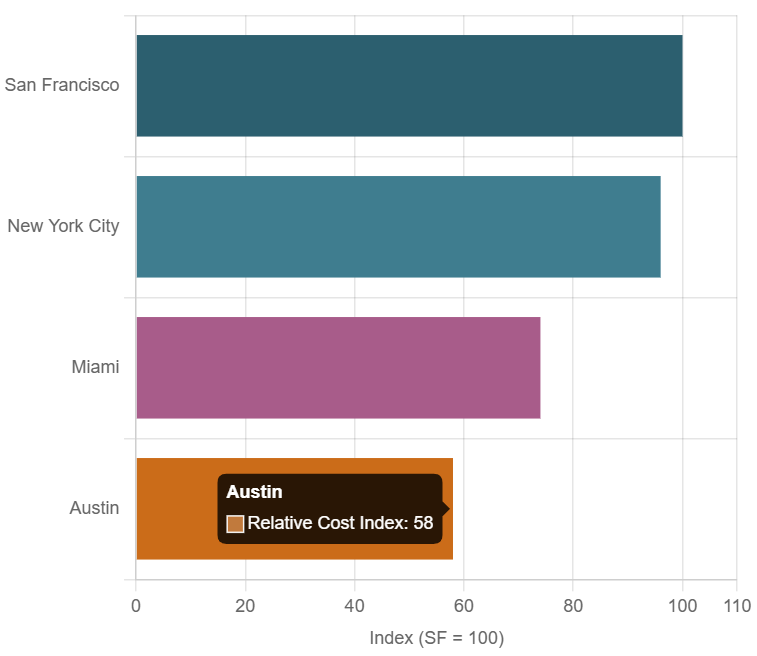
Relative startup cost index (100 = San Francisco baseline)
The Investor’s Perspective
Investors researching the best US cities for startups 2026 are increasingly comfortable writing checks outside the Bay Area, but capital concentration still tells its own story. San Francisco alone accounted for well over half of all AI venture dollars in 2025, meaning investors chasing frontier AI deals still spend a disproportionate amount of time there. At the same time, firms like Founders Fund, Thrive Capital, and SoftBank have opened Miami operations specifically to access LatAm dealflow, while national funds such as a16z and Sequoia now run permanent Austin offices rather than treating the city as a satellite market.
For early-stage investors, deal density still favors San Francisco and New York, where founder meetings, demo days, and warm introductions happen at a volume smaller ecosystems simply can’t match yet. For growth-stage and sector-specific investors — particularly in fintech, robotics, and crypto — Austin and Miami increasingly offer better entry valuations for comparable quality.
The Founder’s Perspective
For founders, the calculus usually comes down to three questions: What does my product need? What can my runway afford? And where will my ideal hires actually want to live? AI-native and deep-tech founders still gravitate toward San Francisco because the technical talent pool and follow-on capital are simply denser there. Founders building capital-efficient B2B software, hardware, or defense-adjacent products increasingly choose Austin, where a dollar of seed capital stretches noticeably further. Fintech and enterprise-focused founders still lean toward New York for proximity to buyers and financial infrastructure, while founders building for Latin American markets — or simply chasing a tax-free base — are increasingly choosing Miami.
None of this means the four cities are interchangeable. A founder evaluating the best US cities for startups 2026 should treat this list as a starting filter, not a final answer — the right city depends heavily on sector, team composition, and how much runway needs to last.
Frequently Asked Questions
What is the single best city for startups in 2026?There isn’t one universal answer. San Francisco leads on raw AI capital, but Austin, New York, and Miami each lead for specific sectors, budgets, and founder priorities — which is exactly why comparisons of the best US cities for startups 2026 usually break the answer down by stage and industry rather than naming one winner.Which city offers the best cost-to-capital ratio for early-stage founders?Austin currently offers the strongest combination of low costs and growing capital access, particularly for hardware, robotics, and B2B software startups.Is Miami a serious startup hub or just a tax haven for founders?Miami has moved well past its reputation as a lifestyle destination. With billions in annual venture funding and a genuine bridge to Latin American capital, it now functions as a legitimate hub, especially for fintech and crypto companies.Do investors still prefer San Francisco over other cities?For frontier AI and deep tech, yes — capital concentration there remains extreme. For fintech, consumer, and regional plays, investors are increasingly comfortable backing founders based in Austin, New York, or Miami.
Final Verdict
There is no single correct answer to which city tops the list of the best US cities for startups 2026 — only the right answer for a specific founder, sector, and stage. San Francisco remains unmatched for frontier AI and deep technical talent. Austin offers the best combination of momentum and cost efficiency. New York delivers unmatched access to financial and enterprise buyers. Miami provides a tax-free base with a genuine bridge into Latin American capital. Founders and investors comparing the best US cities for startups 2026 should weigh these tradeoffs against their own runway, sector, and growth plans rather than defaulting to whichever city currently dominates the headlines.