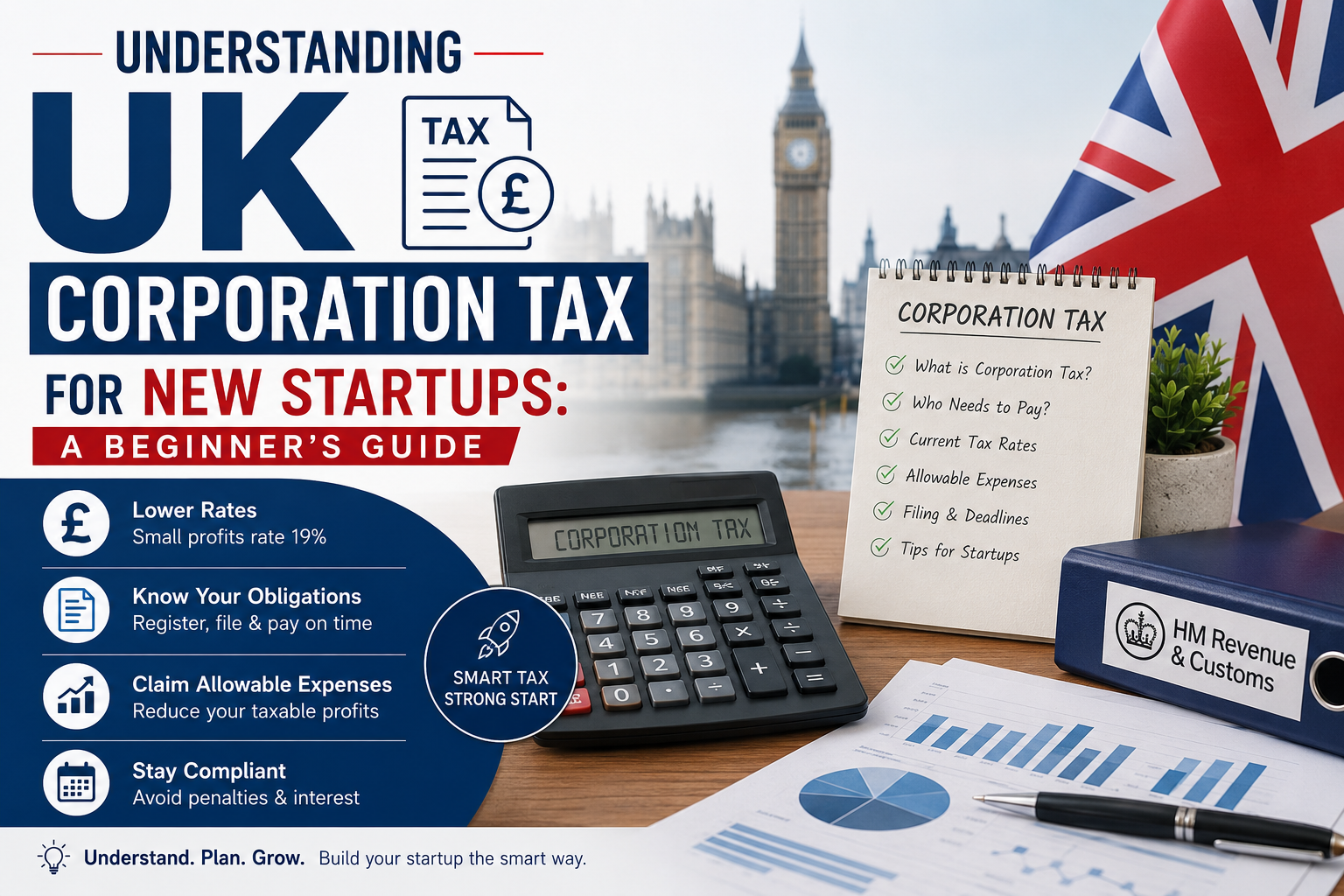
Starting a company in the UK is exciting, but the paperwork that follows incorporation catches almost every first-time founder off guard. Somewhere between building a product, hiring a first employee, and chasing investors, a letter arrives from HMRC about UK Corporation Tax — and suddenly the founder has to become an amateur accountant overnight. This guide breaks down exactly what UK Corporation Tax is, who has to pay it, how much it costs in 2026, and what new founders and their investors should know before the first accounting period ends.
What Is UK Corporation Tax?
UK Corporation Tax is the tax charged on the taxable profits of limited companies, most foreign companies with a UK branch, and some clubs, societies, and associations. Unlike income tax, it is not deducted automatically through payroll — the company itself is responsible for calculating, reporting, and paying it directly to HMRC. Every private limited company registered at Companies House becomes liable for UK Corporation Tax the moment it starts trading, even if it has not yet made a single sale.
For founders, this distinction matters enormously. A startup that is pre-revenue, burning through seed funding, and months away from its first customer can still have obligations tied to UK Corporation Tax, even though the actual bill in year one may be zero. Registration and reporting duties begin regardless of profitability, and missing them can trigger penalties long before the company owes any actual tax.
Who Needs to Register?
Any UK limited company must tell HMRC it is “active” for UK Corporation Tax purposes within three months of starting to trade. Trading generally means the point at which the business begins buying, selling, advertising, or otherwise operating commercially — not simply the date of incorporation. Founders sometimes assume the clock starts when Companies House issues the certificate of incorporation, but HMRC actually cares about the date real business activity begins.
Once registered, the company is issued a Unique Taxpayer Reference (UTR), which becomes essential for every future interaction with HMRC, including filing the annual Company Tax Return (CT600) and paying any UK Corporation Tax owed.
Current UK Corporation Tax Rates (2026)
The rate structure introduced in April 2023 still applies for the 2026 financial year, with no changes announced by HMRC. Instead of a single flat rate, the UK now runs a tiered system based on how much taxable profit a company generates in its accounting period.
| Taxable Profit | Rate Applied | Common Name |
|---|---|---|
| Up to £50,000 | 19% | Small Profits Rate |
| £50,000 – £250,000 | 25% minus Marginal Relief | Marginal Rate Band |
| Above £250,000 | 25% | Main Rate |
These thresholds assume a standard 12-month accounting period and a company with no “associated” businesses under common control. If a founder owns more than one active company, the £50,000 and £250,000 limits are divided by the total number of associated companies, which can push a group of startups into the higher UK Corporation Tax band much sooner than expected.
Understanding Marginal Relief
Marginal Relief exists to prevent a sudden jump from 19% to 25% the moment profits cross £50,000. Instead of a cliff edge, the calculation starts at the 25% main rate and then deducts a relief amount, producing an effective rate that climbs gradually as profits rise. In practice, this means the true effective rate on profits sitting between the two thresholds can reach as high as roughly 26.5% at certain profit levels, before settling back toward 25% near the top of the band. This is one of the more counterintuitive parts of UK Corporation Tax, and it regularly confuses founders who assume the highest band always means the highest marginal cost.
| Annual Taxable Profit | Approx. UK Corporation Tax Due | Approx. Effective Rate |
|---|---|---|
| £30,000 | £5,700 | 19% |
| £50,000 | £9,500 | 19% |
| £90,000 | £22,150 | ~24.6% |
| £150,000 | £37,150 | ~24.8% |
| £250,000 | £62,500 | 25% |
| £400,000 | £100,000 | 25% |
Figures are simplified illustrations for a standard 12-month period with no associated companies and should not replace a formal calculation from an accountant.
A simple way to visualize this progression is as a curve rather than a staircase:
Effective Rate (%)
25 |                                   ________________
   |                          ______--
   |                     ___--
20 |            ____-----
   |      _----
19 |_____/
   |________________________________________________________
     £0        £50k        £100k       £150k     £250k   Profit
The curve stays flat at 19% until £50,000, then rises steadily through the marginal band before flattening out at 25% once profits pass £250,000. Founders modelling their cash flow or preparing a pitch deck for investors should plot their own projected profits against this curve rather than assuming a flat percentage applies across the board.
Why This Matters to Investors, Not Just Founders
Investors evaluating a UK startup increasingly factor UK Corporation Tax directly into their return models. A company projecting £300,000 in annual profit within three years is not simply worth its revenue multiple — its post-tax cash position depends heavily on how UK Corporation Tax, marginal relief, and available reliefs interact. Due diligence checklists from angel syndicates and venture funds now routinely ask whether a startup has registered correctly, whether its UTR is active, and whether prior accounting periods have been filed on time. A founder who can speak fluently about their UK Corporation Tax position signals operational maturity that experienced investors notice.
Key Filing and Payment Deadlines
Missing a deadline is one of the most common — and most avoidable — mistakes new founders make with UK Corporation Tax.
| Obligation | Deadline |
|---|---|
| Register as active with HMRC | Within 3 months of starting to trade |
| Pay UK Corporation Tax owed | 9 months and 1 day after the end of the accounting period |
| File the Company Tax Return (CT600) | 12 months after the end of the accounting period |
| Keep accounting records | At least 6 years from the end of the accounting period |
Note that the payment deadline actually falls before the filing deadline. Many first-time founders assume they can wait until the CT600 is filed to pay, but HMRC expects the estimated bill settled three months earlier, with interest accruing on late payments regardless of when the return is eventually submitted.
Allowable Expenses and Reliefs That Reduce the Bill
UK Corporation Tax is charged on taxable profit, not turnover, which means legitimate business costs reduce the amount owed. Founders should keep clean records of:
- Salaries, employer National Insurance, and pension contributions for staff
- Office rent, utilities, and equipment
- Software subscriptions, hosting, and other operational tools
- Travel and client entertainment costs (subject to specific rules)
- Marketing and advertising spend
Beyond standard deductions, two reliefs are particularly relevant to early-stage companies:
Research and Development (R&D) Relief allows qualifying companies working on genuine technical or scientific advances to claim enhanced deductions or a cash credit, directly reducing UK Corporation Tax liability or, for loss-making startups, generating a repayable credit from HMRC. This has historically been one of the most valuable reliefs for early-stage tech companies, though HMRC has tightened eligibility checks in recent years following widespread misuse.
Capital Allowances let companies deduct the cost of qualifying equipment, machinery, and certain fixtures from taxable profit rather than spreading the cost over years of depreciation, often through the Annual Investment Allowance.
Common Mistakes New Founders Make
- Assuming no tax is owed simply because the company is not yet profitable. Filing obligations exist independently of profitability.
- Forgetting to register as active within three months of trading, which can trigger automatic penalties.
- Confusing the payment deadline with the filing deadline, leading to late payment interest.
- Not tracking associated companies, which shrinks the small profits threshold without the founder realizing it.
- Overlooking R&D relief eligibility, leaving money on the table that could extend runway.
- Mixing personal and business expenses, which complicates the taxable profit calculation and invites HMRC scrutiny.
Planning Ahead: A Practical Checklist
- Register as active with HMRC within three months of trading
- Set aside a percentage of monthly revenue for UK Corporation Tax rather than treating it as a year-end surprise
- Model projected profit against the marginal relief curve, not a flat rate
- Review R&D and capital allowance eligibility every accounting period
- Pay by the nine-month-and-one-day deadline, even if the CT600 is not finalized
- Work with an accountant familiar with startup structures before the first year-end
Frequently Asked Questions
Does a dormant company still need to worry about UK Corporation Tax? A company that has never traded and holds no assets can usually be classed as dormant, which removes the immediate filing burden. The moment it starts any commercial activity — even a small consulting invoice — it must notify HMRC and begin the standard UK Corporation Tax process.
Can a loss-making startup owe UK Corporation Tax? No. If taxable profit is negative, there is no UK Corporation Tax bill for that period, and the loss can often be carried forward to offset future profits, reducing the tax owed once the company becomes profitable.
Is UK Corporation Tax the same as VAT? No. VAT is a separate tax charged on most goods and services once turnover crosses the VAT registration threshold, while UK Corporation Tax is charged on annual profit. A startup can be VAT-registered years before it owes any UK Corporation Tax at all, or vice versa.
Do overseas founders running a UK company still pay UK Corporation Tax? Yes. Any company incorporated in the UK, or a foreign company with a UK branch generating profit, generally falls within the scope of UK Corporation Tax regardless of where the founders personally live, though double-taxation treaties may affect the founder’s personal position.
What happens if a company files late? HMRC applies automatic penalties starting at £100 for missing the Company Tax Return deadline, rising further the longer the delay continues, plus interest on any unpaid UK Corporation Tax balance from the original due date.
Why Founders Should Not DIY This Forever
Many founders handle their own bookkeeping in the earliest months simply because there is no budget for outside help, and that is a reasonable starting point. But as revenue grows, as the company takes on its first employees, or as investors begin asking for management accounts during due diligence, the complexity of UK Corporation Tax planning tends to outpace what a non-specialist founder can safely manage alone. Marginal relief calculations, R&D claim documentation, and associated-company rules all carry real financial consequences if miscalculated, and HMRC enquiries into R&D claims in particular have become noticeably more common. Bringing in a qualified accountant before the first year-end, rather than after a penalty notice arrives, is consistently one of the highest-leverage decisions an early-stage founder can make.
Final Thoughts
UK Corporation Tax is not simply a line item to deal with once a year — it shapes how a startup prices its runway, models investor returns, and plans hiring. The tiered structure, marginal relief mechanics, and the gap between payment and filing deadlines trip up even well-funded founders who assume tax is a problem for “later.” Building a basic understanding of UK Corporation Tax early, keeping clean records from day one, and reviewing eligibility for reliefs like R&D tax credits can meaningfully extend a startup’s runway and make it a more attractive proposition to investors evaluating its long-term financial health. When in doubt, a short conversation with a startup-focused accountant before the first accounting period closes is far cheaper than an HMRC penalty notice after it.